
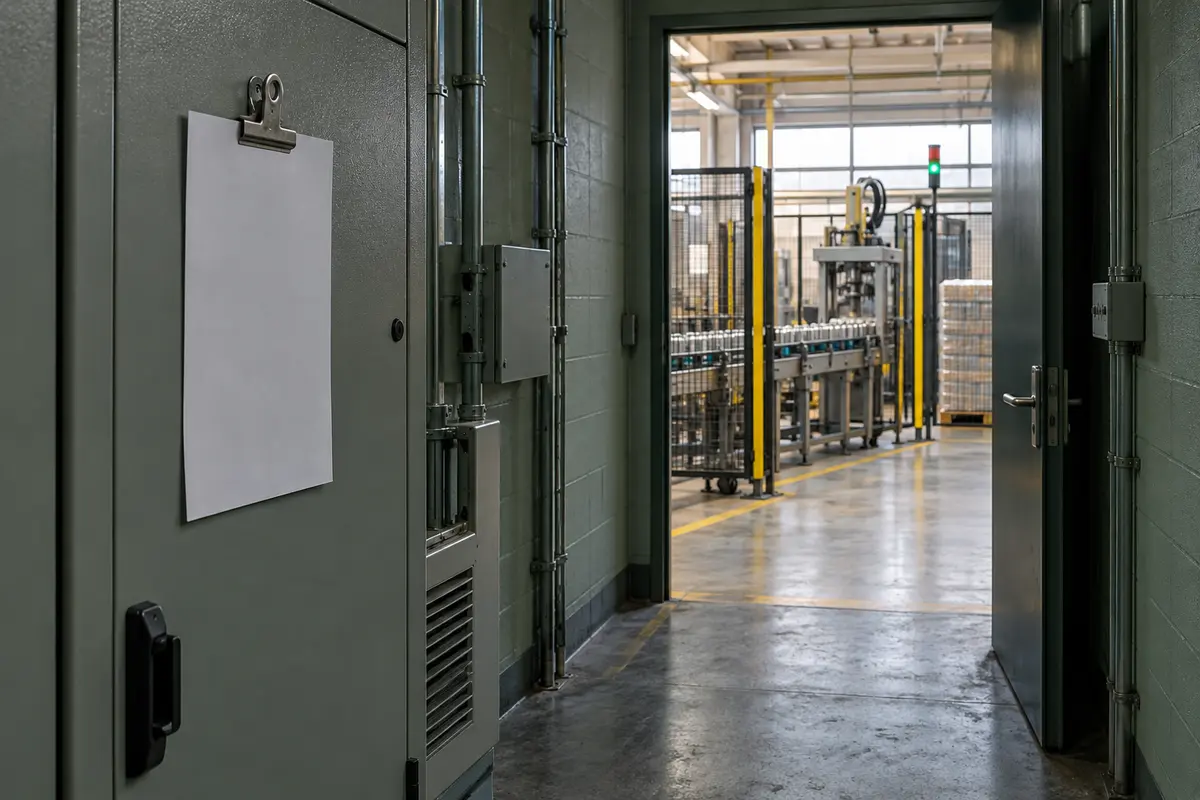
When operations prevent part of an inspection, do not treat unverified sections as compliant. Have the missing scope defined precisely and agree on a professional solution to the constraint. A typical situation occurs when an electrical technician needs to measure or inspect a part of your installation that cannot be accessed during normal operation, or that cannot be switched off without stopping production, cooling, or supplies. The result is an inspection report that describes part of the equipment without verifying it—and the electrical inspection technician, operator, and any supervisory authority must address that gap honestly. Under § 10 odst. 1 nařízení vlády č. 190/2022 Sb., o vyhrazených technických elektrických zařízeních a požadavcích na zajištění jejich bezpečnosti, an inspection report must include, among other things, a definition of the inspection scope, a list of the actions performed, measured values, and a written assessment of whether the equipment is safe to operate. Anything outside the scope cannot be presented as “measured” in the report, whether the reason is inaccessibility, inability to shut it down, or an agreement to postpone the measurement until a maintenance window.
What the “scope” of an inspection during operation actually means
The inspection scope is not merely a list of the systems and appliances the technician managed to inspect. It actively defines the boundary between what was genuinely verified and what was not—and states the specific reason. Three situations are particularly common in practice:
- A physically inaccessible part – a switchboard beneath a retail shelf, a cable route under the floor, or a terminal block behind a server that must remain running.
- A part that cannot be shut down – circuits whose shutdown would jeopardise continuous operation, such as cooling systems, pumps, medical equipment, or data networks.
- Measurements requiring a shutdown or disassembly – for example, tests that cannot be performed on energised equipment.
The regulation recognises that not every action can always be performed. Under § 7 odst. 3, the inspection and testing are carried out within the scope specified in příloha č. 1; if an item is technically impracticable for the equipment being inspected or is not justified for verifying its safety, it is not required. This exception, however, concerns technical practicability and justification—not the fact that a shutdown would be inconvenient for operations. The electrical inspection technician decides whether an item is unnecessary or has merely remained unverified, and this must be stated explicitly in the report.
The distinction between these situations matters. An inaccessible part can often be made accessible through minor tidying or by moving equipment in preparation for the next inspection. Tidying alone will not resolve a part that currently cannot be shut down—you can only schedule it for a time when shutdown is possible and, until then, identify it as unverified in the report’s conclusion.
Key decision-making process: what to do with an unverified part before signing the report
The workflow I recommend for both operators and technicians takes the form of a branching decision. It is not a legal obligation, but a practical way to avoid the most common mistakes when preparing and accepting an inspection report.
Step 1: Identify the unverified part before measurements begin. Walk through the installation with the technician and agree which circuits and equipment will fall outside the scope and why. Record this as the inspection progresses—reconstructing the details after the technician has left is unreliable.
Step 2: Determine the nature of the constraint. Is it permanent—the part can never be shut down during operation without an alternative solution—or temporary, such as a shutdown, maintenance window, or scheduled disassembly? A fundamental constraint must be addressed with a specialist by changing the operating conditions, arranging an alternative mode of operation, or adopting another technical solution. Permanently omitting the part from the documentation neither ensures safety nor grants permission to operate the unverified part. A temporary constraint requires a specific date or event, not merely “later.”
Step 3: Word the report entry correctly. Every unverified part requires three elements: what (identification of the circuit or equipment), why (inaccessibility, inability to shut it down, or the need for a shutdown), and how it will be completed (the planned measure and deadline). Without all three, the entry is incomplete and of no practical use to future operators.
Step 4: Check that the written conclusion matches the scope. The written assessment is mandatory under § 10 odst. 1 písm. l) NV č. 190/2022 Sb.. A conclusion stating that “the equipment complies” would be misleading if 30% of the installation had not been measured. The conclusion must reflect the scope actually verified and the findings made. Even the verified part does not automatically comply; the electrical inspection technician, not the operator using a generic template, formulates the professional assessment.
Step 5: Schedule completion and include it in the operating documentation. A report never repairs an installation by itself. If completing the measurements requires a shutdown, that shutdown must appear as an open item in the maintenance plan and operating documentation—ideally in the inspection, maintenance, and testing schedule, which the operator is already required to maintain under § 7 NV 190/2022 Sb.
Example: a switchboard supplying continuously operating equipment
Consider a facility with a sorted-waste processing line where an electrical inspection technician is conducting a periodic inspection of the electrical installation. The RD-2 switchboard contains two groups of circuits: general lighting and socket circuits, including a busbar that can be switched off at any time, and circuits supplying continuously operating hydraulic-system pumps. Shutting down the pumps would stop the entire line for an indefinite period and create a risk of damage to the equipment.
Successful outcome: On site, the technician clearly specifies that the pump circuits are excluded because they cannot be shut down, for two specific reasons: measurements requiring disconnection cannot be performed, and the terminals cannot be visually inspected while energised without creating a hazard. The report identifies the circuits by breaker number and rated current and by the cable-route designations shown in the drawings. It also states the reason for exclusion and records the agreement with the operator: the operator will arrange a shutdown at a professionally assessed time based on the equipment’s condition and risks, rather than automatically postponing it for several months. If an immediate danger is discovered, safe operation must be addressed at once; postponing action on a calendar does not remove the danger. The written conclusion then provides a partial assessment—the verified part of the installation meets the requirements, while the pump circuits will be assessed separately once access is available.
Unsuccessful outcome: The same location, but a different approach. Because part of the switchboard is inaccessible, the technician records the pump circuits as apparently compliant “by agreement with the operator,” including them in the conclusion because “there is no indication of a defect.” This is incompatible with the requirement under § 10 odst. 1 písm. i) a j) NV č. 190/2022 Sb. for the report to contain a list of the actions performed and the measured values—neither would exist for the pump circuits. A conclusion stating that “the entire switchboard complies” cannot be signed because it contains a claim that was not verified.
Verifying the outcome in this example: Verification takes place in two ways. First, the report is checked as a document—it must include identification, scope, supporting documents, actions performed, measured values, defects, and a written conclusion. For the unverified part, it must clearly show which actions and results are missing; nonexistent values must never be invented. Second, fulfilment of the agreement is checked—after the shutdown, a supplementary assessment of the unverified circuits is produced, either as a separate document or an addendum to the report, and the operating documentation records that the open item has been closed. Only professional completion of the assessment can close the corresponding scope. Any defects discovered must still be addressed separately; the existence of a supplement does not itself mean that the equipment complies.
This example is not universal, of course—in another facility, a different part may be inaccessible and the reason for exclusion may differ. What matters is preserving the same structure: definition, justification, completion plan, and verification.
Table: recording unverified parts in an inspection report
| Type of constraint | What to record in the scope | What to record in the conclusion | How to complete it |
|---|---|---|---|
| Physical inaccessibility | Identification of the circuit/equipment and its location (behind a shelf, under the floor) | Professional conclusion for the verified scope; inaccessible part not verified | Make it accessible within a professionally assessed timeframe |
| Unable to shut down (operations) | Identification of the circuits and the reason—the need for continuous operation | Partial conclusion; unverified circuits to be assessed separately | Schedule a shutdown or dated maintenance window |
| Measurement requiring a shutdown | Which tests were not performed and on which equipment | State which actions are still required for a complete assessment | Perform them during the scheduled shutdown and issue an addendum |
| Partially accessible equipment | What was visually inspected and what was not | Conclusion limited to the visible/verified part | Arrange safe access under professional supervision |
What to check when accepting the report
The separate article on inspection report requirements explains everything the report should contain, while how an electrical installation inspection is conducted at a company describes the inspection process itself. When the scope is limited, the operator should pay particular attention to several recurring issues:
- The conclusion is broader than the scope. If the written conclusion refers to the entire installation but the measured values show that only some circuits were measured, this suggests that someone has covered the omitted part “on paper.” Request an explanation and correction of the scope or conclusion; signing for receipt of the document is not a professional measurement.
- There is no completion plan. For a temporary constraint, the report or an appendix should include an agreed completion date. Without one, the unverified part may gradually “disappear,” only for the next inspection to reveal that it was never measured.
- The unverified part is recorded as a defect. A limitation of scope must be distinguished from an identified defect. Both may exist at the same time, however: the obstruction preventing access or the equipment’s condition may itself require corrective action. Do not label everything unverified as safe merely because it could not be measured.
Initial inspections conducted in stages have their own rule
§ 10 odst. 2 NV 190/2022 specifically addresses an initial inspection conducted in stages: a consolidated report must be prepared before the entire installation enters permanent operation. Do not confuse this situation with a limited periodic inspection of an existing facility. Several partial documents do not become a complete assessment merely because they are placed in the same folder.
Frequently asked questions
Must the electrical inspection technician measure parts that cannot be shut down?
If operating conditions and the nature of the equipment do not permit it, there is no general way to perform the measurement without a shutdown. The technician must identify that part as unverified within the inspection scope and state the reason. Only an item that is technically impracticable or not justified for verifying safety may be omitted under § 7 odst. 3 NV 190/2022 Sb.—that decision is based on the technician’s professional assessment, not operational convenience. NV č. 190/2022 Sb. requires the report to define its scope and provide a written conclusion; anything not measured cannot be presented as measured.
Can I “skip” the unverified part until the next inspection?
An unverified part should not be skipped; its assessment must be completed. If it was excluded from one report because it could not be shut down, it must be assessed as soon as this becomes possible, typically during a scheduled shutdown. Producing a separate supplementary assessment is the clearest solution because it preserves traceability.
What if part of the operating equipment can never be shut down?
Have the solution assessed by the electrical inspection technician and the person responsible for operations. It may require an alternative power supply, an organisational change, or a technical modification prepared by qualified professionals. This article does not claim that an external visual inspection or thermography can replace every prescribed test. Merely recording “cannot be shut down” does not create a permanent exemption from verification.
How can I tell whether the report deals honestly with the unverified part?
Check whether it contains all three elements: what was not verified, why, and how the assessment will be completed. If the report does not mention the unverified part and its conclusion covers the entire installation, check whether it contains unsupported claims.
Does a compliant conclusion for part of the equipment authorise use of the unverified part?
No. A partial conclusion of compliance for the verified part applies only to that part. The unverified part must be assessed separately, and a partial result transfers no conclusions to the remainder of the installation. Such an interpretation would conflict with the purpose of an inspection report as evidence of the verification actually performed.
Sources and scope
- Nařízení vlády č. 190/2022 Sb., o vyhrazených technických elektrických zařízeních, e-Sbírka — § 7 odst. 3 (scope of inspection and testing), § 10 (inspection report requirements).
Sources verified on 7 October 2026. The legal position reflects the verification date and does not guarantee that legislation will remain unchanged. This article does not describe a specific machine or provide a universal procedure for every type of equipment. For a specific situation, I recommend consulting an electrical inspection technician—SOHE performs inspections of designated electrical equipment in Brno and the surrounding area.