
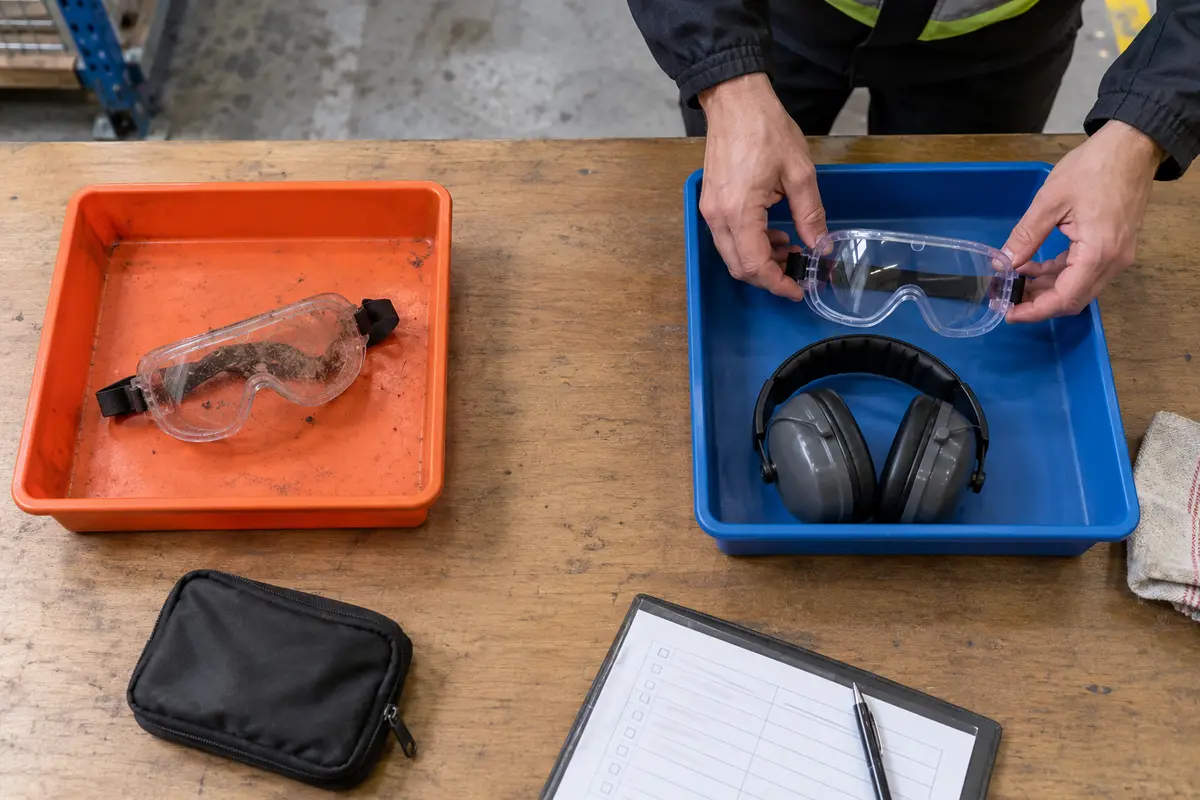
A single item of personal protective equipment may be shared by multiple workers only if the employer implements measures to prevent the transmission of infectious diseases and ensures that it is used by only one person at any given time. This follows from the position of Státní úřad inspekce práce, which permits PPE to be used by multiple employees only under these conditions. It does not, however, say that every form of sharing is automatically safe or automatically prohibited. The decision therefore always rests with the employer and should be supported by evidence showing who handed over what, when, and after which steps had been completed.
What the law says—and where its scope ends
Nařízení vlády č. 390/2021 Sb., o bližších podmínkách poskytování osobních ochranných pracovních prostředků, mycích, čisticích a dezinfekčních prostředků states in Section 3(1) that PPE must remain effective against the relevant risks throughout its use and must not create an additional risk. It must suit workplace conditions, be adapted to the employee’s physical characteristics, and take account of ergonomic requirements and the employee’s health. Before PPE is shared, therefore, verify its effectiveness, the conditions under which it is used, and its fit for the particular person. A respirator worn by a previous user may no longer fit or seal properly, and the new user will often have no way of knowing its actual condition.
Under Section 3(3), employees must be demonstrably instructed in the use of PPE, and “používání osobního ochranného pracovního prostředku více zaměstnanci je možné pouze v případě, že byla učiněna opatření, která zamezí ohrožení infekčními onemocněními” (PPE may be used by multiple employees only if measures have been taken to prevent exposure to infectious diseases). Paragraph 4 requires the employer to determine how, under what conditions, and for how long PPE is to be used—including its handover rules. Section 104(4) of zákon č. 262/2006 Sb., zákoník práce, also applies: the employer must maintain PPE in usable condition and monitor its use. Under Section 3(5) of Government Regulation No. 390/2021 Coll., new PPE must be issued whenever the original item reaches the end of its manufacturer-specified service life, loses its functional properties or effectiveness against the relevant risks, or its use creates an additional risk; the subsequent handling of withdrawn equipment is outside the scope of this article.
SÚIP responded to a question from a workshop where eight welders on one shift use a single welding helmet. The response does not prohibit sharing, but it assumes that the equipment is used by only one employee at any given time. It also emphasises that the employer must not only maintain PPE in usable condition but, above all, prevent the transmission of infectious diseases between employees. Hygiene measures are therefore a prerequisite, not an optional extra.
Everything below that goes beyond the cited obligations represents my practical recommendations for managing shared equipment, not legal requirements. Nor do I describe any interventions involving the equipment itself—cleaning, adjustments, and repairs must be carried out strictly in accordance with the manufacturer’s instructions.
Decision process: allow sharing or issue new equipment
Before handing an item to another worker for the first time, follow this sequence. The supervisor completes it once for each type of equipment and then repeats it for each individual item.
- Classify the equipment. Is it disposable? Reusable safety glasses, a face shield, or earmuffs? Equipment individually moulded to the wearer’s body? Do not share disposable equipment as though it were reusable. For the third category, the adaptation requirement under Section 3(1) presents the greatest difficulty.
- Find the manufacturer’s instructions for handling the item between uses. If the manufacturer specifies a service life in hours, a maximum number of uses, or a maintenance procedure between users, those instructions define your operating limits. Anything not permitted by the instructions must not be done—do not improvise with chemicals or procedures that the manufacturer says may damage the equipment.
- Set the interval between users. Determine the procedure required and the time needed to complete it in accordance with the instructions and hygiene conditions, rather than imposing a universal waiting period. Include maintenance in the procedure, such as cleaning according to the instructions, drying, and storage in a bag. Without this step, you have no basis for demonstrating “measures to prevent exposure to infectious diseases”.
- Check the fit for the new user. Facial shape, head circumference, equipment size, and the simultaneous use of prescription glasses all matter. The equipment must fit the new user well enough to perform its function. Assign inspection responsibilities according to the type of equipment and the applicable instructions. The new user must also know how to recognise a correct fit and when not to start work.
- Record the handover. Record the date, who handed over the item, who received it, the maintenance step performed, and the outcome of the fit check. You may choose the format; what matters is that the record can be produced later.
Table: checks before handover
| Check | What is assessed | What constitutes failure | Consequence of failure |
|---|---|---|---|
| Equipment condition | Visible damage, deformation, or wear to seals or straps | Any defect that reduces effectiveness | Remove from service and issue new equipment (Section 3(5)) |
| Service life | Manufacturer’s information—date, number of uses, or hours | Maximum number exceeded or expiry date passed | Issue new equipment |
| Maintenance between users | Completion in accordance with the manufacturer’s instructions | Instructions were not followed or compliance cannot be demonstrated | Do not hand over the item |
| Fit | Fit on the new user and available adjustment | A correct fit cannot be achieved | Provide that worker with a different item |
| Record | Evidence of the handover and inspection | Missing or incomplete | Complete it before the next use |
Example: safety glasses shared between shifts
In this example workshop, two shifts use reusable safety glasses of the same type. The supervisor is considering sharing them but must separate three questions: does this type of equipment protect against the occupational hazard, has the particular item been properly maintained, and does it fit the next person? Hygienically prepared glasses with scratched lenses are not an acceptable result, nor is an undamaged pair with an uncertain maintenance history.
Failed pathway: An afternoon-shift worker takes glasses from an open shelf. Nobody knows whether they have been used or prepared for reuse. The worker wipes them with a random product from the cleaning cupboard. This procedure demonstrates neither that the product is suitable nor that hygiene protections have been applied, and it may damage the material. The supervisor stops the worker from using that item and provides other suitable equipment. Working without PPE for a “quick job” is not an alternative.
Corrected pathway: The responsible person locates the manufacturer’s instructions and establishes a documented maintenance and storage procedure. Used items are kept separate from prepared ones; different tray colours are merely a local organisational aid, not proof of disinfection. Whoever completes the prescribed procedure records the item’s identification and the inspection result. If the required maintenance cannot be completed between shifts, the next worker receives a separately prepared item. No universal waiting period in minutes is prescribed here.
Verifying the outcome: The supervisor observes one actual handover, from putting down the used item to the next person putting it on. The supervisor checks that the two storage areas are not mixed up, that the worker understands the procedure, and that the glasses fit together with any other equipment. A damaged lens or uncertainty about how the glasses were cleaned means the handover must be stopped again. A signature on the record does not confirm that the risk of infection is zero. The example demonstrates a management process, not automatic permission to share every type of PPE.
What does not belong in the control process
Several practices occur in real workplaces but have no place in a well-managed process:
- Handover before the required maintenance is complete. The speed of the exchange is not the legal test. What matters is compliance with hygiene and other conditions, and use by only one person at any given time.
- Homemade disinfection procedures. If the manufacturer does not specify a product for the material in question, do not use it. This is a practical principle arising from the obligation to preserve the equipment’s effectiveness.
- Adjustments by cutting, bending, or overtightening. Equipment may be adjusted only within the limits permitted by the manufacturer, typically by adjusting its straps.
- Completing an active record retrospectively. The record must be created at the time of handover, not at the end of the week.
When sharing is best avoided
Even if the equipment passes the decision process, there are situations in which individual allocation creates less difficulty than a sharing system: single-use equipment; equipment fitted to one user, such as moulded inserts or custom-moulded hearing protection; equipment used in environments with biological hazards where the burden of infection control outweighs the savings; and short assignments where the handover administration would take more effort than the work itself. These are operational considerations, not legal prohibitions—the decision and its justification remain the employer’s responsibility.
If you need to incorporate rules for the use and handover of PPE into your company’s occupational safety documentation, SOHE provides supporting materials for workplace safety processes in companies.
Frequently asked questions
May one item be used by multiple employees?
Yes, provided that the employer implements measures to prevent exposure to infectious diseases and the item is used by only one person at any given time. This follows from Section 3(3) of nařízení vlády č. 390/2021 Sb. and the SÚIP response concerning one welding helmet shared by eight welders.
Must the handover of PPE be documented in writing?
The law does not explicitly require a specific written record for every handover. The employer must ensure that the employee is demonstrably instructed in the use of the equipment. The article PPE in the workplace: list, policy, and issue records explains how to maintain a PPE list and issue records. An item card or similar record helps demonstrate that the procedure was completed, but it does not replace employee instruction or verification of hygiene conditions before sharing.
What should be done if the equipment does not fit the new user?
Do not modify it or hand that item over to the worker. Under Section 3(1), the equipment must be adapted to the person. If a proper fit cannot be achieved using the adjustments permitted by the manufacturer, the worker must receive a different item.
Should equipment be withdrawn when its service life has ended, even if it appears undamaged?
Yes. Under Section 3(5) of the regulation, the end of its service life or loss of protective effectiveness is grounds for issuing new equipment. Its appearance does not justify extending its service life.
May the equipment be cleaned with any available product between users?
No, unless the manufacturer specifies that product or procedure for the equipment concerned. Improvised chemicals may damage the equipment and cause it to lose its protective function.
Sources and scope
This article is based on the following verified sources:
- Státní úřad inspekce práce — Používání OOPP více zaměstnanci
- e-Sbírka — Nařízení vlády č. 390/2021 Sb.: Section 3
- e-Sbírka — Zákon č. 262/2006 Sb., zákoník práce: Section 104
Sources verified on 7 October 2026. The text reflects the law in force on the verification date and should not be understood as a guarantee that the legislation will remain unchanged. This article provides a general description of a decision process and an example situation; it is not a universal regulation, an operating manual for a specific machine, or instructions for repairing or modifying protective equipment. Procedures going beyond the cited obligations are the author’s personal recommendations, not legal requirements. The frequently asked questions section is intended to help readers navigate the article and is not promotional in nature.