
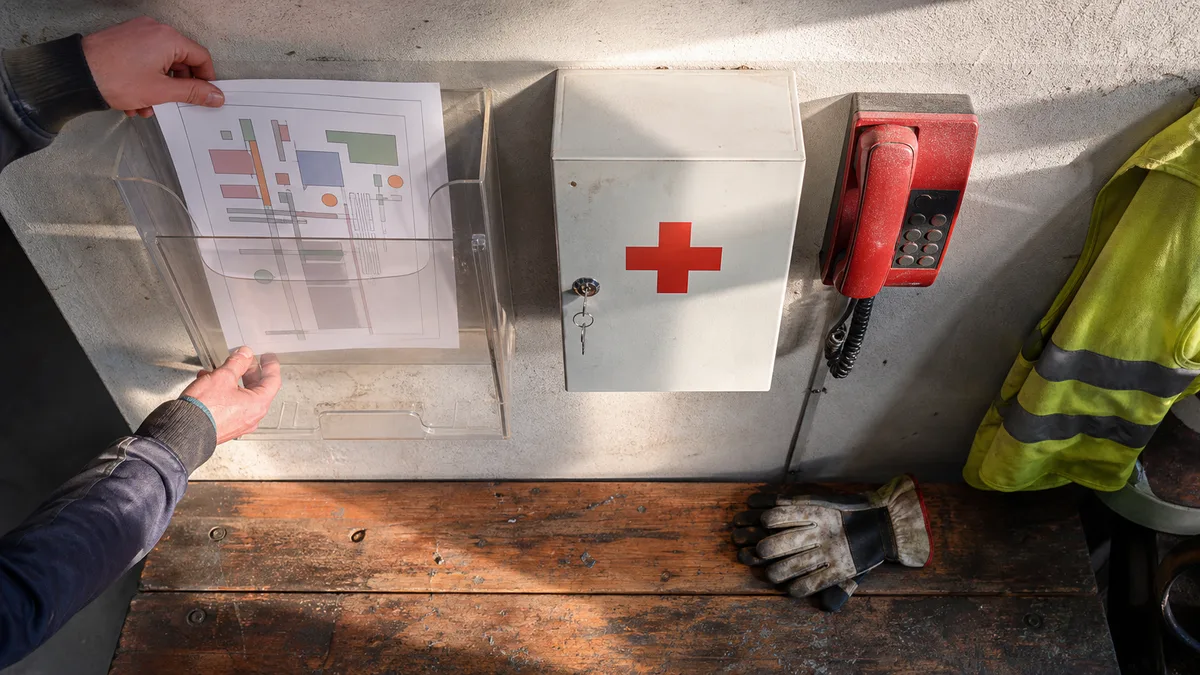
The emergency medical response plan — in Czech “traumatologický plán” — is an unusual document. Most companies have one somewhere: usually pinned to the noticeboard next to the first aid kit, untouched for years, and on closer inspection listing the phone number of an employee who left three years ago. Yet it is one of the few occupational safety documents written not for an inspection, but for the moment when someone is lying on the floor and everyone around is wondering what to do next.
There is also confusion surrounding it: the phrase does not appear in the Labour Code, so companies ask whether they need the plan at all. Let us take it in order — where the duty comes from, what belongs in the plan, where it should be posted, when it gets updated and which mistakes surface at exactly the moment when it is too late to fix them.
Where the duty comes from when the “traumatologický plán” is not in the law
The Labour Code (Act No. 262/2006 Sb.) does not use the term traumatologický plán. It does, however, impose duties on employers that are hard to fulfil — and harder to document — without a written plan.
Under Section 102(6) of the Labour Code, the employer must adopt measures for dealing with emergencies and, according to the type of activity and the size of the workplace, ensure a sufficient number of employees who organise the provision of first aid, arrange for the emergency medical service to be called and organise evacuation. Their training and equipment are arranged in cooperation with the occupational health services provider. On top of this comes the general duty to ensure that employees receive first aid (Section 103 of the Labour Code) and the requirement of Act No. 309/2006 Sb. that workplaces be equipped with the means for providing first aid and for calling the emergency medical service.
In practice, the emergency medical response plan is the established way of putting these measures down in one place: who organises first aid, which numbers to call, where the first aid kits are and what the procedure is. The specific form of the document is a matter of good practice, but the duty itself — to have first aid organised and demonstrable — applies to every employer. During an inspection, the labour inspectorate usually does not ask “do you have a traumatologický plán”, but “show us how you have first aid arranged” — and without a plan, that question is hard to answer well. Where the document fits within the overall body of mandatory paperwork is covered in our article on occupational safety documentation for a small company.
Beware of one common mix-up: the emergency medical response plan is not the same thing as an evacuation plan or fire protection documentation. It deals with people’s health after an injury or a sudden medical event, not with what to do in a fire — the two systems should dovetail, but they are not a single sheet of paper.
Who needs a plan: a two-person office as well as a shift-based plant
The duty to organise first aid has no minimum headcount. Only the appropriate scope differs.
In a small office, the plan can be a single clear page: emergency numbers, the address for the ambulance crew, who organises first aid, where the first aid kit is, the nearest urgent care facility. In production, a warehouse or a workplace handling chemicals, the plan is more extensive — it accounts for shifts, for the specific hazards of the operation and for the fact that an injured person may need help in a particular way (eye irrigation, procedure for chemical exposure, electric shock).
The scope is not derived from gut feeling but from the risk assessment of the specific operation — the same basis the rest of the occupational safety system builds on. How risks are processed is described in our article on occupational risk assessment in a company. A plan that ignores the risks is usually obvious at first glance: generic wording about “providing first aid for common injuries” in an operation working with caustic soda or high voltage.
What the emergency medical response plan should contain
No regulation prescribes the contents of the plan item by item. In practice, a structure has proven itself that matches what a person in a crisis actually needs to find within seconds:
| Part of the plan | What it should contain | Common mistake |
|---|---|---|
| Emergency numbers | 155, 112, plus others depending on the operation | only general numbers, missing internal extension or gatehouse |
| Address and site description | exact address, site entrance, hall or floor number | the ambulance dispatcher has nowhere to navigate the crew |
| Responsible persons | who organises first aid at each workplace and shift, with a phone number | names of people who no longer work at the company |
| First aid kits | where they are, who checks and restocks them | the kit is somewhere other than where the plan says |
| Procedures by risk | a brief procedure for injuries typical of the operation | generic text with no link to actual hazards |
| Medical facilities | the nearest urgent care and hospital, with addresses | a facility that has since changed its hours or closed down |
| Internal reporting | who the injury is reported to within the company, who writes the record | the procedure ends with treatment and the record-keeping is forgotten |
The last row has taken on a new dimension since 1 January 2026. The recording and reporting of work-related injuries is governed by Government Regulation No. 322/2025 Sb., and serious injuries are reported to the labour inspectorate electronically via an online portal. The plan need not reproduce the whole process — but it must say clearly who at the company triggers the follow-up steps. Exactly what happens after an injury, from the injury logbook to the injury record, is described in detail in our article on a work-related injury at the company — the two documents should complement each other, not duplicate each other.
In operations with foreign-language workers — agency staff, employees from abroad — it is worth considering a translated version or at least pictograms for the key steps. A plan that half the shift cannot read fulfils the duty on paper only.
Where the plan should be posted
The regulations do not explicitly specify where to post it. The intent, however, is clear: the measures under Section 102(6) of the Labour Code are meant to work at the moment of an emergency, and a plan locked in a binder in the director’s office will not serve that purpose.
In practice, it works well to post the plan:
- next to every first aid kit — that is where a person in a crisis runs first,
- on noticeboards and in areas employees pass through every day (changing rooms, break room, gatehouse),
- at every workplace separately, including detached operations and branches — a plan at head office is no help to a warehouse on the other side of town,
- in legible form: current date, high-contrast print, not a faded copy of a copy.
An electronic version on the intranet is a useful supplement, but not sufficient on its own — it assumes the injured person or a witness has access, credentials and a working network. A sheet of paper next to the first aid kit has no such preconditions.
How many people to train and how to document it
The Labour Code speaks of a “sufficient number of employees” according to the type of activity and the size of the workplace — it sets no fixed figure. In practice, the reasoning is simple: at every workplace and on every shift there should be at least one person within reach who knows what to do and does not rely on someone else calling an ambulance. In multi-shift operations, that means accounting for night shifts and holiday periods too.
The employer arranges training for these employees in cooperation with the occupational health services provider and must document it with a record — who was trained, when, to what extent and by whom. The designated persons then belong in the emergency medical response plan by name; training with no link to the plan, and a plan with no trained people, are two halves that do not work on their own. The general rules for documenting training are summarised in our article on occupational safety training for employees; we provide practical first aid courses for designated employees as part of employee training right on your premises.
When to update the plan
The emergency medical response plan goes out of date faster than most occupational safety documentation, because it rests on specific people and numbers. An update is called for whenever:
- one of the designated persons leaves or changes,
- phone numbers, the gatehouse or internal extensions change,
- the company relocates, opens a new workplace or changes the layout of the operation,
- a new hazard appears — a technology, a chemical, a new type of work,
- the regulations the plan builds on change: a textbook example is Government Regulation No. 322/2025 Sb., which makes it advisable to check whether the internal injury reporting procedure in the plan matches electronic reporting.
Even with no specific trigger, it pays to go through the plan at least once a year — the regular workplace safety inspection is a natural opportunity. The check takes fifteen minutes: run a test round of names and numbers, walk past the first aid kits, compare the posted versions with the current one.
The most common mistakes in practice
The weak spots in emergency medical response plans repeat across companies:
- A downloaded template with no edits. The plan contains someone else’s address, someone else’s names or hazards that do not exist in the operation at all. During an inspection it looks worse than no plan at all — it proves nobody genuinely thought about first aid.
- Out-of-date people and numbers. The designated employee left the company two years ago, the gatehouse extension has changed. In a crisis you find out at the cost of lost minutes.
- The plan exists only in a binder. Formally in order, practically unavailable — at the moment of an injury, nobody can find it.
- Forgotten detached workplaces. Head office has a plan, the warehouse and the branch do not. Yet the duty applies to all workplaces.
- The first aid kit does not match the plan. The plan points to a place where there is no kit, or the contents have expired and nobody is in charge of checking.
- No link to injury records. It ends with treatment, the record and the report are missed — and the company then races to catch up with the deadlines we described in the article on work-related injuries.
Who will draw up your plan and keep it current
An emergency medical response plan rarely comes about in isolation — it is usually part of the occupational safety documentation and builds on the risk assessment, the categorisation of work and the training. It therefore makes sense for it to be drawn up by someone who knows both the operation and the rest of the documentation, typically a certified risk prevention professional.
If there is nobody like that at your company, or the plan has not been updated for years, we can handle it for you: we walk through the operation, put together a plan based on the actual hazards, designate and train the responsible employees and set up an annual review. Just send us a no-obligation enquiry describing your operation and the number of workplaces — we will come back with a proposed scope and price.
Sources for this article
- Employee training – a SOHE service; practical first aid and occupational safety training on your premises.
- A work-related injury at the company: what to do straight away – the injury logbook, reporting to the labour inspectorate and the injury record that the plan links to.
- Occupational safety documentation for a small company – where the plan fits within the overall body of mandatory documentation.
- Occupational risk assessment in a company – the basis from which the scope of the plan and the number of trained persons are derived.
- Act No. 262/2006 Sb. – the Labour Code, as in force from 1 January 2026; Section 102(6) measures for emergencies and the organisation of first aid, Section 103 the duty to ensure that employees receive first aid.
- Act No. 309/2006 Sb. – further conditions of occupational health and safety, as amended by Act No. 318/2025 Sb. in force from 1 November 2025; equipping the workplace with the means for providing first aid and calling the emergency medical service.
- Government Regulation No. 322/2025 Sb. – from 1 January 2026 it governs injury records, reporting and the injury record that the plan should link to.
The legal position was verified as at 8 August 2026. Czech legislation does not expressly prescribe the emergency medical response plan as a named document; this article describes the established practice by which the duties under Sections 102 and 103 of the Labour Code are fulfilled and documented.
This text is informational and does not replace legal advice. The specific form of the emergency medical response plan, the number of designated employees and the scope of their training need to be set according to the actual operation, the risk assessment and the arrangement with the occupational health services provider.
Is there a plan on your wall that nobody trusts any more? We will put together a plan based on the actual hazards of your operation, train the designated employees and set up regular updates — either as a standalone job or as part of your occupational safety documentation. Send us a no-obligation enquiry or write to info@sohe.cz and we will agree the scope for your operation.