
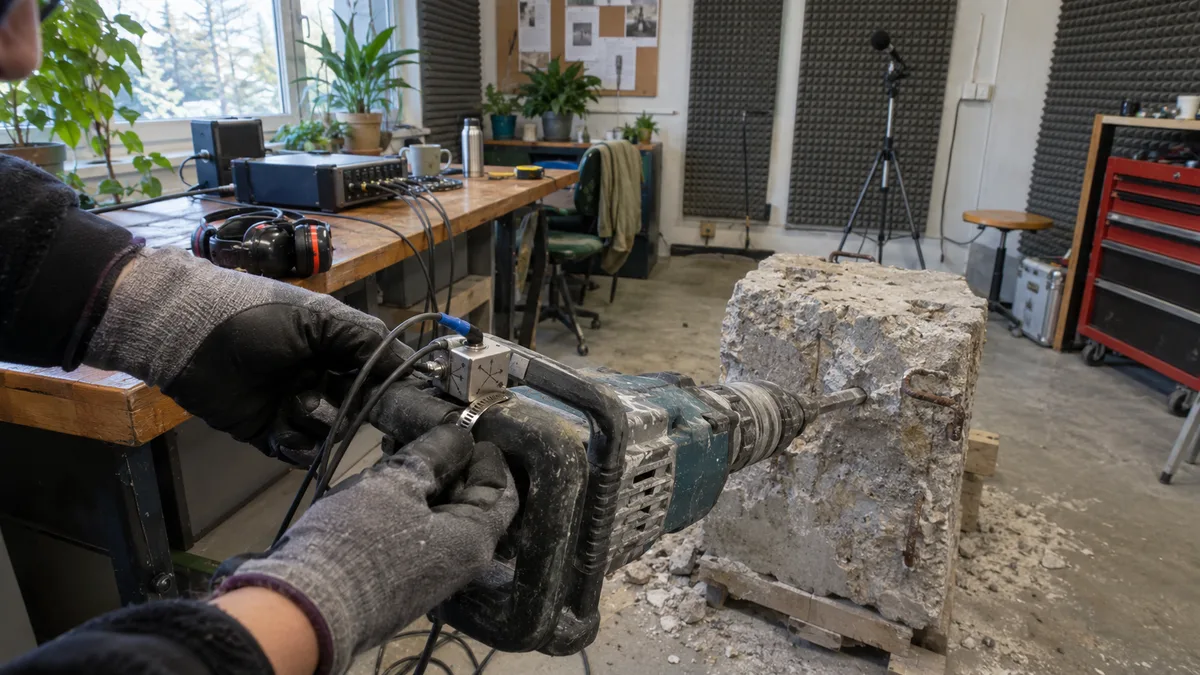
On 8 September 2026, the Úřad pro technickou normalizaci, metrologii a státní zkušebnictví published Věstník ÚNMZ č. 9/2026. The standards announced include the Czech edition of ČSN EN ISO 5349-3, catalogue number 524630, which covers the measurement and assessment of isolated and repeated shocks transmitted to the hands.
However, this is not a new technical method. Věstník ÚNMZ č. 5/2026 had previously approved the English versions of EN ISO 5349-3:2025 and ISO 5349-3:2025 for direct use as ČSN, effective from 1 June 2026. It also explicitly stated that adoption by translation was in preparation.
From 1 October 2026, the Czech translation of the same EN ISO 5349-3:2025, and therefore of the same technical text of ISO 5349-3:2025, replaces the version adopted in May. Both editions thus adopt the same document, EN ISO 5349-3:2025 — they differ in language and method of national adoption, not in their source text. What has changed is the method of national adoption and the language in which the text is available.
What changed on 1 October
ČSN EN ISO 5349-3 concerns exposure to hand-transmitted vibration, specifically the measurement and assessment of isolated and repeated shocks using the frequency range specified in ISO 5349-1.
The difference between the two Czech editions lies in the method of adoption:
| From 1 June to 30 September 2026 | From 1 October 2026 |
|---|---|
| EN ISO 5349-3:2025 was approved for direct use in English | The Czech translation of the same EN ISO 5349-3:2025 applies |
| Catalogue number 523403 | Catalogue number 524630 |
| Adoption by translation was being prepared | The translation replaced the version adopted in May |
| The technical content was based on ISO 5349-3:2025 | The technical content remains based on ISO 5349-3:2025 |
The October edition is therefore not, in itself, a reason to recalculate results, repeat measurements, or professionally reassess older reports. Its main benefit for Czech users is that the standard is now available in Czech.
Which workplaces are affected by the standard
The standard is relevant wherever hand-held tools transmit shocks or vibrations to the hands. Typical examples include demolition and chipping hammers, hammer drills, impact wrenches, and pneumatic tools.
The name of a tool alone does not determine the actual exposure. The result also depends on the work operation being measured, the material, duration of use, working pattern, technical condition of the tool, accessories, and method of work.
The publication of the Czech translation does not, by itself, require every report to be reviewed or a new measurement to be commissioned. Reassessment is particularly appropriate if the tools, work operation, exposure duration, or other operating conditions have changed.
When to review the documentation
1. The latest measurement report
The report should be reviewed primarily when the tools, accessories, material, work operation, or working pattern have changed. Compare the conditions described in the report with current operations.
A report prepared under the May adoption of ČSN EN ISO 5349-3 does not need to be reassessed solely because a Czech translation of the same source standard has been available since October.
2. Occupational risk assessment
Check whether the document reflects the tools actually in use and real working procedures. An update may be required because operations have changed or new professional knowledge has emerged, not merely because the English text has been replaced by a Czech translation.
If you need to compare your documentation with actual operations, our occupational health and safety services can review the consistency of your risk assessment, working procedures, and training. The vibration measurements themselves must then be arranged with a provider qualified to perform the relevant type of measurement.
3. Measurement orders in progress
If a company is already commissioning measurements for another reason, the order should specify:
- which workplaces and work tasks will be included,
- which machines, tools, accessories, and materials will be measured,
- which supporting documents the employer must provide,
- how the results will be used to update the risk assessment.
The transition from the English text to the Czech translation does not, in itself, require the scope of the order to be changed or measurements already completed to be repeated.
4. Older conclusions and references
Do not alter the date or designation of the standard in a completed report yourself. A reference to the May edition identifies the standard applicable when the document was prepared and does not prove that a different method was used.
New documents may cite the current Czech edition under catalogue number 524630. This bibliographic update does not constitute a professional recalculation of the results or a new measurement.
Practical checklist of supporting documents
If reassessment is needed because operations have changed, the following documents may be useful:
- a list of the impact and vibrating tools in use,
- identification of the specific tools and accessories used,
- an overview of work operations and typical durations of use,
- the latest vibration measurement report,
- the current occupational risk assessment,
- the technical and organisational measures adopted,
- tool manufacturers’ instructions,
- maintenance and repair records,
- working procedures and instructions for employees,
- employee training materials,
- a prepared order for further measurements.
A common weakness is inconsistency between documentation and actual operations. A risk assessment may still list older tools, a different operation, or a duration of use that no longer reflects the work being performed. Such discrepancies should be corrected regardless of the publication of the Czech translation of the standard.
How to commission a new measurement
A request to “measure vibration” is too general for proper measurement planning. The order should specify the workplace, tools, accessories, operation being performed, material being processed, and typical working pattern.
Before work begins, also clarify:
- which representative working situations the provider will measure,
- what evidence the provider requires from the employer,
- whether and under what conditions the previous report can be used,
- who will update the risk assessment and related documentation based on the results.
This reduces the risk of the company receiving a technically correct measurement that does not reflect employees’ normal work.
The Czech translation does not establish a new measurement interval
Věstník ÚNMZ and the related notices published by BOZPinfo.cz and Safety Partners do not establish a new annual or other interval for repeating vibration measurements. The date of the next measurement therefore cannot be inferred from the publication of the Czech translation.
A new assessment may be necessary if the tools, accessories, technology, working procedure, exposure duration, or other workplace conditions change. Whether a new measurement is required must be assessed according to the specific operation and the continued relevance of the existing supporting documents, not according to the replacement of the English text by a Czech translation.
Short answer
The Czech translation of ČSN EN ISO 5349-3, catalogue number 524630, applies from 1 October 2026. It replaced the English version of the same EN ISO 5349-3:2025 adopted in May.
This is not a change to the method, calculations, or assessment procedure. The October edition therefore does not, in itself, require older reports to be reviewed, measurements to be repeated, or occupational risks to be reassessed.
Frequently asked questions
Is a new measurement required after 1 October 2026?
Not solely because the Czech translation has been published. Both the May and October editions adopt the same EN ISO 5349-3:2025. A new measurement may be necessary if the tools, technology, working pattern, or other exposure conditions have changed.
Is an older report no longer valid?
Not merely because a Czech translation has been available since October. A report referring to the May adoption was based on the same technical text. Its continued relevance may be affected by operational changes, the scope of the original measurement, or other material circumstances.
Must the standard’s designation be changed in the risk assessment?
Not retrospectively in documents that have already been finalised. The designation of the current Czech edition may be used in new or regularly updated documents. This is a bibliographic update, not a change to the measurement results.
Does the Czech translation introduce annual measurements?
No. The published sources do not establish any new annual measurement interval. The date of the next assessment cannot be determined solely from the publication date of the Czech translation.
Sources used for this article
- Occupational health and safety services for businesses – a service provided by SOHE.
- Occupational risk assessment in a company – how to link risks to actual workplace activities.
- Inspections of machinery and technical equipment under NV 378 – the relationship between inspections, maintenance, and operating documentation.
- PPE in a company: list, policy, and issue records – how to document protective measures and the provision of protective equipment.
- Věstník ÚNMZ č. 5/2026 – approval of the English version of EN ISO 5349-3:2025 for direct use as ČSN and notice that a translation was being prepared.
- Věstník ÚNMZ č. 9/2026 – publication of the Czech translation of ČSN EN ISO 5349-3, catalogue number 524630.
- ISO 5349-1 – the frequency range on which ČSN EN ISO 5349-3 builds.
This article is for information only and does not constitute legal advice. The specific approach to vibration measurement and assessment must reflect actual operations, the manufacturer’s documentation, the environment in which the equipment is used, and the risk assessment.
Would you like to compare your risk assessment, working procedures, and training with actual operations? Explore our occupational health and safety services or send us a no-obligation enquiry. You can also email us at info@sohe.cz.