
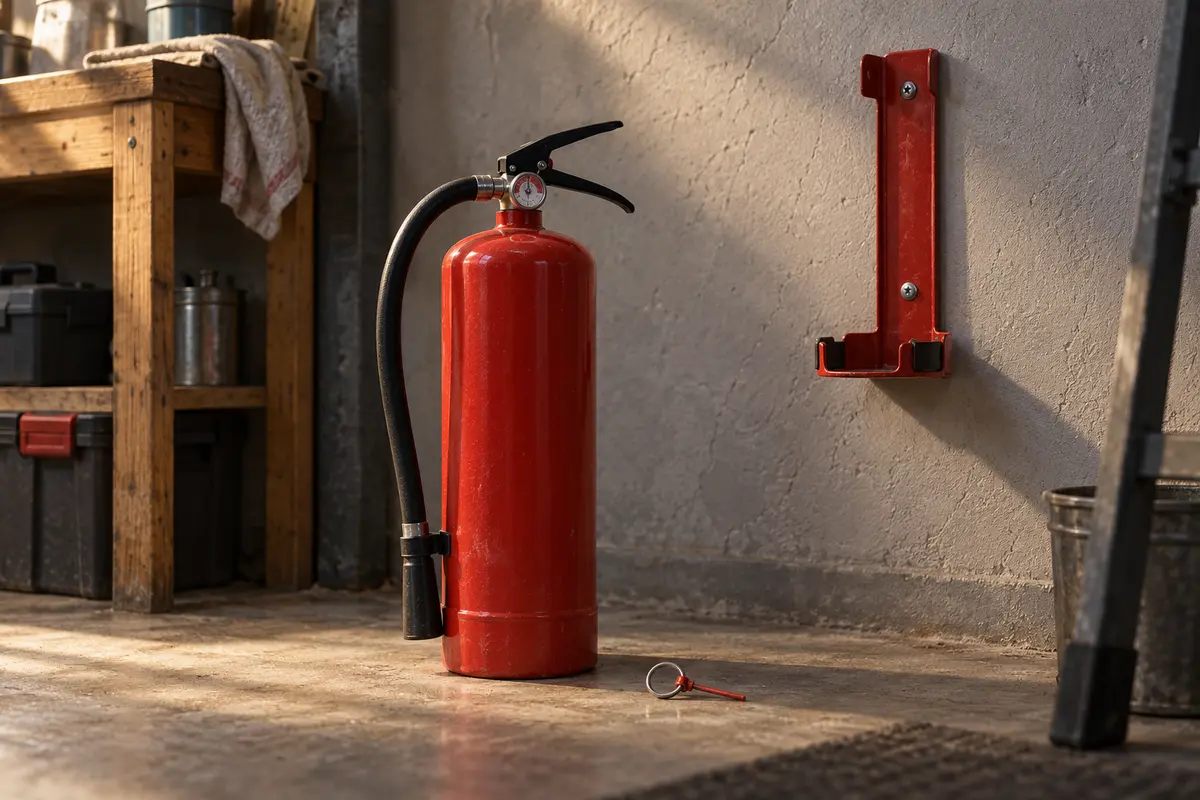
A fire extinguisher that has been used must immediately be taken out of service and handed over to a specialist company for refilling and inspection. According to the guide published by HZS ČR, Institut ochrany obyvatelstva on 29 January 2026, an extinguisher must be submitted for refilling immediately after activation, even if it was discharged only very briefly: a used extinguisher loses pressure and might fail in a subsequent incident. It must be inspected after every use and after mechanical damage, such as a fall. This corresponds to § 9 odst. 2 vyhlášky č. 246/2001 Sb., o požární prevenci, which requires a fire extinguisher to be inspected after every use and whenever there is doubt about its operability. This article addresses what to do after an actual incident: how to handle the extinguisher, how to protect the premises while it is away, and how to confirm that the equipment returned to you once again provides full protection.
Why appearance is not enough
After brief use, an extinguisher may look almost exactly as it did before. This does not prove that it still contains the prescribed amount of extinguishing agent or is ready for another incident. Do not estimate the amount of extinguishing agent by lifting the cylinder or assess its condition merely by looking at the pressure gauge. HZS recommends submitting the extinguisher for refilling and inspection even after brief activation; a second discharge “just to test it” will only consume more of the extinguishing agent.
A fall or suspected leak may not have the same technical consequences as a discharge. It is nevertheless grounds for doubt about operability and for a professional inspection, not reassurance based on outward appearance. Such situations are also identified by HZS ČR.
The main decision-making process after using an extinguisher
Divide the process into four logically connected stages. The practical recommendations below are distinguished from requirements arising directly from the regulation.
Stage 1 — Report and label it. If the fire is still burning, protecting people and calling the fire brigade on 150 or 112 take priority. The following procedure concerns a used extinguisher after the immediate danger has been brought under control and does not replace any fire-reporting obligations. Internal reporting is essential: the person who used the extinguisher must immediately inform the building manager, the person responsible for fire safety, or the owner. Physically remove the extinguisher from its station and attach a label stating “used — do not use.” Do not leave it hanging in place until someone becomes aware that it was used, as another person could mistake it for an extinguisher that is ready for service.
Stage 2 — Assess the effect on the premises’ fire protection. The premises will temporarily have weaker protection, particularly if this was the only extinguisher within reach of the area concerned. Providing a suitable replacement for the extinguisher removed from service is our own practical recommendation based on the principles governing the premises’ fire protection, not a verbatim requirement of the regulation. The regulation itself addresses temporary measures in § 7 odst. 6 for požárně bezpečnostní zařízení, a narrower concept that does not include every portable fire extinguisher. The recommendation should therefore be adapted to the particular premises, their size, the number of extinguishers, and the fire safety documentation. In practice, a replacement may involve borrowing a suitable extinguisher from the service company. Do not move an extinguisher at random from another station, as this could leave an equivalent gap there. Decide on the replacement’s type, quantity, and location with the responsible person according to the premises’ fire protection arrangements.
Stage 3 — Submit the extinguisher for refilling and inspection. Contact a company that maintains fire extinguishers. Under § 9 odst. 3 vyhlášky č. 246/2001 Sb., periodic testing and refilling form part of maintenance. This provision does not mean that, after use, you may wait until the next routine inspection date; inspection after use is covered by odst. 2. Work on the extinguisher—such as replenishing powder, CO₂, or pressure—is not a DIY job for individuals or businesses. The extinguisher is a pressure vessel, and its potential failure presents a hazard in itself.
Servicing may reveal that the extinguisher cannot be returned to you. Under § 9 odst. 9 of the regulation, the service provider withdraws from use any defective extinguisher that cannot be repaired in the prescribed manner, any extinguisher whose serial number and year of manufacture cannot be determined, and any extinguisher more than 20 years old—or more than 40 years old in the case of CO₂ extinguishers—and issues a record stating the reason for withdrawal. A new extinguisher of the appropriate type will then be required. If the extinguisher is approaching its periodic test date—every three years for water and foam extinguishers and every five years for all other types under § 9 odst. 5—it makes sense to combine the test with refilling after use.
Stage 4 — Accept it back only with documentation. When the extinguisher returns from servicing, check two things: the seal and the legible inspection label, showing the month and year of the work, the date of the next inspection or test, and the identification of the responsible person as required by § 9 odst. 6–7. The second item is the record required by odst. 8: it must correspond to the specific extinguisher, its serial number, and its location, and it must state the result and confirm operability. A generic invoice for “servicing” is not a substitute for this information. Only then should you return the extinguisher to its bracket, update the internal records, and remove the label attached during Stage 1.
Decision table: what to do depending on the extinguisher’s condition
| Situation | What to do with the extinguisher | What to do with the premises |
|---|---|---|
| Any discharge, however brief | Take it out of service, label it, and send it for refilling and inspection | Assess the impact and provide temporary protection appropriate to the premises |
| Completely emptied during an incident | Follow the same procedure—the extinguisher remains in the equipment register and must not simply be set aside | A replacement is effectively essential because the area has no extinguisher |
| Fall or mechanical damage without use | Submit it for inspection; do not return it to service | Assess whether the location has been left without protection |
| Suspected leak, corrosion, or damaged seal | Secure it against falling and hand it over to a specialist company | Temporarily protect the location with another extinguisher |
| Extinguisher returned from servicing | Check the label and service record, then record it internally | Restore full readiness |
Example scenario showing both outcomes
Consider a café with offices in the rear section. An employee used a portable fire extinguisher to put out burning paper in the copy room. The discharge lasted only a few seconds and successfully extinguished the fire. There was no way to tell from the outside how much extinguishing agent remained.
Unsuccessful outcome. The employee concealed the use, hung the extinguisher back on the wall, and told no one because she feared getting into trouble for an “unnecessary” activation. The building manager learned of the incident only two weeks later, when another employee mentioned it in connection with damage to the wall. How this outcome was verified: during the regular annual inspection, the service provider found that the extinguisher had been used and was out of service. The premises had therefore operated for two weeks with a false sense of protection, and the extinguisher still had to undergo the same procedure it would have required if the incident had been reported immediately. In addition to needlessly extending the period during which the premises were exposed, time was lost establishing what had happened and when. Fortunately, no other fire occurred during that period, but this favourable outcome cannot be treated as proof that the procedure was correct.
Correct outcome. The employee reports the incident immediately. The building manager takes the extinguisher out of service and labels it, arranges a suitable temporary extinguisher with the responsible person without removing protection from another station, and sends the used unit for refilling and inspection. How this outcome is verified: when the extinguisher returns, the manager checks the information on the label—the month and year of the inspection, the next due date, and the identification of the service provider—and archives the record with the fire safety documentation. The extinguisher is then returned to its original position, and the dates of the incident and restored readiness are entered in the internal register.
The difference between these outcomes is not the technical work, which is handled by the service provider, but time. The unsuccessful outcome extended the period without genuine protection to two weeks. The correct outcome provides a replacement for the duration of the servicing, which cannot be guaranteed in advance. This example does not apply identically to every property: the procedure will be stricter in premises with only one extinguisher or mandatory fire safety documentation, and records will be required to close the incident.
What you must not do
Do not return an extinguisher to service based on an estimate—for example, because it “still feels almost full.” The effects of pressure and the extinguishing agent after activation are not visible, so do not try to assess them yourself. Do not refill the extinguishing agent, manipulate the valve, or test the pressure yourself either. These actions interfere with a pressure vessel and carry a risk of injury and damage to the extinguisher. If you are unsure about the parameters specified by the manufacturer, consult the company that refills and maintains the extinguisher; these parameters are not universal.
Regular annual inspections, periodic tests, and extinguisher records are discussed in the article fire extinguisher inspections in a business: intervals and records. If you manage several properties or a larger facility and need temporary fire protection while your extinguisher is being serviced, see SOHE’s fire safety services.
Frequently asked questions
Can I refill the extinguishing agent myself?
No. Refilling and maintenance must be carried out by a specialist company. A fire extinguisher is a pressure vessel, and any work on it must be left exclusively to people with the appropriate equipment and expertise.
Do I have to report that the extinguisher was used?
Internal reporting to the person responsible for the premises’ fire safety should be treated as an essential part of the process. Without it, the extinguisher may remain in place in a condition that only appears ready for use. The obligation to report the fire itself to the relevant authorities is governed by separate rules and is not covered by this article.
What if the extinguisher fell but was not used?
Mechanical damage without use is also a reason to submit the extinguisher for inspection. An impact, a fall, or a suspected pressure leak creates doubt about operability that cannot be resolved through an external visual check.
Will the same extinguisher be returned after servicing?
That depends on the arrangement with the particular company and on the extinguisher’s condition. Under § 9 odst. 9 vyhlášky č. 246/2001 Sb., the service provider will withdraw an extinguisher that is defective and cannot be repaired, has no identifiable serial number and year of manufacture, or is more than 20 years old—or more than 40 years old in the case of a CO₂ extinguisher—and issue a record stating the reason. What matters is that the extinguisher you receive is operational and has a current label and documentation confirming refilling and inspection.
How can I tell whether the returned extinguisher is ready for use again?
Check the seal, the inspection-label information required by § 9 odst. 6–7, and the record required by odst. 8, including the serial number and confirmation of operability. Request and retain both items, and return the extinguisher to its station only after checking them.
Sources and scope
- Hasičský záchranný sbor České republiky, Institut ochrany obyvatelstva — the article “Průvodce správným umístěním, použitím a údržbou hasicího přístroje v domácnosti,” available at hzscr.gov.cz, particularly the recommendation of 29 January 2026 to submit an extinguisher for refilling and inspection after every use or instance of mechanical damage.
- Vyhláška č. 246/2001 Sb., o požární prevenci, particularly § 9 odst. 2 (inspection after use or when operability is in doubt), odst. 3 and 5 (refilling and periodic testing), odst. 6–8 (labels and records), odst. 9 (withdrawal from use), and § 7 odst. 6 (temporary measures for požárně bezpečnostní zařízení).
The source materials were verified on 7 October 2026. The legal position reflects the law as of that date and does not imply that legislation will remain unchanged. The recommendations concerning temporary protection of the premises are our own practical guidance based on the premises’ fire protection arrangements, not a direct restatement of the cited provision; we do not treat the term “revizní technik” here as a universal legal qualification. This article is neither a manual for a specific device nor a binding procedure for every property—always adapt the solution to the extinguisher type and operating conditions.