
The short answer: A compressor itself is not regulated pressure equipment, but its air receiver is—once its maximum working pressure PS exceeds 0.5 bar and its volume exceeds 10 litres or the product PS × V exceeds 100 (§ 4 and § 5 of nařízení vlády č. 192/2022 Sb.). A 50 l / 10 bar workshop air receiver gives a product of 500 and falls into Class II. It requires an initial inspection before commissioning, an operational inspection within 14 days and then once a year, an internal inspection once every 5 years, and a pressure test once every 10 years—all performed by an inspection technician certified for pressure vessels. Legislation checked as of 28 August 2026.
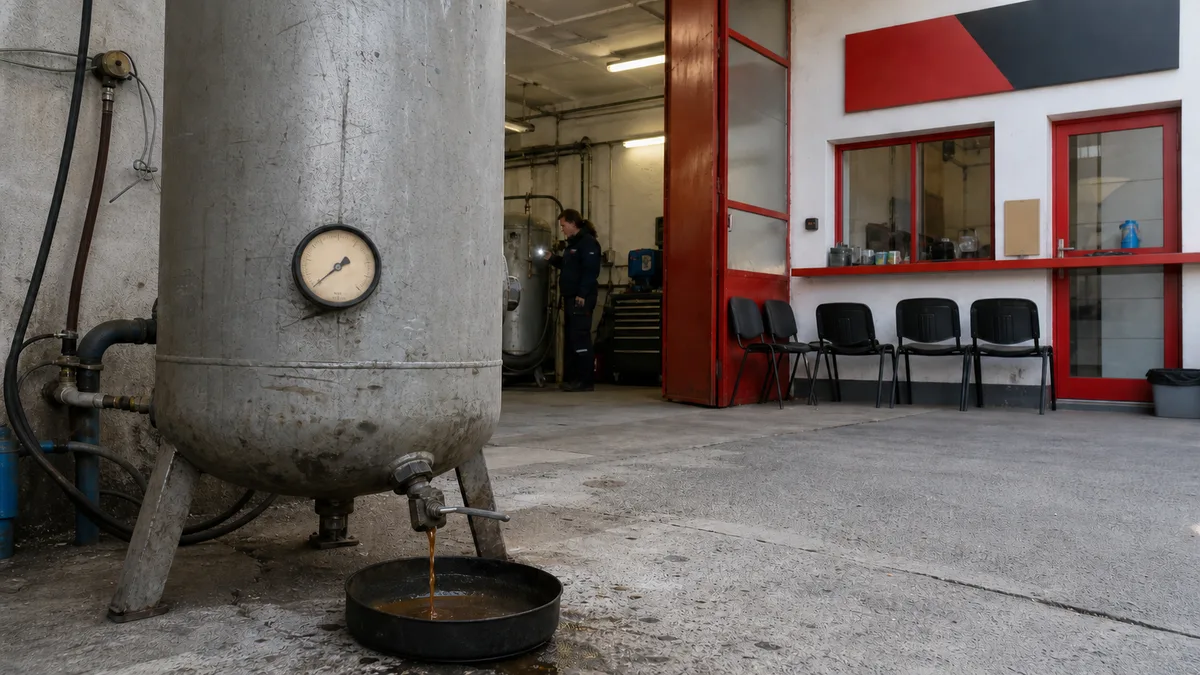
A reciprocating compressor has been running in the corner of an automotive workshop for ten years. Someone drains the condensate whenever they remember, while the paperwork has remained in a binder since the machine was purchased. The question of whether the air receiver has a valid inspection usually arises only when the labour inspectorate visits, an insurance claim occurs, or a new safety officer asks to see the register of regulated technical equipment.
This is not a rhetorical question. In 2025, Oblastní inspektoráty práce carried out 450 inspections of regulated pressure equipment and identified 884 deficiencies; only 156 inspections found no violations. Recurring findings included inspection reports that failed to comply with § 18 of the regulation, missing inspection and maintenance records, vessels that were neither anchored nor earthed, damaged fittings, and illegible nameplates—precisely the issues most easily overlooked on a single workshop compressor.
In brief:
- An air receiver is regulated pressure equipment if its maximum working pressure PS exceeds 0.5 bar and its volume exceeds 10 litres or the product PS × V exceeds 100.
- Under NV č. 192/2022 Sb., it requires an initial inspection before commissioning, an operational inspection within 14 days and then once a year, an internal inspection once every 5 years, and a pressure test once every 10 years.
- Inspections may be performed—and tests supervised and evaluated—only by an inspection technician for pressure equipment.
The compressor is not regulated equipment, but the air receiver is
Nařízení vlády č. 192/2022 Sb. excludes compressors and pumps from regulated pressure equipment in § 4 odst. 2 písm. i), because pressure is not a significant design factor in these devices; piping is also excluded under písm. d). The pressure vessel connected to the compressor is regulated equipment: under § 4 odst. 1 písm. b), this includes any vessel containing gases or vapours with a maximum working pressure above 0.5 bar. Wheels do not change this classification—under § 2 písm. b), a mobile or portable vessel is also considered a stationary pressure vessel if it is permanently connected to the pressure source.
One machine therefore falls under two regimes. As machinery, the compressor must be inspected at least once every 12 months under § 4 odst. 2 of nařízení vlády č. 378/2001 Sb., which we cover in a separate article. The air receiver is additionally subject to its own, stricter regime under zákon č. 250/2021 Sb. and NV č. 192/2022 Sb. A machinery inspection record does not replace the vessel inspection. The workshop’s compressed-air distribution system is not regulated pressure equipment—Státní úřad inspekce práce stated in May 2023 that an ordinary distribution system may be installed by the operator if good engineering practice is followed, although it remains subject to annual inspections under NV č. 378/2001 Sb.
Calculation from the nameplate: pressure × volume
Under § 4 odst. 2 písm. b), the exemption applies only to vessels with a volume of no more than 10 litres and a PS × V product not exceeding 100—both conditions must be met. An air receiver over 10 litres is therefore regulated equipment at any pressure above 0.5 bar, while a smaller vessel becomes regulated once the product exceeds 100. Read both figures from the vessel nameplate, not from the compressor’s pressure switch: PS is the maximum permissible pressure specified by the vessel manufacturer, and V is its internal volume in litres (§ 2 písm. h) až j)).
| Air receiver nameplate | PS × V | Regulated pressure equipment? |
|---|---|---|
| 6 l / 8 bar | 48 | no – up to 10 l and product up to 100 |
| 10 l / 11 bar | 110 | yes – product above 100 |
| 24 l / 8 bar | 192 | yes – volume above 10 l |
| 50 l / 10 bar | 500 | yes – Class II |
| 500 l / 13 bar | 6,500 | yes – Class II |
Under § 5 odst. 2, Class I includes only vessels with a pressure above 100 bar and a volume above 1,000 litres; a workshop air receiver will fall into Class II. This determines the scope of the inspection technician’s certification (NII), although the intervals are the same for both classes. Under § 5 odst. 3, the equipment also includes its safety and pressure accessories—the safety valve, pressure gauge, and fittings—which are covered by the inspection as well.
Which inspections and tests are required, and who performs them
Inspections are performed, and tests supervised and evaluated, by an inspection technician (§ 9 odst. 5)—a person holding a Technická inspekce ČR certificate for pressure vessels, valid for 5 years (§ 11 odst. 3 of zákon č. 250/2021 Sb.), and working for a company authorised to perform inspections (§ 20 of the regulation; the authorisation is valid for 10 years under § 8 odst. 4 of the Act). Both can be checked in the public TIČR register.
| Procedure | Who | When / maximum interval | Regulation |
|---|---|---|---|
| Initial inspection | inspection technician, arranged by the supplier | before commissioning a new, repaired (welded or drilled), or relocated stationary vessel | § 12 |
| Operational inspection | inspection technician | within 14 days of commissioning, then once every year | § 13, příloha č. 4 |
| Internal inspection | inspection technician | once every 5 years; after a shutdown exceeding 3 years and after an extraordinary event | § 14, příloha č. 4 |
| Leak test | supervised by an inspection technician | after opening the pressure assembly, unless a pressure test is performed | § 15 |
| Pressure test | supervised by an inspection technician | after repairing the pressure assembly, after relocation, and once every 10 years from the year of manufacture | § 16, § 9 odst. 4, příloha č. 4 |
The intervals in příloha č. 4 are the maximum permitted. Under § 9 odst. 3, the operator must specify them in an inspection and testing plan based on the manufacturer’s documentation and operating conditions, and the inspection technician may shorten them (příloha č. 3 bod 4.4). A subsequent inspection must be completed by the last day of the calendar month in which the interval expires (§ 9 odst. 4). The operator arranges servicing of the safety valve and accessories in accordance with the supplier’s instructions; for vessels, these checks form part of the internal inspection (příloha č. 1 bod 2.10).
Under příloha č. 2 bod 2.2.2, an operational inspection checks the condition of the vessel and its accessories, documentation management, compliance with pressure limits, access to the vessel, nameplate legibility, and operator competence. An internal inspection requires taking the vessel out of service, isolating it from the pressure source, and examining it both internally and externally. On an air receiver, particular attention is typically paid to corrosion at the bottom, where condensate collects. Under § 16 odst. 2, the pressure test uses a liquid, usually water. Section § 18 odst. 2 specifies the mandatory contents of the inspection report: a list of procedures and measuring instruments, defects with references to the breached provisions, a conclusion on whether the equipment can be operated safely, and the validity date. A one-sentence report stating “no defects” does not meet these requirements.
Operating log, local operating rules, and the person responsible for operation
Before commissioning, the operator appoints a person responsible for operation (§ 8 odst. 4). This may not be the inspection technician who inspects the vessel (příloha č. 3 bod 4.6). Under § 19 odst. 1, the operator must also prepare local operating rules within 2 months of commissioning—the manufacturer’s instructions apply until then—and ensure that the operating personnel keep and sign operating records covering operating time, extraordinary events, safety valve testing, and maintenance (§ 19 odst. 3). The manufacturer’s documentation and records of inspections and repairs must be retained throughout the equipment’s service life. Zákon č. 250/2021 Sb. includes the operating log in the operating documentation under § 2 písm. h), while příloha č. 3 bod 1 písm. j) requires a register of all pressure vessels, which belongs in the inspection plan for the following year.
Under § 24 odst. 4, an air receiver may be operated only by a person over 18 years of age who is medically fit, familiar with the relevant regulations, trained, and assessed as competent. The record is signed by the inspection technician or the responsible person, and the assessment must be repeated at least once every 3 years (§ 24 odst. 5 a 6). In a small workshop, this can typically be handled by training the mechanics as part of their workplace safety training.
What not to do
- Do not confuse a machinery inspection with a vessel inspection. Under § 20 odst. 3 písm. a) of zákon č. 250/2021 Sb., operating regulated equipment without a documented inspection report completed within the required intervals constitutes a condition that endangers safety.
- Do not weld or drill the vessel yourself. Under příloha č. 1 bod 1.5, work affecting the pressure assembly is a repair that requires authorisation and must be followed by a construction test and a pressure test (bod 3). By contrast, replacing a gasket, safety valve, or pressure gauge is maintenance that does not require such authorisation (bod 1.7).
- Do not increase the pressure above PS or tamper with the safety valve. Příloha č. 1 bod 2.10.2 requires pressure-limiting equipment to prevent sustained pressure above PS and limits any temporary increase to 10% of PS.
- Do not leave the vessel unanchored or unearthed. Section § 7 odst. 3 requires the vessel to be earthed and anchored, while odst. 2 requires safe access to its accessories—both were recurring findings by inspectorates in 2025.
- Do not rely on intervals from a repealed regulation. Vyhlášku č. 18/1979 Sb. was repealed by zákon č. 250/2021 Sb. (§ 25 bod 23). Nevertheless, as of the review date of 28 August 2026, compressor retailers’ advice pages commonly stated that a pressure test was required “once every 9 years”, citing that repealed regulation. Under příloha č. 4 of the current regulation, the interval is 10 years.
Used compressors and the condition after an extraordinary event
When buying a used compressor, you are also acquiring the vessel’s history. Under § 3 odst. 5 of zákon č. 250/2021 Sb., the equipment’s condition is assessed under the regulations in force when it was commissioned, so the inspection technician needs the original documentation. Before paying, check:
- Vessel nameplate — manufacturer, serial number, year of manufacture, PS, and V. The pressure-test interval is calculated from the year of manufacture, and an illegible nameplate is itself a finding (příloha č. 2 bod 2.2.2).
- Accompanying documentation — declaration of conformity, instructions, equipment passport, or inspection book. If issued documentation is missing, § 20 odst. 3 písm. c) of the Act treats this as a condition endangering operational safety, and the operator must define the scope of checks in the local operating rules (§ 20 odst. 4).
- The latest inspection reports, including the internal inspection and pressure test—the reports will show what needs to be done immediately.
- Condition around the bottom — rust around the drain valve and lower welds indicates how regularly the previous owner drained the condensate.
Under § 12 odst. 1 písm. c), a stationary vessel moved to a new location requires an initial inspection, followed by an operational inspection within 14 days under § 13 odst. 2. Moving mobile, transportable, or portable vessels does not trigger these duties, but we still recommend arranging an operational inspection after taking possession; otherwise, there is no clear starting point for the annual interval. Under § 14 odst. 2, a vessel taken out of service for more than 3 years must undergo an internal inspection before returning to operation.
The same applies after an extraordinary event. A dropped vessel, a workshop fire, frost in an uninsulated compressor room, or a malfunctioning safety valve—after any event that may have damaged the pressure assembly, § 14 odst. 2 of the regulation requires an internal inspection regardless of the normal interval, and the responsible person must report changes to the inspection technician (příloha č. 3 bod 2). An event causing damage clearly exceeding CZK 5,000,000 must be reported without undue delay to the relevant Oblastní inspektorát práce under § 22 of zákon č. 250/2021 Sb. Occupational injuries are subject to a separate procedure described in our article on workplace injuries in a company.
How the air receiver inspection relates to electrical inspection
The compressor’s pressure and electrical systems are governed by different regulations but should share one inspection schedule. A permanently connected rotary screw compressor forms part of the building’s electrical installation: its supply, protection, and starter are covered by the electrical inspection, while a new permanent supply with its own protective device is an alteration requiring an initial electrical inspection. A plug-connected reciprocating compressor is an electrical appliance—in workshop group C under ČSN 33 1600 ed. 2—with intervals described in the article on company electrical appliance inspections, including the extension lead from which workshop compressors are often powered. The vessel’s earthing required under § 7 odst. 3 is measured by an electrical inspection technician, not a pressure equipment specialist. It therefore makes sense for both technicians to work from the same equipment register and for their reports to be kept together in the operating documentation.
What has changed in the past two years
The amendment made by nařízení vlády č. 175/2024 Sb. (effective from 1 July 2024) changed only § 22 of NV č. 192/2022 Sb.—the education and experience requirements for inspection technicians. The thresholds of 0.5 bar / 10 l / product 100 and the intervals in příloha č. 4 remained unchanged. ČSN 69 0012 Tlakové nádoby stabilní – Provozní pravidla was published in December 2024 and took effect on 1 January 2025. It replaced the 1984 edition still cited by retailers’ advice pages and, according to its foreword, is aligned with zákon č. 250/2021 Sb. and NV č. 192/2022 Sb. Check which edition is cited in your local operating rules and inspection reports—inspections performed under obsolete standards are among the recurring findings made by inspectorates. Compressor safety as machinery is covered by the harmonised ČSN EN 1012-1 (2011 edition).
Frequently asked questions
Is a 24-litre, 8-bar air receiver regulated pressure equipment?
Yes. Its volume exceeds 10 litres, so the exemption under § 4 odst. 2 písm. b) cannot apply, irrespective of the PS × V product. The vessel falls into Class II and requires an initial inspection, an operational inspection within 14 days and then annually, an internal inspection after 5 years, and a pressure test 10 years after the year of manufacture.
Who may perform an operational inspection of an air receiver?
An inspection technician holding the appropriate Technická inspekce ČR certificate for stationary pressure vessels of the relevant class (scope NII), working for a company authorised to perform inspections. Both can be checked in the public TIČR register. The technician may not also be the person who operates the vessel or is responsible for its operation at your premises (příloha č. 3 bod 4.6).
Do I need an operating log for the compressor?
The regulation requires operating records to be kept and signed by the operator (§ 19 odst. 3), while zákon č. 250/2021 Sb. includes the operating log in the operating documentation under § 2 písm. h). The local operating rules define the scope of these records—for an air receiver, they will typically cover condensate draining, safety valve testing, faults, and maintenance. A notebook kept beside the compressor is sufficient, provided that it is actually used.
Does this also apply to a self-employed person with a workshop but no employees?
Under § 20 odst. 1, zákon č. 250/2021 Sb. defines an operator as either a legal entity or a self-employed natural person operating regulated equipment. The inspection and documentation duties therefore do not depend on the number of employees.
Sources used for this article
- Workplace safety for companies – a SOHE service.
- Machinery inspections under NV 378/2001 Sb. – annual inspection of the compressor as machinery.
- An inspection by the labour inspectorate – how the inspection proceeds and which documentation is requested.
- Inspections of electrical appliances and tools in companies – intervals for group C and extension leads.
- Zákon č. 250/2021 Sb. – occupational safety in the operation of regulated technical equipment; § 2, 3, 6, 8, 11, 20, 22 a 25.
- Nařízení vlády č. 192/2022 Sb. – regulated pressure equipment; § 2, 4, 5, 7 až 9, 12 až 16, 18, 19, 24 a přílohy č. 1 až 4.
- Nařízení vlády č. 175/2024 Sb. – amendment effective from 1 July 2024 (čl. IV, § 22).
- Nařízení vlády č. 378/2001 Sb. – safe operation of machinery; § 4 odst. 2.
- Výsledky kontrol OIP vyhrazených tlakových zařízení v roce 2025 – technicka-zarizeni.cz, 21 May 2026.
- Instalace rozvodu vzduchového potrubí – SÚIP, 10 May 2023.
- ČSN 69 0012 Tlakové nádoby stabilní – Provozní pravidla (12/2024, effective from 1 January 2025) – agentura ČAS catalogue.
- ČSN EN 1012-1 Kompresory a vývěvy – Bezpečnostní požadavky – Část 1: Vzduchové kompresory (4/2011) – agentura ČAS catalogue.
- ČSN 33 1600 ed. 2 – inspections and checks of electrical appliances during use.
This article is for informational purposes and does not constitute legal advice. The specific inspection and testing regime for an air receiver, the scope of the local operating rules, and the vessel’s classification must be determined according to the actual operation, the manufacturer’s documentation, the operating environment, and the risk assessment.
Not sure whether your air receiver is included in the register of regulated equipment or when its latest inspection expired? As part of our workplace safety services for companies, we can help you compile a pressure vessel register, local operating rules, and an inspection plan. We can arrange pressure equipment inspections through a cooperating inspection technician, while our electrical inspection covers the electrical system—the supply, protection, vessel earthing, and workshop appliances. Send us a no-obligation enquiry or email info@sohe.cz; a photo of the vessel nameplate and the latest inspection report are all we need to get started.