
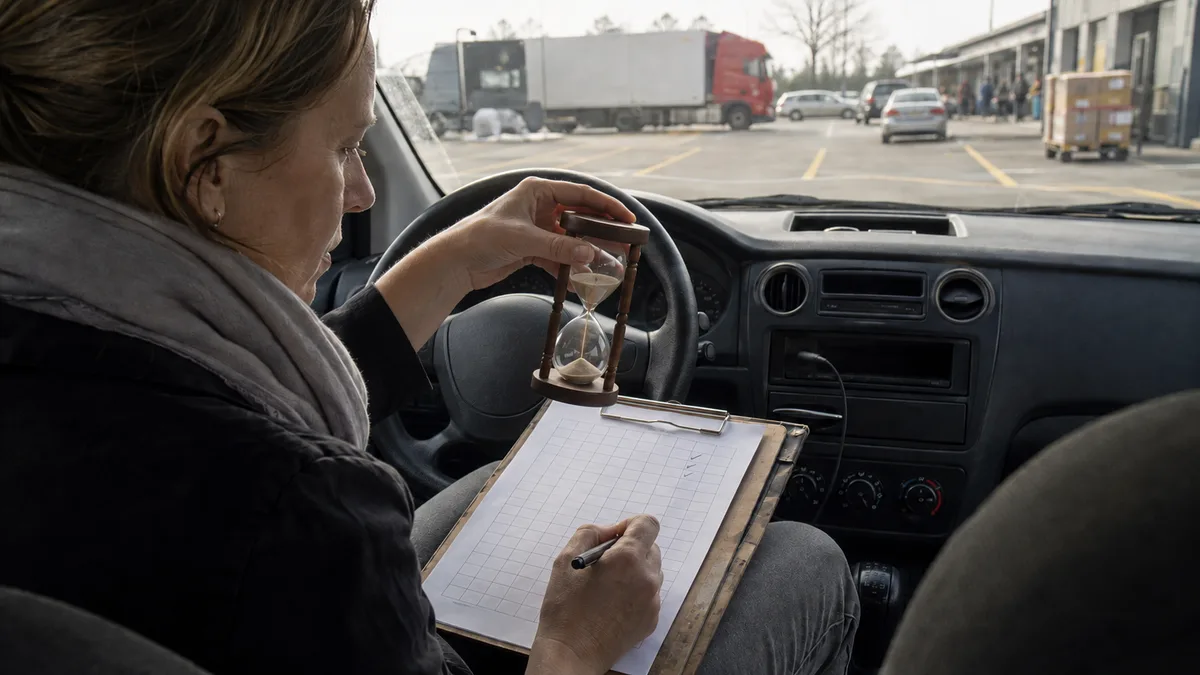
A sales representative leaves Brno at six in the morning, reaches Ostrava at half past ten, drives to Olomouc after a meeting, and returns home in the evening. They spend seven hours behind the wheel that day. They stop twice: once to refuel and once for coffee—both times for less than ten minutes because they want to be home by the evening.
The mileage log is correct. The travel order is correct. The car has a valid roadworthiness certificate. Yet the company has breached an obligation imposed by law and has no record of the journey in a form that would withstand an inspection.
Most companies associate driving-time rules with lorries and tachographs. But alongside the system for professional drivers, there is another, much simpler system—and it applies specifically to sales representatives, technicians, and managers who drive company cars to visit customers. We will explain who it applies to, how many hours an employee may actually drive, how long the break must be, whether it is paid, what the company must record, and what the police may require from the driver at the roadside.
Two systems, two different sets of rules
Section 100 of the zákoník práce lists the transport employees for whom the government establishes special rules on working time and rest periods. These include crew members of goods vehicles or buses, road maintenance employees, railway transport employees, public transport employees, aircraft crew members, and employees responsible for airport operations. They are subject to a special system involving tachographs, uninterrupted rest periods, and international rules.
A service technician, sales representative, or operations manager driving a company car to a meeting does not fall into any of these groups. Their driving is governed by nařízení vlády č. 168/2002 Sb., kterým se stanoví způsob organizace práce a pracovních postupů, které je zaměstnavatel povinen zajistit při provozování dopravy dopravními prostředky.
The key provision appears in Annex No. 1, point 3. It expressly applies to an employee “who drives a means of transport and to whom a special legal regulation does not apply”—in other words, precisely someone who drives in connection with their work but is not a professional driver. Point 3 refers only to the employee and the means of transport; it does not distinguish between vehicle categories or owners.
We discussed separately whether such an employee must also receive training, and how often, in our article on training for occasional company drivers. Here, the focus is different: the journey itself and the records that must remain afterward.
4.5 hours—and everything that counts towards them
The regulation requires the employer to ensure that the employee does not exceed the maximum driving time of 4.5 hours. The sentence immediately following this rule is crucial: an interruption in driving lasting less than 15 minutes is also considered driving time.
This is where most business trips quietly exceed the limit. An eight-minute refuelling stop does not interrupt the driving time. A ten-minute coffee break does not interrupt it. Nor does a phone call in a car park if the driver remains in the vehicle. If someone drives for seven hours “with breaks,” but none of those breaks lasts at least fifteen minutes, the regulation treats them as having driven continuously for seven hours.
No later than the end of the maximum driving period, driving must be interrupted by a safety break of at least 30 minutes—unless it is followed by an uninterrupted rest period between two shifts or an uninterrupted weekly rest period. The break may be divided into two parts of at least 15 minutes taken during the driving period. Two fifteen-minute breaks therefore comply with the rule; three ten-minute breaks do not.
What must not be done during the break
A break during which the driver answers emails or arranges another meeting is not a safety break. The regulation states this directly: during the break, the employee must not perform any activity arising from their work duties, except supervising the vehicle and its load.
The same provision contains two practical points. Safety breaks may be combined with meal and rest breaks—a thirty-minute lunch break can therefore satisfy both requirements. Breaks must not be provided at the beginning or end of working time, so a “break” consisting of a later departure or an earlier end to the shift cannot be counted.
Paid or unpaid? The difference lies in one section
Payroll departments often get this question wrong because both breaks merge into a single half-hour stop at a petrol station.
Under § 88 odst. 1 zákoníku práce, an employer must provide a meal and rest break of at least 30 minutes after no more than six hours of continuous work. However, paragraph 4 of the same section states that meal and rest breaks are not included in working time.
A safety break is a different legal concept. Under § 89 odst. 1 zákoníku práce, a break to which an employee is entitled while performing work under special regulations is included in working time. Paragraph 2 also addresses an overlap: if a safety break coincides with a meal and rest break, the meal and rest break is included in working time.
In practice, this means that the half-hour an employee spends away from the wheel after 4.5 hours of driving forms part of their working time—and if it coincides with lunch, the lunch break also counts as working time. Companies that automatically deduct this half-hour as an unpaid break are unlawfully reducing the employee’s recorded working time.
The records almost nobody keeps
The third obligation in point 3 is the one that most often causes problems during an inspection. The employer must ensure that the employee keeps daily records, either on paper or using a technical device, of the time spent driving the means of transport and the safety breaks taken.
This is not the working time record required under § 96 zákoníku práce, which records the beginning and end of shifts, overtime, night work, and on-call time. Nor is it the mileage log that companies keep for tax purposes: that records the route, mileage, and purpose of the journey but says nothing about when the driver stopped or for how long. Even when combined, the two documents a company commonly keeps do not constitute the required record.
A usable record is usually simple. Each day requires one line showing the date, vehicle, start and end times of driving, and the start and end time of each break. The regulation permits both paper records and technical devices—telematics or a company application therefore comply if they can produce a printable record of driving time and breaks, rather than merely showing the vehicle’s location. The cheapest option is a table in the travel order in which the driver enters two additional times. The most expensive option is having no record at all.
What the driver must carry on the road
There is a widespread belief that drivers must carry proof of occasional company driver training and that the police inspect it. Section 6(7) of zákon o provozu na pozemních komunikacích lists what a motor vehicle driver must carry while driving: a valid driving licence (this does not apply to holders of a driving authorisation issued by the Czech Republic or a Czech driving licence), a vehicle registration certificate (this does not apply if the vehicle is entered in the Czech road vehicle register), a certificate of professional competence if § 3 odst. 4 applies to the driver, and, for vehicles in categories M2, M3, N2, N3, O3, or O4, or category T vehicles with a design speed exceeding 40 km/h, proof of the latest roadside technical inspection if it was conducted in another Member State and proof of the latest periodic technical inspection if the vehicle is registered in another Member State.
Proof of training does not appear on that list. Under § 6 odst. 8, the driver is required to present the documents listed in paragraph 7 for inspection—nothing else. It is therefore not the driver who needs proof of training at the roadside, but the employer: during an inspection by the labour inspectorate, when an insurance claim is handled, or when an occupational accident is investigated. An injury sustained in an accident during a business journey is an occupational accident under § 271k odst. 1 zákoníku práce if it occurred while carrying out work duties or in direct connection with them; by contrast, under paragraph 3, an accident occurring while travelling to or from work is not an occupational accident. The first steps after an injury are summarised in our article on occupational accidents and the accident log.
The policy the regulation treats as a given
Section 3 of the regulation states that the employer must organise employees’ work in accordance with this regulation, special legal regulations, the manufacturer’s instructions for operating and using the means of transport, and the local operational safety rules issued by the employer, which define the working and technological procedures for the safe operation of transport.
In an ordinary company, this document is usually called the company vehicle operation policy. To serve its purpose, it should answer at least the following questions:
- who may drive a company vehicle and what proof of training they must have,
- how routes are planned with regard to the 4.5-hour limit and when a journey must be split over two days,
- where and how daily driving-time and break records are kept and who collects them,
- what the driver must do if the vehicle breaks down on the road—the regulation expressly requires in Annex No. 1, point 2(e), the use of a high-visibility warning vest when dealing with a breakdown that occurred during a journey and requires the driver to enter the road,
- who monitors the vehicle’s technical condition and how defects are reported.
Without this document, the company has no way to demonstrate that it organised the work as required by the regulation. We describe the minimum documentation needed by a smaller company in our article on occupational safety documentation for small businesses.
What are the consequences?
Breaching the obligations under this regulation is not a minor matter. Section 30(1)(s) of zákon o inspekci práce defines as an occupational safety offence, among other things, an employer’s breach of an obligation concerning work organisation and working procedures established by a government regulation governing the organisation of work and working procedures that an employer must ensure when operating transport using means of transport. Under § 30 odst. 2 písm. c) of the same act, this offence may result in a fine of up to CZK 1,000,000.
The maximum fine is not usually the first consequence to affect a company. When an accident occurs, missing records and a missing policy shift the entire dispute towards the question of whether the employer organised the journey at all—and that is a difficult question to answer retrospectively. Our article on labour inspectorate inspections explains what inspectors examine and the order in which they request documentation.
How to set it up without slowing anyone down
Companies that manage this successfully have usually done three things. First, they created a policy and had everyone who drives for work sign it as part of their training. Second, they added two lines for break times to the travel order, ensuring that the required record is created alongside a document already in use. Third, they stopped planning routes that only remain within the limit if nothing unexpected happens along the way.
The last point prevents the most disputes. The Brno–Ostrava–Olomouc–Brno route simply cannot fit into a single 4.5-hour driving block, and the half-hour break must be planned in advance rather than reconstructed afterward.
Frequently asked questions
How many hours may an employee who is not a professional driver drive?
The maximum driving time is 4.5 hours. This follows from Annex No. 1, point 3(a) of nařízení vlády č. 168/2002 Sb. Once this period has elapsed, a safety break of at least 30 minutes must follow, unless the employee begins an uninterrupted rest period between two shifts or a weekly rest period.
Does a refuelling stop count as driving time?
Yes, if it lasts less than 15 minutes. The regulation expressly states that an interruption in driving lasting less than 15 minutes is also considered driving time.
Is the safety break paid?
It is included in working time under § 89 odst. 1 zákoníku práce. If it also coincides with a meal and rest break, that break is included in working time as well (§ 89 odst. 2), even though it would otherwise be excluded under § 88 odst. 4.
Must the driver carry proof of training?
Zákon o provozu na pozemních komunikacích does not include it among the documents that a motor vehicle driver must carry while driving under § 6 odst. 7. The employer needs proof of training as evidence that the obligation has been fulfilled; the driver does not need it during a roadside inspection.
Is a mileage log sufficient as a record?
Not on its own. A mileage log records the route, mileage, and purpose of the journey; the regulation requires daily records of driving time and safety breaks taken. The existing form can be supplemented by adding the start and end times of driving and the times of the breaks.
Does this also apply when using a private car for a business trip?
Point 3 of Annex No. 1 refers to an employee who drives a means of transport and to whom no special legal regulation applies. It does not distinguish between vehicle owners—the decisive factor is that the employee is driving while carrying out work duties. For private vehicles, we therefore recommend applying the same driving and break system and covering it in both the company policy and the vehicle-use agreement.
Sources for this article
- Occupational safety services for companies – a SOHE service.
- Training for occasional company drivers: when it is mandatory and how often – the basis of the training obligation and how to set the frequency.
- Occupational safety documentation for small businesses – the minimum set of documents, including the company vehicle policy.
- Occupational accident at work: what to do immediately – the procedure following an accident on a business trip.
- Labour inspectorate inspection – what inspectors examine and which documents they expect to see.
- Nařízení vlády č. 168/2002 Sb. – the organisation of work and working procedures when operating transport using means of transport; § 3 local operational safety rules, Annex No. 1, point 2(e), a warning vest when dealing with breakdowns, and Annex No. 1, point 3, maximum driving time, safety breaks, and daily records.
- Zákon č. 262/2006 Sb. – zákoník práce; § 88 meal and rest breaks, § 89 inclusion of safety breaks in working time, § 96 working time records, § 100 transport employees subject to special rules, § 103 odst. 2 a 3 training and verification of knowledge, and § 271k odst. 1 a 3 the definition of an occupational accident and the exclusion of travel to and from work.
- Zákon č. 361/2000 Sb. – o provozu na pozemních komunikacích; § 6 odst. 7 documents the driver must carry while driving and § 6 odst. 8 their presentation for inspection.
- Zákon č. 251/2005 Sb. – o inspekci práce; § 30 odst. 1 písm. s) an offence involving a breach of work organisation obligations under NV 168/2002 Sb., and § 30 odst. 2 písm. c) the maximum fine of CZK 1,000,000.
This article is for informational purposes and does not constitute legal advice. The specific arrangements for driving, breaks, and record-keeping must reflect the actual operation, vehicle types, working-time schedule, and risk assessment.
Do you lack a company vehicle operation policy, with every employee recording driving time differently? As part of our occupational safety services for companies, we will prepare local operational safety rules, set up a record form that is completed alongside the travel order, and train your drivers. Email info@sohe.cz or send us a non-binding enquiry—all we need is the number of vehicles and the number of employees who drive for work.