
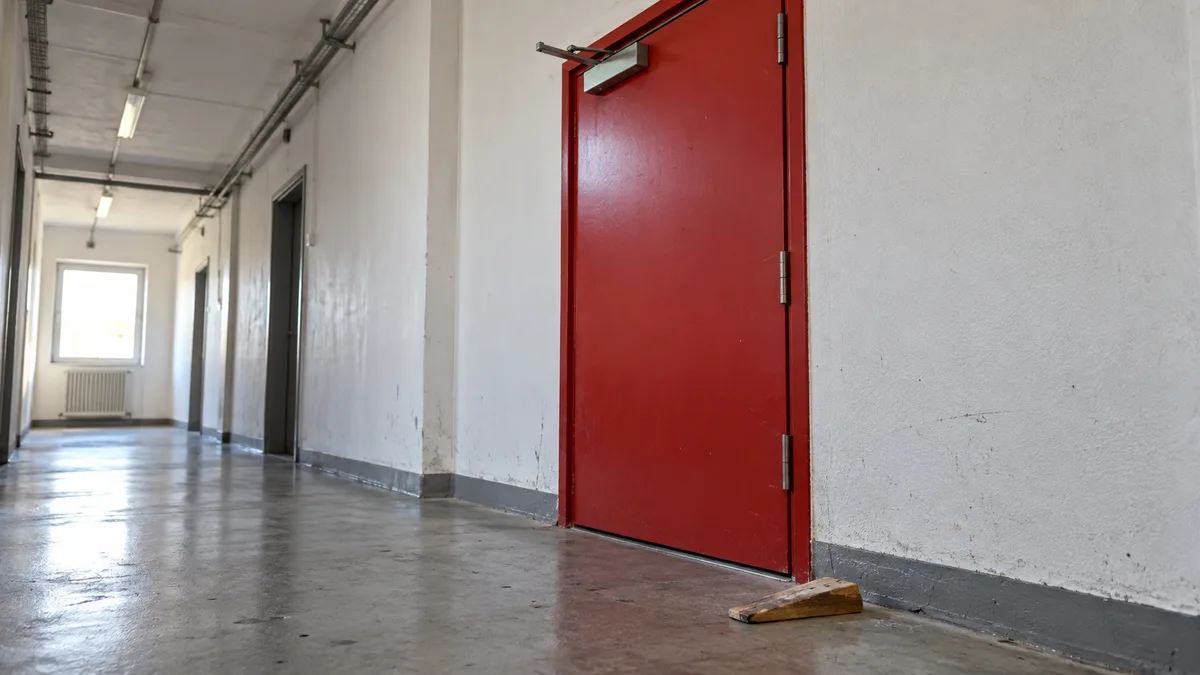
A wedge under a fire door is not a minor operational aid. If the door is intended to close an opening between fire compartments during a fire, holding it open by improvised means compromises that function. Simply kicking the wedge away and taking no further action is not enough: the door must be capable of closing safely, the reason why it was being held open must be addressed, and any approved hold-open system must be assessed for the specific door and building.
If you find a wedge during normal operation, do not adjust the door closer or any electrical equipment. Notify the responsible person and, without putting anyone at risk, allow the door to perform its function. In the event of fire or smoke, evacuation and calling the emergency services take priority over testing a door in a hazardous part of the building.
First establish what kind of door it is
Neither the colour nor the size of a door determines its fire safety function. Check the building documentation, the požárně bezpečnostní řešení (fire safety design), equipment records and product markings. You need to know whether it is a fire-resisting closure, where the escape route runs and what the closure is intended to achieve at that location.
If the documentation is missing or the door markings are unclear, do not conclude that it is definitely not a fire door. Until this has been verified, do not solve operational inconvenience by permanently blocking it. The building manager may involve an osoba odborně způsobilá v požární ochraně (professionally qualified fire safety specialist) and the appropriate service provider; their roles may differ. An operational assessment is no substitute for product intervention by a person without the necessary competence.
A useful fault description might read: “The door between the corridor and the storeroom was open, with a wooden wedge under its lower edge. After the obstruction was safely removed, the door failed to close fully.” This is more useful than a vague statement that “the door is faulty”. However, do not record a fire resistance rating or certification that you have not verified.
A wedge is not the same as an approved hold-open system
HZS Pardubického kraje, in its series on fines, describes precisely this situation: self-closing fire doors in stairwells, corridors or between fire compartments held open by a wooden wedge, string, a flowerpot, a shoe rack or even a fire extinguisher. According to the fire service, fire doors fulfil their purpose only when fully closed; they may be held open only by an approved method that allows them to close automatically in the event of fire. Examples include electromagnets that hold doors open during normal operation and release them in response to a smoke detector signal, or compact systems combining a door closer and smoke detector. A standalone magnet with no connection to a detection system, a hook or a chair does not constitute such a system.
Under Section 2(4)(f) of vyhláška č. 246/2001 Sb., o požární prevenci, fire doors and fire-resisting closures for openings, including their functional equipment, are classified as fire safety equipment. A wedge is therefore more than untidiness: it disables equipment whose operability the operator is required to document.
It would also be wrong to make the opposite generalisation that all fire doors must remain closed at all times without any hold-open device. The permissible solution depends on the documentation and conditions applicable to the specific closure. This article therefore does not provide instructions for retrofitting a magnet, selecting components or modifying the požárně bezpečnostní řešení.
| Situation | Operational action | Do not assume |
|---|---|---|
| A wedge is holding the door open | Safely remove the obstruction and report the problem | That this verifies the door’s complete operability |
| The door fails to close fully after release | Call the responsible person and service provider | That tightening an arbitrary screw will be enough |
| An installed device holds the door open | Check the documentation and prescribed function | That every visible device is approved |
| Staff repeatedly block the door | Address the underlying reason and instruct staff | That a one-off ban will resolve the problem permanently |
A safe procedure after finding a blocked door
First distinguish an emergency from a routine fault. If there is smoke, heat or another immediate hazard in the area, do not move closer to take a photograph or read a label. Follow the local procedures for evacuation and calling for help.
During normal operation, inform the building manager or the designated responsible person. When the obstruction is removed, the door must not strike anyone; coordinate the movement of people and the handling of loads. Do not remove covers, disconnect cables or test an unfamiliar system by triggering an alarm. Leave any task for which you lack the knowledge and authorisation to the appropriate person.
Record the location, time, obstruction and observed behaviour. If it is possible to observe a normal closing cycle without risk, you can note that the leaf does not reach the closed position or that an object is obstructing it. Such an observation is not a professional test of all the closure’s functions. Nor does it demonstrate that the door will provide its specified fire resistance merely because it appears to close.
If the door fails to close fully after the wedge has been removed, it is fire safety equipment that is unable to perform its function. For this situation, Section 7(6) of vyhláška č. 246/2001 Sb. requires the condition to be clearly marked both on the equipment and in the area. The operator must arrange for the equipment to be restored to operation without delay and, through an osoba odborně způsobilá or technik požární ochrany, implement interim organisational and, where applicable, technical measures until the repair is completed.
The next step is to assess the cause. Relocated cabinets, altered flooring or supply procedures may obstruct the door, or the closure may have a technical fault. Each cause involves a different responsible role. If access to the area must remain restricted until the repair, establish the operating arrangements on the basis of an assessment by the responsible specialist and the documentation, not an improvised decision by reception staff.
When deliveries or ventilation are the reason
Removing the wedge often reveals the original problem: employees repeatedly pass through with a trolley, or the room overheats. A ban without an operational change may simply lead to further improvisation. Record when the passage is used, who carries the load and which part of the current arrangement genuinely makes the work difficult.
For deliveries, consider how they can be organised to allow safe passage without permanently blocking the closure. This does not mean using a person as a substitute for fire safety equipment in all circumstances. The specific procedure must preserve the door’s function and reflect local conditions. If a technical hold-open system is needed, have its suitability and system interfaces assessed by a qualified specialist.
A ventilation problem must be addressed separately. Fixing a door in the open position is neither a ventilation design nor a remedy for an indoor hygiene problem. The building manager needs to know that employees are resorting to a workaround and must decide on a safe alternative with the appropriate specialists.
Section 11(3)(b) of vyhláška č. 246/2001 Sb., o požární prevenci also requires circulation areas forming part of escape routes, such as corridors and stairways, to remain unobstructed at all times, while Section 11(3)(c) prohibits the use of protected escape routes in a manner that increases the fire risk. A service trolley left behind after removing the wedge must therefore not create another obstacle on the way out.
Example scenario: a delivery to a storeroom
This is an illustrative scenario. Every morning, packages are wheeled through a door between a company corridor and a storeroom. A wedge is used “just for a moment”, but remains in place after the morning rush. The building manager removes the obstruction, records the finding and discovers that a trolley positioned behind the door leaf prevents the door from closing completely.
The first step is to clear the space required for closing and have the condition of the closure addressed by the appropriate service provider. The second is to change the delivery process: designate a place for the trolley outside the required passage and agree on a method for handing over packages. The third is to explain to staff why the door must not be secured with a wedge and whom to call when a problem arises.
The unsuccessful branch occurs if the door still fails to close fully after all obstructions have been removed. The building manager must not mark the issue as “resolved” merely because the wedge has disappeared. A technical fault must be logged, and the arrangements until repair must follow a professional assessment. Successful completion includes not only removing the fault but also establishing an operating procedure that does not drive employees back to blocking the door.
What it means for the fault to be truly resolved
After the repair, request an appropriate record identifying the door, the work performed and any restrictions. A service invoice without a description of the outcome is not in itself proof that all necessary functions have been verified. Under Section 7(4) of vyhláška č. 246/2001 Sb., the operability of fire safety equipment must be inspected at least once a year unless the manufacturer or documentation specifies a shorter interval. Under Section 7(8), the inspection record must include, among other things, the equipment’s location and type designation, the inspection result, any identified faults together with the method and deadline for remedying them, and the date of the next inspection. The article fire-resisting closures, dampers and EPS: annual operability inspection explains what an annual inspection covers and what the record should contain.
Also check routine use: nothing obstructs closing or passage, employees know whom to contact to report a fault, and the original reason for blocking the door has been addressed. There is no need to demonstrate safety through improvised experiments with fire or smoke. Such testing may endanger people and activate other systems in the building.
Do you need an assessment of the operating arrangements for fire doors and the connected escape routes? Fire safety services from SOHE can help define the faults and identify the documentation needed for an appropriate solution.
Frequently asked questions
Should a wedge always be removed immediately?
During normal operation, the obstruction should be removed safely without allowing the door or any load to endanger people. In the event of fire or smoke, evacuation and calling for help take priority.
Are all doors fitted with door closers fire doors?
No. Verify their function and specifications from the markings and documentation. A door closer alone does not prove a fire safety function.
Can a magnet hold a fire door open?
Only a suitable approved solution that releases the door in the event of fire—typically an electromagnet controlled by a signal from a smoke detector or an EPS (fire alarm system). An arbitrary magnet without this connection is not such a solution.
Does closing the door prove its fire resistance?
No. Observing the door close verifies only part of its behaviour; its operability and specifications require appropriate professional documentation and inspections.
What if the wedge reappears a week later?
In addition to dealing with it safely again, identify the cause: deliveries, a technical fault or another operational need. A one-off ban without addressing the cause may not be enough.
Sources and scope
- HZS Pardubického kraje (2015) — Series: Fines from the Fire Service, or When a Friendly Approach Fails
- Vyhláška č. 246/2001 Sb., o požární prevenci — e-Sbírka: Section 2(4), Section 7, Section 11(3) (version effective from 1 January 2026)
Sources verified on 7 October 2026. The practical procedure and example scenarios are the author’s recommendations; specific operating conditions require an assessment based on the equipment and documentation.