
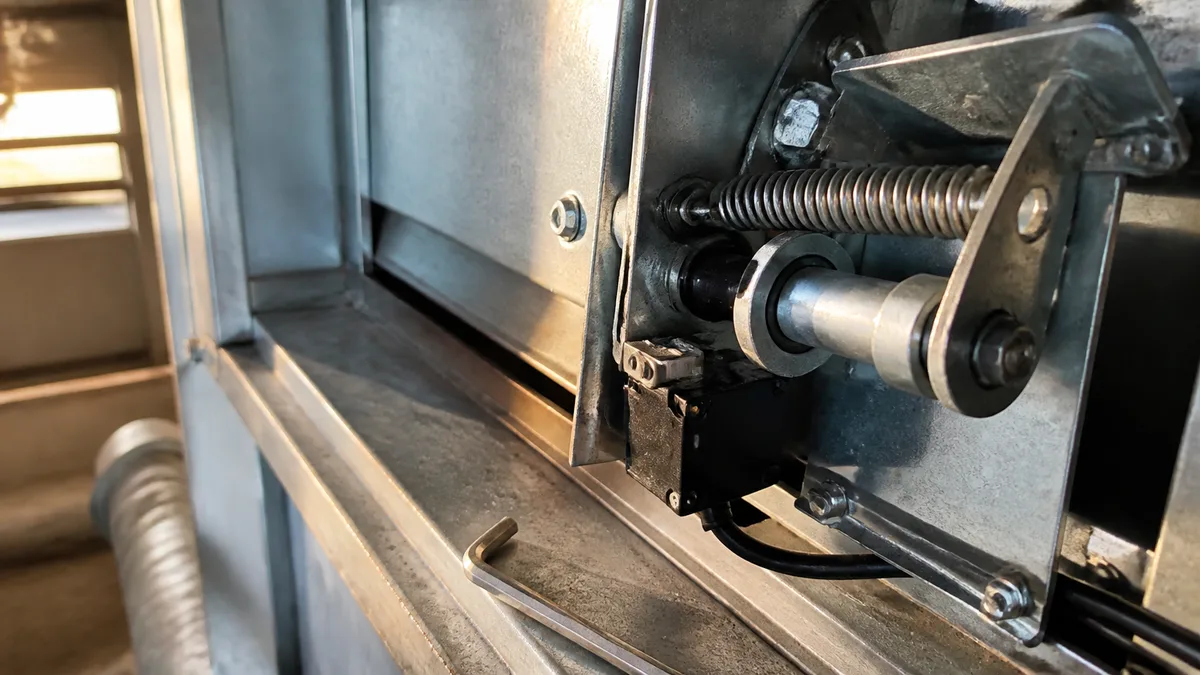
The wedge under the fire door in the corridor can sit there for years and nobody thinks twice about it. The door is heavy, fifty people a day push a trolley through it and the closer only slows them down. Yet this is not untidiness — it is a piece of fire safety equipment that has been put out of service. And the fire inspector will spot it before asking for a single piece of paper.
When someone in a company says “fire protection inspection”, most people picture extinguishers and green signs above the doors. But the decree on fire prevention classes things nobody thinks of as “equipment” among fire safety equipment (PBZ): fire doors, fire dampers in ventilation ducting and the fire detection and alarm system. All three have an annual operability check, each is got wrong in a different way, and in every case it shows up in the record. Let’s go through where the obligation comes from, what is verified in each group, who may carry out the check and what a record looks like when it still tells you something a year later.
What counts as fire safety equipment
The list is in § 2 (4) of vyhláška č. 246/2001 Sb., o požární prevenci (the Decree on Fire Prevention). Letter a) covers fire signalling equipment — this includes the fire detection and alarm system (EPS) and remote alarm transmission equipment. Letter f) covers equipment for limiting the spread of fire and names the fire damper, fire doors and fire closures of openings including their functional fittings, plus fire barriers and penetration seals.
That definition has awkwardly concrete consequences. A door closer held open, a wedge under the leaf, a damper built into a suspended ceiling with no access panel, or a control panel nobody has tested for six months — these are not operational trifles but the condition of equipment that the regulation expects to be operable.
Where the obligation comes from and why it does not depend on the category of activity
The basis is § 5 (1) (a) of zákon č. 133/1985 Sb., o požární ochraně (the Fire Protection Act): legal entities and self-employed persons are obliged to procure and provide fire safety equipment with regard to the fire risk of the activity carried out and to keep it in operable condition.
Note what is not in that sentence. There is no link to the category of activities carried out. That is a substantial difference from fire protection documentation, whose scope does follow from the category — and where a company without elevated fire risk genuinely gets to skip a large part of the paperwork. Operability is not skippable. If the building has fire dampers or fire doors, the regulation assumes they work and that it is documented, even if only three people sit in an office there.
The interval is set by § 7 (4) of the decree: the operability check is carried out at least once a year, unless the manufacturer, verified design documentation, verified non-authorised documentation or detailed design documentation, or a fire hazard assessment sets a shorter interval. The phrase “verified non-authorised documentation” was added to § 7 (2) and (4) by vyhláška č. 467/2025 Sb., effective from 1 January 2026.
An interval longer than a year is allowed only for the buildings listed in Annex 6 to the decree — selected areas of nuclear installations, not an ordinary warehouse or shop. A quote promising a two-year cycle for a warehouse or retail unit cannot lean on that exception.
| Equipment | What it usually is in the building | Designated PBZ | Basic interval |
|---|---|---|---|
| Fire closures | Fire doors, gates, access hatches, covers — including the closer, hardware and seals | No | Once a year |
| Fire dampers | Dampers in ventilation ducting where it passes through a fire separating structure | Yes | Once a year |
| EPS | Control panel, detectors, manual call points, sounders, remote alarm transmission equipment | Yes | Once a year + function tests under § 8 |
The “designated PBZ” column is not a formality. The list in § 4 (3) of the decree includes, among others, the EPS, remote alarm transmission equipment, fixed fire-extinguishing systems, smoke and heat exhaust equipment, fire dampers and fire or evacuation lifts. Fire doors are not on it. Designated equipment falls under the stricter regime of § 10, and under § 7 (3) its operability is also demonstrated by entries in the operating documentation, typically the operating logbook.
Fire closures: the cheapest item and the most frequent finding
The annual check of fire doors is both visual and functional. It verifies the integrity of the leaf, frame and seals — on timber closures usually the intumescent strip, which swells in a fire and closes the gap between leaf and frame — plus the function of the closer, the legibility of the identification plate with the fire resistance classification, the hardware in the escape direction, and above all whether the door is held open or locked.
Three defects account for most findings, and all three have a cause that another line in a report will not fix:
- A closer removed or held open. This is not vandalism but the operator who drives through the doorway fifty times a day with a pallet truck. The technical answer is an electromagnetic hold-open device linked to the EPS, which keeps the leaf open and releases it on alarm.
- Double doors where the passive leaf fails to close. The active leaf shuts, the passive one stays ajar and the gap remains open. Where both leaves are opened in normal operation, the answer is usually a closer on both leaves plus a closing sequence coordinator — without it the leaves close in the wrong order and the door does not shut at all. But what a specific closure needs follows from its classified design and from the design and accompanying documentation for those particular doors, not from a general rule; on doors where the passive leaf is permanently secured and never opened in normal use, the documented design may be different.
- Locked doors on an escape route. This grows out of a legitimate fear for property, and the answer is technical rather than a staff briefing: the door must allow escape in the manner set by the fire safety design of the building and the applicable requirements. Depending on the escape route design and on the number and character of the occupants, that may mean emergency exit hardware or panic hardware — panic hardware is not a mandatory solution for every such door.
One trap in the regulation: § 7 (1) exempts manually operated fire closures of openings, barriers and penetration seals from mandatory function tests before being put into service. This is where the widespread misconception comes from that nothing at all is checked on them. They are not exempt from the annual operability check under § 7 (4).
Because fire closures are not designated PBZ, the qualification regime under § 10 (1) does not apply to them. However, under § 10 (3) the manufacturer’s accompanying documentation may set the knowledge and equipment conditions for the person carrying out the check — and then they are binding. The scope of the check is likewise governed by the accompanying documentation and by normative requirements; requirements for fire closures are covered by ČSN 73 0810 Požární bezpečnost staveb — Společná ustanovení (Fire protection of buildings — Common provisions), whose current edition replaced the older 2009 edition in mid-2016. If you don’t know how many closures your building actually has or what the manufacturer prescribed for them, we will walk the building with you and hand over an item-by-item inventory rather than a single page with a stamp.
Fire dampers: a 72 °C thermal release and a hatch in the ceiling
A fire damper is designated PBZ and mechanically a fairly simple thing: a blade that closes the ventilation duct where it passes through a fire separating structure. The documentation of the Czech manufacturer Mandík shows clearly how it triggers — the thermal release on the PKTM 90 range responds at a nominal temperature of 72 ± 1.5 °C and closes within 120 seconds; below 70 °C the mechanism will not trigger by itself. Motorised dampers are fitted with a spring-return actuator, on the BELIMO BF 24-T and BF 230-T types with a BAE 72-S thermal release element — the damper closes both on loss of power and on excess temperature.
The annual check involves a test closing and opening, verification that the end positions are reached and signalled, the condition of the blade, seals and intumescent material, the condition of the actuator and release, and the damper marking.
The most common practical problem is not technical but structural: a damper hidden in a suspended ceiling with no access panel. The technician cannot reach it, and the check is either not done or ticked off by eye. Providing access is building work, and it is cheaper to order it in advance than to improvise on site with a technician standing by.
EPS: the annual check is only one of three intervals
For the fire detection and alarm system, § 8 of the decree adds operational function tests on top of the annual operability check — monthly for control panels and supplementary equipment, and every six months for automatic fire detectors and for equipment the EPS controls, unless the documentation or the manufacturer sets a shorter interval.
An important detail: under § 8 (2) these tests are carried out by the person entrusted with maintaining the equipment. The decree does not distinguish between internal and external — it can be trained staff on your side, provided they really are entrusted, competent and follow the equipment documentation; elsewhere a service company does it. And if the test date coincides with the annual check, the annual check replaces the test. For the annual operability check, the scope and the conditions for the person carrying it out are set by legislation, normative requirements and the manufacturer’s accompanying documentation — a manufacturer’s authorisation for the given panel type is worth insisting on where it is prescribed that way, not across the board simply because the EPS is designated PBZ.
The normative basis is ČSN 34 2710 Elektrická požární signalizace — projektování, montáž, užívání, provoz, kontrola, servis a údržba (Fire detection and alarm systems — design, installation, use, operation, inspection, servicing and maintenance); the valid edition is from 2023 and replaced the 2011 one.
What the annual check involves in the field is illustrated by manufacturers’ service instructions. With the Czech brand LITES, detectors are tested in TEST mode using the appropriate test pole, and any detector that cannot be activated this way is removed and measured on a detector tester; outputs and functional links to downstream equipment are verified, and a trial run on the standby power supply is carried out by disconnecting the mains for the period set by the design. The same instructions stress two things worth remembering — the check is carried out by a person meeting the qualification under ČSN 34 2710 and the addendum to the manufacturer’s accompanying documentation, and before the check begins, unwanted triggering of downstream equipment must be prevented, meaning extinguishing systems, power shutdown, fire gates or roof vents. That forgotten step lies behind most of the stories about the service technician who evacuated the warehouse.
One more item for the 2026 budget: vyhláška č. 467/2025 Sb. added Central stop and Total stop shutdown devices to the list of PBZ in § 2 (4) (g). If you have them in the building, you have another item to check.
What belongs in the record and what usually appears instead
The required contents of the operability check record are listed in § 7 (8) of the decree. For these three groups of equipment, identification is where it most often goes wrong: the record must state the location, type, manufacturer’s designation and type designation of the equipment checked, and where necessary for precise identification, the serial number as well. A single sheet of paper saying “fire closures in the building comply” identifies nothing in a building with forty doors, and a year later you will not be able to tell from it which door had what replaced.
Before you accept the record, go through four points:
- The date of the next check. It is a required item under § 7 (8) (e), not a service bonus.
- Defects, including how and by when they will be remedied. A bare “does not comply” does not meet the requirement.
- The operating logbook for designated PBZ. For dampers and the EPS, operability is also demonstrated under § 7 (3) by entries in the operating documentation — the record alone is not enough.
- Links between interconnected equipment. If the EPS controls fire dampers or door hold-open devices, you have equipment that interacts. A coordination function test for such an arrangement is required by § 7 (1) before the equipment is put into service — the annual check is a different regime. Under § 7 (4) it is carried out to the extent set by legislation, normative requirements and the manufacturer’s accompanying documentation, so verifying the links belongs in it insofar as that documentation requires it or something has changed on the interconnected equipment. Where the links are verified, three separate reports from three companies do not, by themselves, prove that anything works between the systems.
When equipment fails the check, § 7 (6) requires this to be marked on the equipment and in the space where it is installed, measures to be taken for its immediate return to service, and substitute organisational or, where appropriate, technical measures to be arranged through a professionally qualified person or a fire protection technician until it is working again. A non-functioning damper with its condition marked and a substitute measure in place is an entirely different situation during an inspection than a non-functioning damper nobody knows anything about.
What it costs and how to read a quote
These jobs are not billed as a flat fee per building but per item — which is exactly why quotes are hard to compare. The cheapest item is usually a fire closure, because checking a single leaf is a matter of minutes. A damper costs more because of access and dismantling; for the EPS, the price is driven by the number of detectors, loops and controlled devices — a system with four detectors and a system with several hundred are not comparable items.
What actually moves the price most is accessibility, not technology. Dampers above a ceiling with no hatch, detectors high above racking, or doors in an area where operations cannot be halted will multiply the time on site — and that shows up in the total before the per-item rate does.
When comparing quotes, ask three things: which manufacturer’s accompanying documentation the supplier works to, how they will demonstrate that they meet the qualification conditions set by legislation, normative requirements and the manufacturer’s accompanying documentation — for the EPS and dampers this may include a manufacturer’s authorisation for the given type, where it is prescribed for that equipment — and whether the entry in the operating logbook and any coordination function test are included in the price or billed on top.
It pays to align the dates with your other obligations into a single site visit — the 2027 inspection plan shows how. What to prepare before the fire inspector arrives is covered in the article on an HZS inspection at your company. Fire extinguishers have their own regime and records.
Sources
- Fire safety equipment checks and fire protection documentation – a SOHE service.
- An HZS inspection at your company: what the fire inspector checks — what the inspector asks for first and in what order.
- Fire protection documentation: when it is needed and who prepares it — the volume of paperwork, which unlike operability does depend on the category of activity.
- Fire extinguisher checks at your company: intervals and records — the other half of fire equipment, with its own records regime.
- Zákon č. 133/1985 Sb. – the Fire Protection Act; § 5 (1) (a) establishes the duty to keep fire safety equipment in operable condition.
- Vyhláška č. 246/2001 Sb. – on fire prevention; § 2 (4) defines PBZ, § 4 (3) designated PBZ, § 7 the intervals, the record and the procedure when equipment is unfit, § 8 the EPS regime, § 10 the conditions for persons carrying out checks.
- Vyhláška č. 467/2025 Sb. – amendment to the decree on fire prevention effective from 1 January 2026 (changes to § 7 (2) and (4) and the addition of § 2 (4) (g)).
- ČSN 73 0810 Požární bezpečnost staveb — Společná ustanovení (Fire protection of buildings — Common provisions); requirements for fire closures (the standard is not freely available).
- ČSN 34 2710 Elektrická požární signalizace — projektování, montáž, užívání, provoz, kontrola, servis a údržba (Fire detection and alarm systems — design, installation, use, operation, inspection, servicing and maintenance); qualification for EPS checks (the standard is not freely available).
This text is informational and does not replace legal advice. The specific inspection regime for fire safety equipment needs to be set according to the actual operation, the manufacturer’s documentation, the environment of use and a risk assessment.
We carry out operability checks of fire closures, dampers and fire alarm systems with an item-by-item record, an entry in the operating logbook and a coordination function test wherever the equipment is interconnected. Send us a no-obligation enquiry — an approximate number of doors, dampers and detectors plus the year of the last check is enough, we will find the rest on site. You can also reach us at info@sohe.cz.