
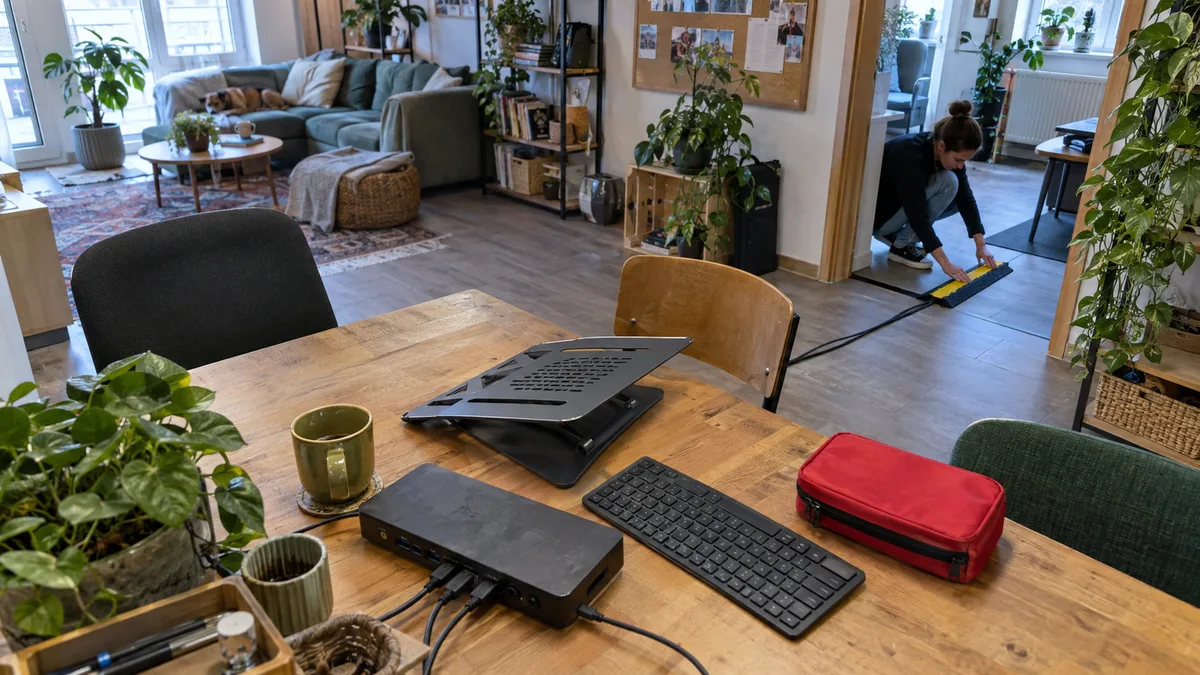
A laptop on the kitchen table, a charging cable across a walkway, and eight hours spent working on the built-in keyboard. The employee may be at home, but their work tasks, company-issued equipment, and work-related risks have not disappeared.
Working from home therefore cannot be dealt with by a single sentence in an employment contract or a certificate confirming completion of a general course. The company needs to know where and how the employee works, what risks are associated with their work, what equipment they use, and what they should do if a defect or injury occurs.
Working from home does not change the basic OHS rules
Under Section 317(1) of zákon č. 262/2006 Sb., zákoník práce, remote work is permitted on the basis of a written agreement between the employer and the employee. An exception is set out in Section 317(3) of the same Act for situations in which the employer orders remote work in writing under specified conditions on the basis of a measure issued by a public authority.
A written agreement alone does not address occupational safety. Under Section 101(1) of zákoník práce, the employer is responsible for OHS with regard to risks that may endanger life or health in connection with the work performed. Section 102 of the same Act requires the employer to create safe working conditions, identify hazardous factors and processes, assess risks, and adopt measures to reduce them.
Employees also have duties of their own. Under Section 106(4) of zákoník práce, for example, they must comply with OHS regulations and instructions, report defects that endanger safety, and report their own occupational injury without delay if their health allows them to do so. This cooperation does not, however, transfer responsibility for establishing the OHS system from the employer to the employee.
What to prepare before the employee first works from home
A small company does not need a separate policy for every step. It does, however, need traceable documentation that reflects the work actually performed.
| Document | What it should cover in practice |
|---|---|
| Remote-work agreement | The agreed location or locations, extent of remote work, organisation of working time, method of communication, and termination of the agreement |
| Equipment and expenses arrangement | Equipment provided, responsibility for its handover and servicing, and the chosen method of reimbursing expenses under Section 190a of zákoník práce |
| Risk assessment | The employee’s activities, characteristics of the workstation, equipment used, identified risks, and specific measures |
| Workstation assessment | An agreed checklist, consultation, essential photographs, or a prearranged inspection |
| OHS training | Risks associated with working from home, rules for using equipment, working arrangements, reporting defects and injuries, and verification of knowledge |
| Equipment and defect records | The laptop, monitor, docking station, power supplies, and other equipment provided, including the procedure to follow if it is damaged |
A general form can provide a framework, but it must be adapted to the work in question. An accountant using a laptop faces different conditions from a designer working with two monitors or a service technician who only completes reports at home.
If the company does not have a remote-work risk assessment or needs to align its documentation with actual operations, it can use the OHS services for companies service. The resulting documentation should reflect specific occupations, equipment, and working arrangements, rather than merely the employee’s job title.
How to assess a home workstation
A remote-work agreement does not give the employer a general right to enter an employee’s home without their consent. The method used to assess the workstation should therefore be agreed in advance and should be proportionate to the risks associated with the work performed.
For routine administrative work, the process can begin with a self-assessment checklist. In particular, the employee should describe:
- their desk, chair, and space available for changing position;
- the position of the screen, keyboard, and mouse;
- lighting, glare, and ventilation options;
- the routing of power and data cables;
- visible damage to sockets, cables, or power supplies;
- the ability to summon help in an emergency;
- distractions that could impair safe concentration at work.
Photographs or a video call should capture only what is necessary to assess the workstation. If the checklist does not provide enough information, the employer and employee can agree on a consultation, additional documentation, or an inspection. If the risks cannot be reduced to an acceptable level, the workstation, the extent of remote work, or the place where the work is performed should be changed.
The risk assessment must reflect the actual work
Simply copying an office risk assessment without modification is not enough. A home environment may involve a different equipment layout, the presence of other people, and less suitable working habits.
Prolonged laptop use
A laptop screen is often too low, while the built-in keyboard makes it impossible to position both the screen and the hands appropriately at the same time. For longer periods of work, a laptop stand or external monitor combined with a separate keyboard and mouse may help. The specific setup must be adapted to the user, the duration of the work, and any health limitations.
Cables and power supplies
A charging cable running through a doorway or across a walkway creates a risk of tripping and pulling the laptop down. Cables should be routed away from walkways or placed in suitable cable covers. A power cable should not be pinched by a door, run underneath a carpet, or used if its conductors are exposed or its connector is damaged.
Extension leads and adapters
Daisy-chaining multi-socket adapters and extension leads increases the number of connections and may result in inappropriate loading. Employees should know a simple rule: stop using a damaged power supply, cable, or socket, disconnect the equipment safely, and report the defect to the designated person.
Working arrangements and isolation
Equipment is not the only source of risk. Sitting for long periods without changing position, working outside the agreed schedule, unclear expectations about availability, or a lack of contact with a supervisor may increase both physical and psychological strain. Measures may include a clear work schedule, breaks, regular contact with a supervisor, and a procedure for situations in which the employee needs assistance.
Company-owned and personal equipment require different arrangements
For a company-owned laptop, monitor, docking station, and power supplies, the employer can record the type of equipment, handover date, instructions, servicing, and reported defects. Under Section 4(1) of zákon č. 309/2006 Sb., machinery, technical equipment, means of transport, and tools must be suitable for the work, fitted with protective devices where necessary, and regularly and properly maintained, inspected, and tested.
This provision does not, however, establish an automatic annual inspection interval for every laptop, monitor, or power supply. The scope and frequency of inspections are determined according to the type of equipment, how and where it is used, the manufacturer’s instructions, the outcome of the risk assessment, and applicable regulations or technical standards.
For a personal monitor, lamp, or extension lead, the company should determine in advance whether the employee may use it for work and under what conditions. The company may prohibit certain personal devices, permit defined categories, or arrange for them to be inspected. A vague instruction stating that “employees use their own equipment at their own risk” is not a substitute for assessing working conditions.
Training should explain the actual risks of working from home
Under Section 103(2) of zákon č. 262/2006 Sb., zákoník práce, the employer must provide employees with training on legal and other OHS regulations that supplements their professional qualifications and relates to the work they perform and the risks they may encounter.
Under Section 103(3) of the same Act, the employer determines the content and frequency of training, the method used to verify knowledge, and the documentation to be kept. The law therefore does not prescribe a single training interval for all employees who work from home.
In practical terms, remote-work training should explain:
- how to set up the workstation and change working position;
- how to use assigned electrical equipment safely;
- which defects require equipment to be taken out of use;
- how and to whom a defect must be reported;
- what working arrangements have been agreed;
- what to do in the event of an injury or other emergency;
- what to do before changing the location from which the employee works.
A record showing only that the employee opened a training video does not demonstrate that they understood the material. A short test, a discussion with a supervisor, or a practical review of the workstation checklist may be appropriate.
An injury at home may be an occupational injury
Under Section 271k(1) of zákon č. 262/2006 Sb., zákoník práce, an occupational injury is damage to an employee’s health or their death occurring independently of their will as a result of short-term, sudden, and violent external influences while performing work tasks or in direct connection with them.
The employee’s home address or the fact that the incident occurred during working hours is therefore not decisive on its own. The specific sequence of events must be established. Tripping over a power cable while connecting a company laptop may be assessed differently from an injury sustained during a purely personal activity.
Employees must report an injury without undue delay if their health allows them to do so. Recording the time, the work task being performed, a description of the location, and any available evidence will help clarify the incident. The employer must then proceed under Section 105 of zákoník práce by investigating the causes and circumstances of the injury and recording it in the accident log. Whether the injury must also be reported and whether a formal report must be prepared or submitted depends on the consequences and circumstances of the incident.
Since 1 January 2026, the reporting and submission of occupational injury records have been governed by nařízení vlády č. 322/2025 Sb. Submissions to the relevant labour inspection authority required by this regulation are made through the Státní úřad inspekce práce portal. The practical steps to take after an incident are summarised in Occupational injury in a company: what to do immediately.
Checklist for a small company
Before regular home working begins, check whether:
- a written remote-work agreement is in place;
- the agreed work locations have been specified;
- equipment, its handover, and reimbursement of expenses have been addressed;
- the risk assessment covers both the work performed and the conditions of the home workstation;
- the employee has documented the condition of the workstation using the agreed method;
- the company distinguishes between company-owned equipment and permitted personal equipment;
- the employee has completed training relevant to remote work;
- the employee’s understanding of the instructions has been verified;
- a procedure for reporting defects and occupational injuries is known;
- documentation is updated when the work, equipment, or agreed location changes.
A missing item will not usually be remedied by another general certificate. The first step is to update the risk assessment and the actual process that the training is intended to explain to the employee.
Quick answer
OHS rules also apply when working from home. Except under the special arrangements in Section 317(3) of zákoník práce, the employer must agree remote work in writing, assess the risks associated with the work performed, adopt proportionate measures, provide appropriate training, and establish rules for using equipment and reporting defects and injuries.
Frequently asked questions
Must a remote-work agreement include an OHS section?
Zákoník práce requires a written agreement but does not specify its complete mandatory content. In practical terms, it is advisable to agree on the place of work, organisation of working time, equipment, expenses, communication, and cooperation in assessing the workstation. This does not replace a separate risk assessment or training.
Can the employer inspect the employee’s home?
Not without a prior agreement with the employee. The workstation assessment method should be proportionate to the risk. For administrative work, a detailed checklist and consultation may be sufficient; an inspection, photographs, or a video call must be agreed in advance and limited to what is necessary.
Is it enough to send the employee an online training course?
Online training can form part of the system if it reflects the specific work and identified risks. Under Section 103 of zákoník práce, however, the employer also determines how knowledge will be verified and how documentation will be maintained. Training is not a substitute for technical and organisational measures.
Does every personal electrical appliance at home need an inspection?
There is no single answer that applies to every device. The company must determine which personal equipment may be used, how its risks will be assessed, and how defects, inspections, and withdrawal from use will be handled. The specific arrangements depend on the equipment, its use, the environment, and the manufacturer’s documentation.
Is an injury sustained while working from home automatically an occupational injury?
It is neither automatically recognised nor rejected based on the address or time alone. What matters is whether the employee’s health was damaged while performing work tasks or in direct connection with them and whether the incident meets the criteria for an occupational injury under Section 271k of zákoník práce.
Sources for this article
- OHS services for companies – a service provided by SOHE.
- OHS risk assessment in a company – how to describe hazards, assess risks, and assign specific measures.
- OHS training for employees – training content, repetition, and demonstrable documentation.
- Employees’ personal electrical appliances in the workplace – establishing rules for equipment not owned by the employer.
- Zákon č. 262/2006 Sb. – zákoník práce; OHS, risk prevention, training, remote work, and occupational injuries.
- Zákon č. 309/2006 Sb. – additional occupational safety requirements and the safe use of work equipment.
- Nařízení vlády č. 322/2025 Sb. – employer duties relating to occupational injuries.
- Metodika řízení práce prováděné formou home office – methodological guidance published by Ministerstvo práce a sociálních věcí on work organisation, ergonomics, and home workstation assessment.
This text is for information purposes and does not constitute legal advice. Specific home-working arrangements must reflect actual operations, the manufacturer’s documentation, the environment in which equipment is used, and the risk assessment.
SOHE will prepare or update OHS documentation for companies according to the occupations involved, equipment used, and actual extent of home working. For a quotation, submit a no-obligation enquiry or email info@sohe.cz.