
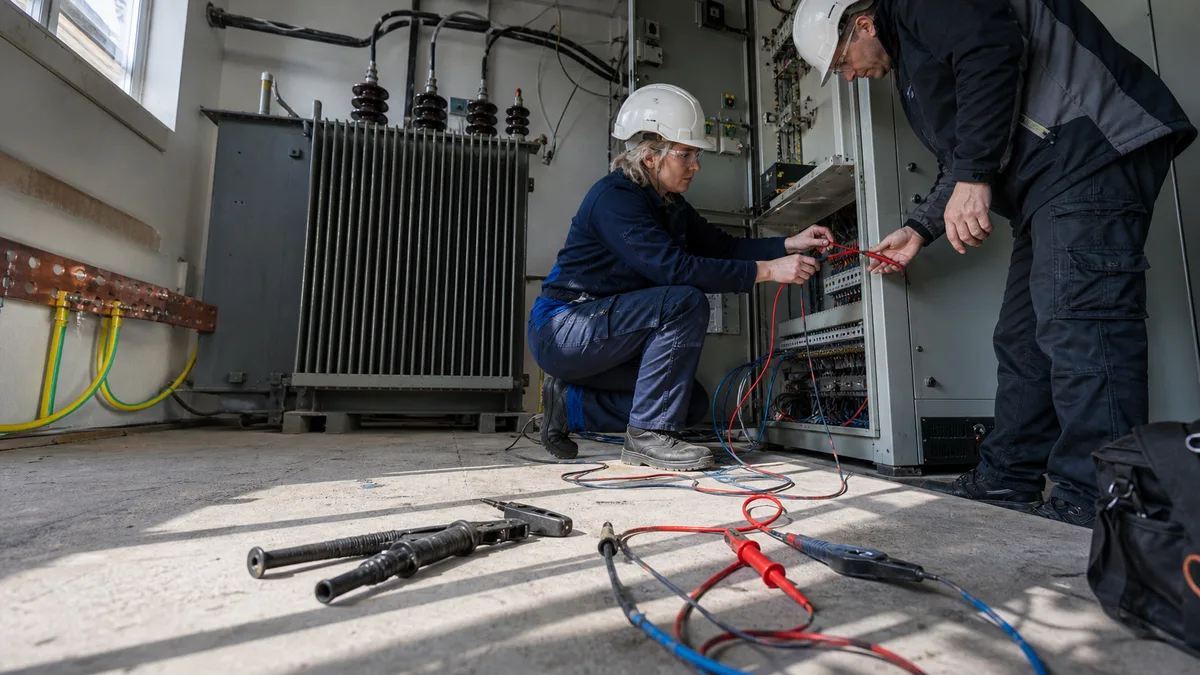
The enquiry arrives in November and sounds straightforward: we need our transformer substation inspected, please send us a quote. Attached is a photo of a brick enclosure by the fence. Six weeks remain until the end of the year, production runs three shifts, and nobody at the company knows exactly where the distributor’s cable ends and yours begins.
For a customer-owned 22/0.4 kV substation, the question is almost never whether to carry out the inspection. Three other questions matter: exactly what will be inspected, when the work can fit into a shutdown and what documents the technician will have on arrival. Both the price and the duration of the outage depend on these factors—not on the voltage printed on the rating plate.
We will examine the ownership boundary, how the inspection interval is determined, what qualifications the technician must hold, what can be completed while the installation remains energised, what requires a shutdown—and what to compare in both the quote and the report so that two similar prices do not pay for two different jobs.
First establish where the distributor’s equipment ends and yours begins
A transformer substation is not just a transformer. It is a chain: the HV supply—a cable loop or an overhead line with a downlead—HV switchgear with switch-disconnectors or circuit breakers, metering, protection, the transformer, the main LV switchboard, power factor correction, the earthing system and auxiliary circuits, including station service supplies, signalling, lighting and remote control.
Some of these assets may belong to the distribution system operator. At kiosk and indoor substations on customer premises, the distributor commonly owns the cable and its terminations, and sometimes the incoming switchgear panel. The ownership boundary may lie at terminals that cannot be seen without opening the panel. Its exact location is specified in the connection agreement or operating agreement—documents based on zákon č. 458/2000 Sb. (the Czech Energy Act).
Without a defined boundary, two quotes may look identical while covering different parts of the substation. More importantly, it is impossible to agree on the crucial point: who will operate which equipment on the day of the shutdown.
The interval is determined by the facility, environment and documentation—not the voltage
The most common statement in an enquiry is: “We have a brick-built substation, so the interval is five years.” That is not how it works.
The intervals for periodic inspections of designated electrical equipment are set out in nařízení vlády č. 190/2022 Sb. and its annex—but you will not find a row labelled “22/0.4 kV transformer substation.” The tables are organised by the purpose of the facility, the type of space and external influences. The specific interval is therefore derived from two items that the operator should have readily available: the external influences determination report for the substation area and the purpose served by the facility. If several criteria apply to the equipment, the shortest interval is generally used in practice.
This has several inconvenient consequences. A switchgear room at an industrial site is assessed differently from a substation in an office building, even if both are built of brick. An outdoor kiosk exposed to persistent moisture, dust or corrosive conditions is subject to a stricter regime than a dry indoor switchgear room. If the external influences report is missing from the records, the inspection technician has no basis on which to determine the interval—the first task is then not the inspection, but obtaining the missing document.
The regulation also allows an operator with an established and genuinely followed preventive maintenance schedule to extend the interval under specified conditions. This requires documented checks, maintenance, records and evaluation—not a declaration in an email. A shorter interval required by the manufacturer of a specific item of equipment takes precedence over the general interval. We explain how intervals are determined in general, and why quotes still refer to the older table in ČSN 33 1500, in our separate article on electrical installation inspection intervals.
One more practical note about timing: for intervals longer than one year, it is common to work with the calendar year in which the interval expires, which encourages companies to postpone the inspection until December. An HV shutdown, however, must be arranged weeks or even months in advance, and few organisations have spare capacity in December—neither service companies nor the distributor’s control centre.
Who may inspect equipment above 1 kV
The qualification system for designated electrical equipment is based on zákon č. 250/2021 Sb. and nařízení vlády č. 190/2022 Sb.; professional competence in electrical engineering and the status of an inspection technician are governed by nařízení vlády č. 194/2022 Sb. The contractor must hold authorisation to work on designated electrical equipment within the relevant scope, while the person carrying out the inspection must hold an inspection technician’s certificate—also with the appropriate scope.
The word “appropriate” is the crux of the matter. A certificate is issued for a defined scope, type of equipment and voltage limit. For a customer-owned 22/0.4 kV substation, the scope must include equipment above 1 kV, meaning the E1 designation, with a voltage limit that covers 22 kV or with no limit. E2 covers equipment up to 1 kV: it is sufficient for the LV part of the substation, but not for the HV panels. The letter following the scope does not indicate an additional scope; it identifies the equipment type according to the environment: A covers equipment in areas without an explosion hazard, while B covers equipment in areas with an explosion hazard. A standard customer-owned substation therefore requires a certificate corresponding to E1A, while a substation in an area with an explosion hazard requires E1B. The specific combination is always determined by the equipment concerned and the area in which it is installed.
Ask for both the certificate and the authorisation before placing the order, and check their scope and validity rather than merely the name and stamp. More recent documents can be verified in the public register maintained by Technická inspekce České republiky.
There is also one fact that no purchase order can change: under § 101 odst. 1 zákoníku práce, i.e. zákon č. 262/2006 Sb., the employer is obliged to ensure employees’ occupational health and safety with regard to risks that could endanger their lives and health. The contractor bears contractual responsibility for its work. Responsibility for operating the substation remains with you.
What is actually checked in a customer-owned substation
The scope is determined by the substation’s design, documentation and operating conditions—no universal checklist can replace this assessment. It is nevertheless possible to identify where defects are commonly found.
HV switchgear. Customer-owned substations may use gas-insulated, air-insulated or solid-insulated switchgear, as well as combinations of these technologies. Gas-insulated models include the Schneider Electric RM6, Siemens 8DJH and ABB SafeRing and SafePlus; by contrast, the Schneider Electric SM6 is air-insulated switchgear that uses SF6 only in certain switching components. Gas-free models with vacuum switching, such as the Eaton Xiria, are also becoming more common. On gas-filled panels, the pressure or gas-density indicator on the front of the panel is crucial. This switchgear is sealed at the factory and the gas is not topped up during operation, so a pointer outside the operating range does not mean “refill it”; it means that the panel must be addressed with the manufacturer. On vacuum circuit breakers, contact wear is monitored according to the number of operations and the vacuum is verified. For a transformer panel with a switch-disconnector and fuses, a mundane but costly rule applies: if one fuse blows, the entire set must be replaced—the other two were exposed to the same fault, and their characteristics may no longer match.
Transformer. On an oil-filled transformer with a conservator, the oil level, the condition of the silica gel in the breather (blue gel turns pink when saturated, while orange gel fades), the thermometer with a maximum-temperature pointer and the Buchholz relay are checked. A hermetically sealed transformer without a conservator will not have a Buchholz relay—it is monitored by pressure and temperature protection, commonly a DGPT2-type relay. A dry-type cast-resin transformer presents different concerns: contamination of windings and cooling ducts by dust, unobstructed cooling and the operation of temperature protection with sensors embedded in the windings. A dust-covered cast-resin transformer in a dusty industrial hall loses cooling performance before anyone can detect the problem from its power consumption.
Connections and contact resistance. This is the most common silent defect. A loose or oxidised connection has higher contact resistance and heats up; the heat accelerates oxidation and insulation degradation, creating a self-reinforcing cycle. Aluminium busbars also creep beneath bolted connections—a joint tightened to the specified torque ten years ago may no longer retain that torque today. Connections must therefore be assessed not only visually, but also by thermographic inspection under load and contact-resistance measurements.
Earthing and bonding. For a substation above 1 kV, there is no single universal resistance value in ohms. The assessment concerns touch and step voltages during an earth fault, taking account of the fault-current magnitude and duration in the particular network—and Czech 22 kV distribution networks commonly operate with a resonant-earthed neutral, which fundamentally affects both. The framework is provided by ČSN EN IEC 61936-1 ed. 2 and ČSN EN 50522 ed. 2; the impedance of the earthing system is measured using an injection method with a remote electrode, not with an earth tester connected to a stake beside the door.
Protection and its settings. Digital protection relays—Schneider Sepam, Siemens SIPROTEC and ABB REF—retain their settings in memory, but memory is not evidence. The inspection verifies that the settings correspond to the documentation and the distributor’s requirements, and functionality is tested by secondary injection. Where a transformer panel is protected only by fuses, the “setting” is the selection of a fuse appropriate to the transformer rating—and it does not change automatically when demand increases.
Power factor correction. Capacitor banks age, and uncompensated power factor correction is at risk in installations with variable-frequency drives, welding equipment or PV inverters: harmonics are drawn into the bank, stages become overloaded and the capacitors fail prematurely. Detuned power factor correction with 7% reactors, with resonance at around 189 Hz, avoids this problem. It is also worth checking whether the controller is actually switching the stages it believes it is switching.
Changes since the last inspection. An easy rule to remember: anything that has changed in the company over the past three years has also changed the substation. A new PV system, battery storage, standby generator, additional chargers or a more powerful press can each alter fault levels, loading or the potential for reverse power flow—and none will add itself to the diagram.
What can be done while energised and what requires a shutdown
| Without shutdown | Typically only after the relevant section has been isolated and secured |
|---|---|
| review of documentation, diagrams and the ownership boundary | inspection of otherwise inaccessible parts of panels and feeders |
| visual inspection from safely accessible locations | insulation-condition measurements within the scope appropriate to the equipment |
| readings of load, temperature, gas pressure and signalling | inspection and measurement of earthing and bonding |
| thermographic inspection of loaded components | cleaning and checking the tightness of connections |
| review of the operating log and fault records | functional testing of interlocks, trip circuits and protection |
| compilation of missing documents and spare parts | servicing of switch-disconnectors, circuit breakers and the transformer |
The table is indicative. Whether a particular check requires the entire substation to be shut down, only one panel to be isolated or can be performed while energised depends on the work procedure, equipment design and accessibility, as determined by the person responsible for the electrical installation. Depending on the circuit configuration, some earthing and bonding measurements and functional protection tests can be completed without a site-wide shutdown.
Thermographic inspection works in exactly the opposite way from the rest of the list—it requires load, otherwise it reveals nothing. A defective connection shows itself through heat, but only while current is flowing through it; we explain what can and cannot be inferred from this in our article on thermographic inspection of switchboards. It cannot, however, replace work that can only be performed safely after complete disconnection, securing against reconnection, verifying the absence of voltage, earthing and short-circuiting, and protecting the workplace against adjacent live parts—the five steps specified in the rules for operating and working on electrical installations (ČSN EN 50110-1 ed. 4) and in the substation’s local operating safety regulations.
Another distinction often missing from quotes is that an inspection is not the same as servicing. Transformer oil analysis—water content, breakdown voltage and dissolved gases—cable diagnostics, partial-discharge measurements and complete protection testing are usually separate items. For a substation that has been operating for twenty years, it makes sense to fit them into a single shutdown. Nobody will want to arrange another one a year later.
Documents that determine both the price and the length of the shutdown
Send these before the quote is prepared. Without them, the technician will either add a contingency to the price or base it on a scope that does not match the actual substation:
- the latest inspection report and evidence that its defects have been remedied;
- as-built single-line diagrams for the HV and LV systems, not merely the original design versions;
- design and operating documentation, including the switchgear and transformer manufacturers’ instructions;
- the external influences determination report;
- the substation’s local operating safety regulations;
- the inspection, maintenance and testing schedule, or the preventive maintenance schedule where applicable;
- the connection agreement or operating agreement showing the ownership boundary;
- a list of HV panels, transformers and protection devices, including their settings;
- service reports, oil-analysis results and fault records;
- a summary of changes since the last inspection—PV systems, storage, generators and new loads.
Two of these documents are directly supported by legislation. In § 2, nařízení vlády č. 378/2001 Sb. refers to průvodní dokumentace (the manufacturer’s documentation for the specific equipment) and místní provozní bezpečnostní předpis (local operating safety regulations), which govern in particular the technological work procedures for using the equipment and the rules for the movement of equipment and employees in the workplace. Both describe your specific facility and cannot be purchased off the shelf.
Missing documentation is not a reason to postpone the job—it is a reason to disclose the issue in advance. Producing an accurate as-built diagram, locating protection settings or carrying out additional investigation will affect both the price and the duration of the shutdown. It makes a difference whether this is identified when the quote is prepared or at three o’clock in the afternoon on the day of the shutdown. We summarise what records a company should hold for its electrical equipment in our article on operating documentation for electrical equipment.
If you are not confident preparing the document list and defining the scope yourself, our electrical installation and switchboard inspection service starts with exactly this process: we review the documentation, ownership boundary and substation before agreeing on the date and scope.
How to plan a shutdown so that it does not overrun
Start two to three months before the required date. Not because of the service company—because of the distributor.
If switching affects distribution system equipment or restricts other customers, notification and approval are governed by the distribution system operator’s conditions. ČEZ Distribuce, EG.D and PREdistribuce each have their own forms and time limits, which change from time to time, so verify the current requirements directly with your distributor. Expect weeks or months rather than days.
Before the shutdown, obtain written confirmation of:
- who will perform the isolation, secure the workplace and restore the supply—you, the contractor or the distributor’s control centre;
- whether the work will be carried out under a written příkaz B and who will issue it;
- how all potential sources of reverse power will be disconnected and secured—PV systems, battery storage, UPS systems and generators;
- which inspections, repairs and measurements can fit into a single window and in what order;
- which spare parts and consumables will be available on site in advance—HV fuses, seals, silica gel and fasteners;
- who will decide whether to extend the shutdown if a serious defect is found, and by what deadline;
- how production will be restarted—which systems are energised first and which cannot tolerate a cold start.
Point three is often the weakest. PV inverters have anti-islanding protection, but relying on it while working in a secured workplace is a serious error: disconnection and securing must be physical and visible, including for batteries and UPS systems. They will not wait for your decision.
A site-wide summer shutdown is a logical time for the work—which is precisely why everyone is fully booked then. Placing the order one week before production stops generally leaves no time to prepare the full scope.
The quote and the report: what to compare and what not to accept
The voltage level does not drive the price. The key factors are the number of HV panels and transformers, the scope of the LV system and power factor correction, the required cooperation from the distributor, the duration and organisation of the shutdown, cleaning, equipment servicing, protection testing and additional diagnostics. Two quotes with the same total price may therefore cover very different work.
Ask for an itemised scope: the HV section, transformer, LV switchboard, power factor correction, earthing, thermographic inspection, the actual isolation and re-energisation, service work, travel and preparation of the inspection report—as well as everything charged separately. A single line labelled “transformer substation inspection” tells you nothing.
The same discipline applies to the deliverable. The inspection report should define the inspected equipment and the scope boundary, identify the documents and measuring instruments used, record the work performed and values measured, describe specific defects, evaluate defects from the previous report and conclude whether the equipment is capable of safe operation.
A statement that “the equipment complies,” without identifying the HV panels, transformer, measurements and scope, is not a basis for managing maintenance—it is merely a piece of paper for a filing cabinet. For every defect, you need to know three things: what it affects, why it is a problem and whether it prevents continued operation. That information determines both the budget and the next shutdown. We explain what to look for in the report and when its conclusion is unusable in our article on inspection report requirements.
Sources for this article
- Electrical installation and switchboard inspections – a service provided by SOHE.
- Electrical installation inspection intervals — how the interval is derived from the facility’s purpose and external influences, and why the older table is still cited.
- Operating documentation for electrical equipment — what records a company should have readily available for its equipment before the technician arrives.
- Inspection report requirements — what to look for in the report and when its conclusion is unusable.
- Zákon č. 250/2021 Sb. — occupational safety in connection with the operation of designated technical equipment; introduces authorisations for organisations and certificates for inspection technicians.
- Nařízení vlády č. 190/2022 Sb. — designated electrical equipment and requirements for ensuring its safety, including periodic inspection intervals; příloha č. 5 defines the E1/E2/E3 scope of an inspection technician’s certificate separately from equipment types A (areas without an explosion hazard) and B (areas with an explosion hazard).
- Nařízení vlády č. 194/2022 Sb. — professional competence for work on electrical equipment; § 8 defines the inspection technician and § 9 governs professional training and examinations.
- Nařízení vlády č. 378/2001 Sb. — § 2 defines průvodní dokumentace and místní provozní bezpečnostní předpis.
- Zákon č. 458/2000 Sb. — energetický zákon; the framework for connection agreements and the relationship with the distribution system operator.
- Zákon č. 262/2006 Sb. — zákoník práce; § 101 odst. 1 makes the employer responsible for ensuring occupational health and safety.
- ČSN EN IEC 61936-1 ed. 2, ČSN EN 50522 ed. 2, ČSN EN 50110-1 ed. 4 and ČSN 33 1500 — installations above AC 1 kV, earthing, operation of and work on electrical installations, and inspections; the standards are not freely available.
This article is for information only and does not constitute legal advice. The specific inspection, checking and servicing regime for a customer-owned transformer substation must be established according to its actual operation, the manufacturer’s documentation, the operating environment and the risk assessment.
Planning a transformer substation inspection begins with the documentation and ownership boundary, not a date on the calendar. We will review the scope of the equipment, the state of the records and the required cooperation with the distributor before telling you what can fit into a single shutdown—details are available on our electrical installation and switchboard inspection service page. Contact us through our no-obligation enquiry form or at info@sohe.cz.