
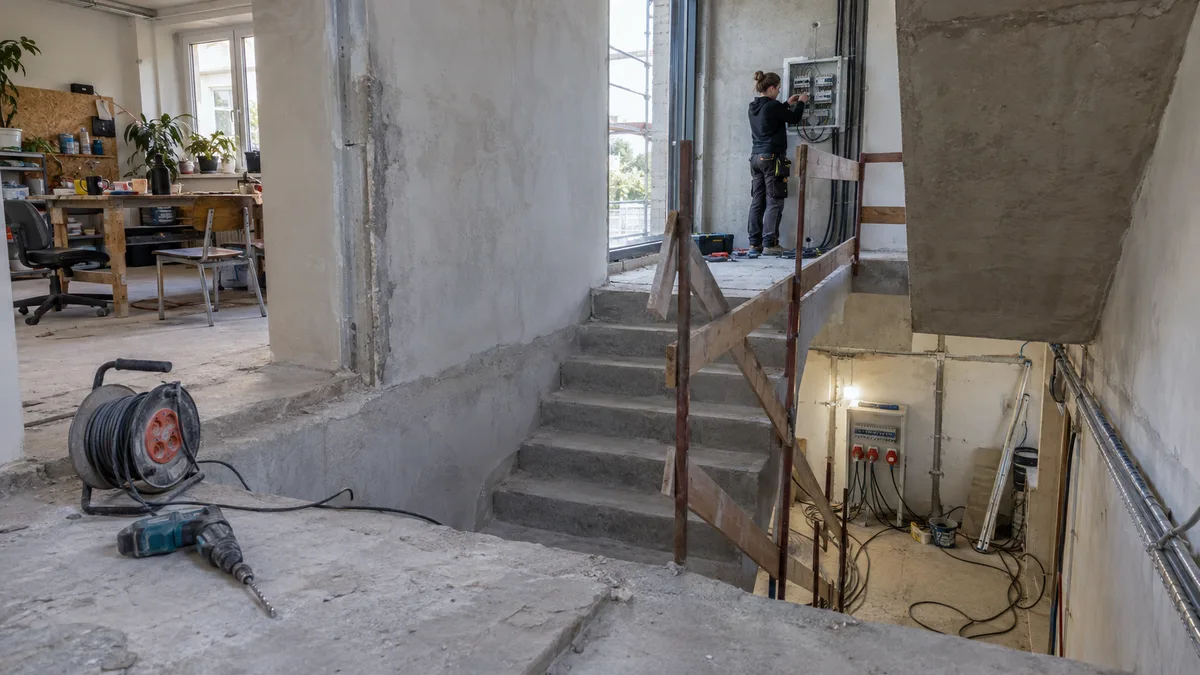
A main distribution board stands by the service connection on a construction site, a secondary distribution board has been added two floors above, and a new supply cable runs between them. Yet the inspection report in the file names only the original board. The date on its cover page may still be valid, but the report does not automatically cover the newly added part of the installation.
A similar misconception concerns extension leads and tools. An inspection of the temporary electrical installation is not a blanket confirmation that every grinder, pump, and cable reel plugged into its sockets is safe. Each group of equipment has its own inspection scope, records, and documentation.
Six months applies to temporary construction-site equipment
Annex 4 to nařízení vlády č. 190/2022 Sb. sets a maximum periodic inspection interval of 0.5 years for temporary construction-site equipment. For routine planning, therefore, allow for a six-month cycle.
The interval applies to the temporary electrical installation to the extent that it has actually been installed and documented. It may include, for example:
- the construction-site supply,
- the main construction-site distribution board,
- secondary distribution boards,
- fixed or movable parts of the temporary distribution system,
- final circuits and protective devices included in the inspection.
What matters is not the number of enclosures or the date on a single label. The decisive factor is how the equipment is defined in the inspection report. If the report identifies only the main distribution board, it cannot automatically be assumed to include a secondary board added later, a new supply cable, or a floor connected after the most recent inspection.
The manufacturer’s documentation for a new distribution board also addresses a different aspect than the initial inspection of the connected installation. The manufacturing documentation concerns the distribution board as a product; the inspection technician assesses the specific assembly after it has been connected on site.
Following wiring work, damage, flooding, or a supply cable being driven over by machinery, you should not simply wait for the next scheduled date. The affected part must be taken out of service, and the need for repair, inspection, or a new electrical inspection must be assessed according to the extent of the incident.
A distribution board, extension lead, and drill are not one unit
The temporary installation ends where separately connected work equipment begins. This distinction is important both when commissioning an inspection and when checking documentation.
| Equipment on site | What to monitor |
|---|---|
| Temporary electrical installation and distribution boards | Initial and periodic inspections within a precisely defined scope |
| Extension leads and detachable supply cables | Identification, condition, and records of inspections and repeated tests |
| Hand-held electrical tools | Inspections and tests based on use, documentation, and assessed risks |
| Equipment after repair | Safety verification after repair and before reuse |
| Hired equipment | Condition upon receipt, identification, and valid documentation for the specific item |
Hand-held electromechanical tools, electronic devices, and electrical appliances rated up to and including 400 V, provided they are not intended for permanent connection to the electrical network, as well as extension leads and detachable supply cables, are not designated electrical equipment under Section 3(2)(a) and (b) of nařízení vlády č. 190/2022 Sb. This does not mean, however, that their condition need not be monitored.
For work equipment, Section 4(2) of nařízení vlády č. 378/2001 Sb. requires a follow-up inspection at least once every 12 months, within the scope specified by local operational safety regulations, unless a special legal regulation, accompanying documentation, or standard specifies a different frequency or scope. On a construction site, the risk assessment may lead to shorter intervals because supply cables and tools are exposed to water, dust, abrasion, falls, and being driven over by machinery.
ČSN EN 50699 is used for repeated testing of electrical appliances. ČSN EN 50678 covers the verification of appliances after repair. The six-month interval for temporary equipment therefore cannot simply be applied to every extension lead and machine.
What a health and safety coordinator actually wants to see
There is no single universal form for “distribution board documentation.” A reliable set of records must connect the documentation with the actual conditions on site.
In particular, prepare:
- a current inspection report with a clearly defined scope,
- matching identification of the main and secondary distribution boards in the report and on site,
- previous reports and documentation for subsequent modifications or repairs,
- a list of extension leads and electrical tools,
- records of inspections, defects, and items taken out of service,
- a procedure for reporting defects and preventing further use of affected equipment,
- identification of the person responsible for electrical equipment operation and communication with the inspection technician,
- information about electrical risks provided to the individual contractors.
The health and safety coordinator does not replace the inspection technician and does not perform specialist measurements on their behalf. However, the coordinator may identify discrepancies between the documentation and reality: a different distribution board is present on site, additional branches have been added, the report does not identify the inspected equipment, or visibly damaged supply cables are in use.
A missing sheet in a file and an exposed live part are not the same problem. An administrative discrepancy should first be checked against the actual scope. A distribution board with a missing cover, a damaged plug, or a cable lying in water is grounds for disconnecting the affected equipment and preventing its further use until it has been professionally assessed.
What to check directly on site
An inspection does not begin with the date on a label. Start at the source and follow the entire power-supply route to the final piece of equipment.
For a distribution board, check in particular:
- legible manufacturer and asset identification,
- consistency between its identification and the inspection report,
- closure of the enclosure and the condition of doors, locks, and blanking plates,
- cracks, deformation, and signs of water ingress or overheating,
- labelling of circuits, circuit breakers, switches, and sockets,
- accessibility and clear identification of the main switch,
- secure cable entries and strain relief,
- unobstructed access to controls,
- a location suitable for the construction-site environment and operations.
Electrical installations on construction and demolition sites are covered by ČSN 33 2000-7-704. ČSN EN 61439-4 applies to construction-site distribution boards. An ordinary domestic distribution board does not become a construction-site distribution board merely because it is moved onto a site and fitted with sockets.
For extension leads, examine the sheath, plug, socket, cable connections, and strain relief. A cable should not be routed through an area where vehicles or construction machinery may repeatedly drive over it. If crossing a traffic route cannot be avoided, the protection method must be selected according to the expected load and site traffic.
H07RN-F rubber cable is a common example of a durable flexible cable for demanding conditions, but it is not a universal solution for every construction site. The appropriate type, conductor cross-section, length, and protection depend on the installation design, environment, and connected load.
What the inspection report should make clear
An inspection of designated electrical equipment under Annex 2 to nařízení vlády č. 190/2022 Sb. includes visual examination, tests, and measurements appropriate to the equipment being inspected. The report must make it possible to determine what the inspection technician actually assessed.
For a construction-site installation, therefore, look in particular for:
- identification and location of distribution boards,
- a description of supply cables and inspected circuits,
- details of the protective devices used,
- results of the measurements and tests performed,
- a list of identified defects,
- an unambiguous conclusion for the defined scope,
- the inspection date and identification of the inspection technician.
Depending on the specific installation, verification may include the continuity of protective conductors, insulation condition, conditions for automatic disconnection, wiring, and the operation of protective devices. The inspection technician determines the exact set of tests according to the wiring and protective measures used.
The statement “the construction-site distribution board complies” provides weak evidence if the document does not identify which board was inspected or whether the report also covers the supply cable, secondary distribution systems, and final circuits.
If you need the entire temporary installation assessed rather than a single enclosure, define this scope when placing the order. We can arrange an electrical installation inspection according to the number of distribution boards, branches, and the actual wiring on site.
What determines the scope and price
A request for the “inspection of one distribution board” may mean examining a single enclosure or the entire temporary installation supplied through that board. Without clarification, these variants cannot be treated as the same assignment.
The scope of work is primarily affected by:
- the number of main and secondary distribution boards,
- the number and length of supplied branches,
- the availability of diagrams and previous reports,
- modifications made since the most recent inspection,
- the ability to safely isolate individual parts,
- the number of defects and the need for repeated measurements after repair,
- a separate requirement to inspect extension leads and tools.
Attach photographs of manufacturer and asset labels, the previous inspection report, a list of secondary distribution boards, and a brief description of the modifications to your enquiry. Also state whether you require only an inspection of the temporary installation or a separate inspection of the connected equipment.
A practical regime for a smaller construction site
Assign each distribution board a unique asset identifier and use the same identifier in the inspection report, equipment list, and defect reports. Record extension leads and tools separately because the distribution board inspection does not confirm their condition.
The following procedure works well in practice:
- Before use begins, create documentation of the installation as actually connected.
- Record all main and secondary distribution boards.
- Record the date and scope of the most recent inspection.
- Submit installation modifications for professional assessment.
- Label visibly damaged equipment and take it out of service.
- After repair, request documentation relating to the specific item.
- Before the coordinator’s inspection, compare the documentation with the actual conditions on site.
The greatest savings usually come not from a cheaper stamp but from a well-prepared scope: consistent labelling, accessible distribution boards, complete documentation, and a planned shutdown agreed in advance.
Quick answer
For temporary electrical equipment on a construction site, Annex 4 to nařízení vlády č. 190/2022 Sb. sets a maximum periodic inspection interval of 0.5 years, or six months. However, the inspection report covers only the equipment and circuits included within its stated scope.
Extension leads and hand-held electrical tools must be recorded and inspected separately. Their regime is determined according to their use, accompanying documentation, applicable standards, and risk of damage.
Frequently asked questions
Must a construction-site distribution board be inspected every six months?
Annex 4 to nařízení vlády č. 190/2022 Sb. sets a maximum periodic inspection interval of 0.5 years for temporary construction-site equipment. The decisive factor is the scope of the entire temporary installation, not merely the separate distribution board enclosure.
Is a report for the main distribution board sufficient?
Only for the scope actually defined by the report. A secondary distribution board or newly added cable is not included merely because it is connected downstream of the main board.
Do extension leads have the same six-month interval?
Not automatically. Ordinary extension leads are not designated electrical equipment under Section 3(2)(b) of nařízení vlády č. 190/2022 Sb. Their inspection regime is established separately according to legal regulations, documentation, standards, and conditions of use.
Does a new distribution board replace the initial inspection?
The manufacturer’s documentation describes the distribution board as a product. It does not replace the assessment of the specific temporary installation after connection, including its supply cables, protective measures, and downstream circuits.
What should be done with a damaged extension lead?
The lead must be labelled and taken out of service so that nobody can reconnect it. After repair, its safety must be verified using a procedure appropriate to the type of equipment and work performed; simply replacing the coloured inspection label is not sufficient.
Sources for this article
- Electrical installation inspection – a SOHE service.
- Inspection, maintenance, and testing rules under NV 190/2022 – how to connect deadlines, responsibilities, and records.
- How to read an electrical inspection report – what to look for in the report’s scope, defects, and conclusion.
- Health and safety coordinator on a construction site – the coordinator’s role and its relationship to construction-site organisation.
- Nařízení vlády č. 190/2022 Sb. – designated electrical equipment, inspection content, and maximum periodic inspection intervals.
- Nařízení vlády č. 378/2001 Sb. – safe operation, use, and follow-up inspections of work equipment.
- ČSN 33 2000-7-704 – electrical installations on construction and demolition sites.
- ČSN EN 61439-4 – distribution boards intended for construction sites.
- ČSN EN 50699 – repeated testing of electrical appliances.
- ČSN EN 50678 – verification of electrical appliances after repair.
This article is for information only and does not constitute legal advice. The specific regime for a temporary installation, distribution boards, extension leads, and tools must be established according to actual operations, the manufacturer’s documentation, the operating environment, and the risk assessment.
Do you need to define the scope and arrange an electrical installation inspection on a construction site? Send us the documentation through our non-binding enquiry form or email info@sohe.cz; based on the wiring, we will separate the temporary installation inspection from inspections of extension leads and tools.