
A company’s electrical installation is something no one thinks about daily — until an inspection, an insurance claim, or a new tenant comes along, and someone asks when the last inspection was done. The answer to “how often” doesn’t have a single universal number that applies to an entire building.
The interval is determined not by the occupancy permit date or the inspection technician’s gut feeling, but by the environment the wiring operates in and the type of premises. A dry office is assessed differently from a workshop with presses, and differently again from an external circuit on a factory hall facade — and all three can easily be found under one roof.
Why Inspection Deadlines Matter at All
A regular electrical installation inspection isn’t just a formal “piece of paper for an audit.” It’s one of the few tools for detecting hidden faults early, which could lead to a fire, electric shock, or unexpected operational downtime. It is also a legal obligation of the operator.
The legal framework sits above the technical standard. Under Sections 101 and 102 of the Labour Code, an employer must ensure occupational health and safety and prevent risks; Section 4 of Act No. 309/2006 Coll., as amended, requires technical equipment to be regularly maintained, checked, and inspected. Furthermore, fixed electrical installations are typically classified as reserved electrical equipment under Act No. 250/2021 Coll. and Government Decree No. 190/2022 Coll., which set out requirements for their safe operation.
If you are unsure whether your electrical installation inspections meet current requirements, we can help you clarify the situation.
Where the Deadlines Come From: the Standard, Not Gut Feeling
The frequency of regular inspections is not set by a technician based on mood or a sense that “it looks okay here.” The base maximum intervals are laid down in Annex 4 of Government Decree No. 190/2022 Coll.; a more detailed breakdown by environment is then regulated by technical standards — for regular inspections, ČSN 33 1500 and the ČSN 33 2000-6 series are key. ČSN 33 1500 itself is not generally binding, but it represents a recognized procedure against which compliance with obligations is assessed.
Moreover, effective from January 1, 2025, ČSN 33 2130 ed. 4 applies, adjusting the requirements for internal electrical wiring. An inspection thus also checks for compliance with this standard.
Who performs the inspection is not arbitrary either. Inspection activities are carried out by an inspection technician holding a valid certificate according to Government Decree No. 194/2022 Coll. Supervision is performed by the regional labour inspectorate under Act No. 251/2005 Coll., which can impose fines for identified deficiencies.
Overview of Regular Inspection Deadlines by Environment
The standard works with two criteria simultaneously — the environment (external influences) and the type of premises — and the stricter of the two applies. The following overview should therefore be taken as a guide, not a binding table for your specific switchboard.
| Environment or Type of Premises | Indicative Inspection Interval |
|---|---|
| Masonry office and residential buildings, basic and normal environment (dry, clean, heated) | 5 years |
| Apartment buildings – common areas | 5 years (unless otherwise specified) |
| Shops, stores and public spaces | 4–5 years |
| Outdoor circuits and covered outdoor areas | 4 years |
| Schools, kindergartens, hotels and other accommodation facilities | 3 years |
| Hot, humid, dusty environments and environments with increased corrosive aggressiveness | 3 years |
| Production halls and workshops (depending on environment) | 2–3 years |
| Assembly spaces for more than 250 people (halls, auditoriums, department stores) | 2 years |
| Environments subject to vibration and passive environments with fire or explosion hazard | 2 years |
| Timber-framed buildings and structures made of combustible construction materials | 2 years |
| Dusty spaces with non-conductive dust (wood processing, textile mills) | 2 years |
| Medical locations (surgeries, hospitals) | 1–3 years depending on zone |
| Wet environments and environments with extreme corrosive aggressiveness | 1 year |
| Mobile and transportable units | 1 year |
| Temporary construction site installations | 0.5 years (6 months) |
| Photovoltaic power plants (AC and DC parts) | According to ČSN 33 2000 and EN standards, typically 2–4 years |
The interval runs from the last inspection, not from the occupancy permit date or the date of purchase. An assessment of the condition and risks can justifiably shorten it — the standard specifies an upper limit that generally cannot be extended. Lightning conductors have their own intervals according to ČSN EN 62305 — for protection classes LPL I and II, a full inspection is required every 2 years; for LPL III and IV, every 4 years.
Why “Five Years for the Whole Building” Is Not Enough
The most common mistake of small business owners: taking the five-year deadline for an office and applying it to the entire facility. But what applies to a dry office does not apply to the workshop at the back or to the switchboard on the factory hall’s external wall. The inspection technician assesses the object piece by piece, and each part can fall into a different category.
Thus, different deadlines often coexist within a single site:
- The office part in a dry, heated environment on a five-year cycle,
- The storage mezzanine with dust and handling equipment on a shorter cycle,
- The outdoor circuit for parking lot lighting or an AC unit on the outdoor environment cycle.
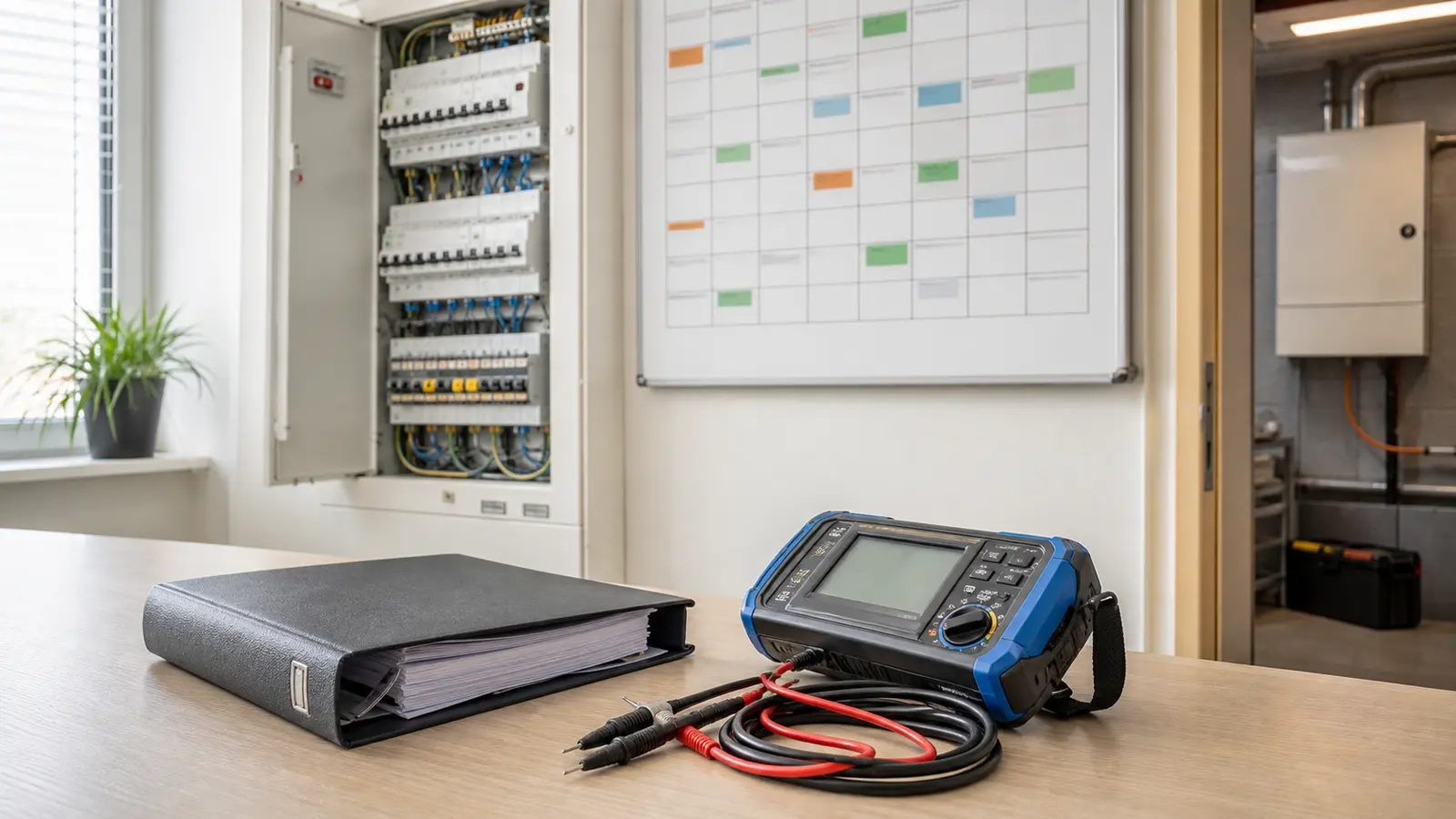
All deadlines are recorded in the inspection reports and must be tracked. That’s why maintaining an inspection schedule — a list of circuits with the dates of the last and next inspection — pays off. The article Electrical Installation Inspection in an Administrative Building gives an insight into how an administrative building itself is assessed and what the technician looks at.
What the Technician Really Assesses When Setting the Interval
The inspection technician doesn’t just evaluate the condition of the switchboard, but primarily the environment in which the equipment operates. The classification, and therefore the interval, is derived from this. Specifically, they monitor:
- Humidity and temperature. In a basement or an unheated hall with visible condensation, the insulation resistance of conductors drops, and protective conductor joints corrode — such an environment falls under shorter intervals.
- Dust levels. Settled dust impairs cooling, reduces insulation distances, and in premises with flammable dust, can ignite from a heated joint. Warehouses and production areas therefore typically have shorter intervals than an office.
- Shocks and vibration. In engine rooms, near presses and compressors, long-term vibration loosens screw terminals in switchboards; the joint’s transition resistance increases, causing it to heat up and, in extreme cases, spark.
- Mechanical stress. A cable running at a level where a forklift drives daily is riskier than a circuit in an office ceiling void — the insulation can get scuffed, and the protective conductor can break.
- Age and material of the installation. For aluminum wiring from the 1960s to 1980s, its condition and workmanship may justify an earlier check or repair — the conductor material itself does not dictate a shorter interval. This is because aluminum under terminal pressure “creeps” (deforms) over time, the joint loosens, transition resistance rises, and the joint heats up — a typical cause of faults in older pre-fab and administrative buildings.
Based on a combination of these factors, the technician sets the interval within the standard’s limits. A good technician will explain why — and if you need to align deadlines for planned shutdowns, the solution is usually to shorten the longer interval, not to extend the shorter one.
When the Deadline Starts: Initial Inspection and Renovations
The regular interval is not counted from the occupancy permit date, but from the inspection. For new or refurbished installations, the starting point is the initial inspection, which is carried out before the equipment is put into operation — the first regular inspection interval runs from its date. If the initial inspection is in January 2026 and the building falls under a five-year interval, the next deadline is January 2031. It is covered in more detail in the article Initial Electrical Installation Inspection.
For older spaces that are “just being used” without documentation, the initial inspection is often missing. The right step then is to order an inspection that documents the condition, from which the regular interval is then counted. A common misconception is: “the electrician did the inspection when they wired it up.” However, installation and inspection are two different roles — the electrician connects the equipment and verifies functionality, while a certified inspection technician under Government Decree No. 194/2022 Coll. measures, assesses safety, and issues the inspection report.
What an Inspection Report Should Contain and How to Read the Next Due Date
An inspection report is a document from which you can see not only the current state, but also when you need to repeat the inspection. The next regular inspection deadline is part of it — you’ll usually find it in the conclusion, either as an interval (“4 years”) or as a specific date (“by 03/2029”). If it’s missing, the report is incomplete. Everything an inspection report should contain is summarized in the article Inspection Report Essentials.
The report also lists any identified defects. Common defects typically don’t halt operations, but should be rectified within a deadline set according to their severity and the inspection technician’s conclusion; defects that pose an immediate safety threat mean the equipment should not be used until repaired and re-tested. The next regular inspection deadline is then set by the inspection technician based on the extent of the intervention and the equipment’s operational mode.
Who Is Responsible for Tracking Deadlines
This is the biggest pitfall in practice. Responsibility lies with the equipment operator — i.e., the company, homeowner association, municipality, or school that uses the electrical installation. Relying on the “inspector to call on their own” is not enough. The inspection technician performs an inspection on order, but the operator is responsible for tracking the deadline.
In organizations, this is usually the responsibility of the statutory representative, technical manager, or the person responsible for OHS documentation. That is precisely why it makes sense to have a system in place that tracks deadlines. As part of Occupational Health and Safety for Companies, we also offer management of an inspection schedule — so you don’t have to worry about missing anything.
The Consequences of an Expired Inspection
The consequences of an expired inspection fall into three levels, none of which are pleasant:
1. Legal and sanction level. The labour inspectorate or fire rescue service can impose a fine during an inspection under Act No. 251/2005 Coll.; its amount is based on the severity of the findings, and the upper penalty limits changed with amendments from January 1, 2026, so always refer to the current wording of the law. The absence of a valid inspection report is among the more serious findings.
2. Insurance level. If damage occurs (fire, injury) and a valid inspection is missing, the insurance company may, based on the agreed terms and conditions, reduce or refuse the payout. How the inspection certificate is viewed during an insurance claim is discussed in the article Missing Inspection and the Insurance Company.
3. Criminal law level. In the event of a serious injury or fatality, the investigation looks at whether the operator fulfilled their duty to ensure safe operation — and the inspection certificate is one of the documents reviewed.
Electrical Installations, Appliances, PV Systems, and Lightning Rods — Four Different Inspections
An inspection of a fixed electrical installation does not cover everything powered by electricity in a company. The following have separate regimes — with their own deadlines, standards, and reports:
- Appliances and hand tools (kettles, chargers, extension cords, drills) according to ČSN 33 1600 ed. 2,
- Rooftop photovoltaics as electrical equipment requiring its own inspection of both the DC and AC parts,
- Lightning rod and lightning protection system according to ČSN EN 62305, with intervals derived from the protection class.
For lightning protection, a new edition ČSN EN IEC 62305 ed. 3 is also being published from autumn 2025; it runs concurrently with ed. 2 until 31. 10. 2027, after which ed. 3 applies exclusively.
Don’t confuse them: an appliance inspection and a fixed installation inspection are two different things, and one does not replace the other. Each has its own interval and its own report, and they are tracked separately.
How to Keep Your Inspections Under Control
The solution is simple: have one reliable partner who understands both electrical systems and occupational safety and will manage deadlines and documentation for you. At SOHE, we do it this way — we handle inspections for electrical installations, lightning rods, appliances, and PV systems under one roof. When you add OHS and Fire Protection, you eliminate the need to coordinate multiple suppliers, and the individual documents align with each other.
Prices depend on the scope — a smaller facility or office might start from approximately CZK 2,500, with larger sites priced according to the number of circuits and switchboards. An inspection of a single switchboard starts at roughly CZK 1,000. We always give you the exact price upfront after a non-binding inquiry.
Article Sources
- Electrical Installation Inspections – SOHE service.
- Electrical Installation Inspection in an Industrial Hall – stricter regime in production and warehouses.
- Switchboard Inspections – the switchboard as the core of every electrical installation inspection.
- Act No. 262/2006 Coll., as amended – Labour Code; Sections 101 and 102.
- Act No. 309/2006 Coll., as amended – Section 4 requires regular maintenance, checks, and inspections of technical equipment.
- Act No. 250/2021 Coll., as amended – safety of operation of reserved technical equipment.
- Government Decree No. 190/2022 Coll., as amended – reserved electrical equipment and requirements for their safety.
- Government Decree No. 194/2022 Coll., as amended – professional competence; who is authorized to perform inspections.
- Act No. 251/2005 Coll., as amended – on labour inspection; supervision and sanctions.
This text is for informational purposes only and does not replace a legal opinion. The specific inspection regime must be set according to actual operations, manufacturer documentation, the environment of use, and a risk assessment.
Would you like to check if your inspections are in order or align deadlines into a single schedule? Reach out via our non-binding inquiry, at info@sohe.cz, or call +420 724 689 762. We’ll go through your circuits and set the next deadlines tailored to your operations.