
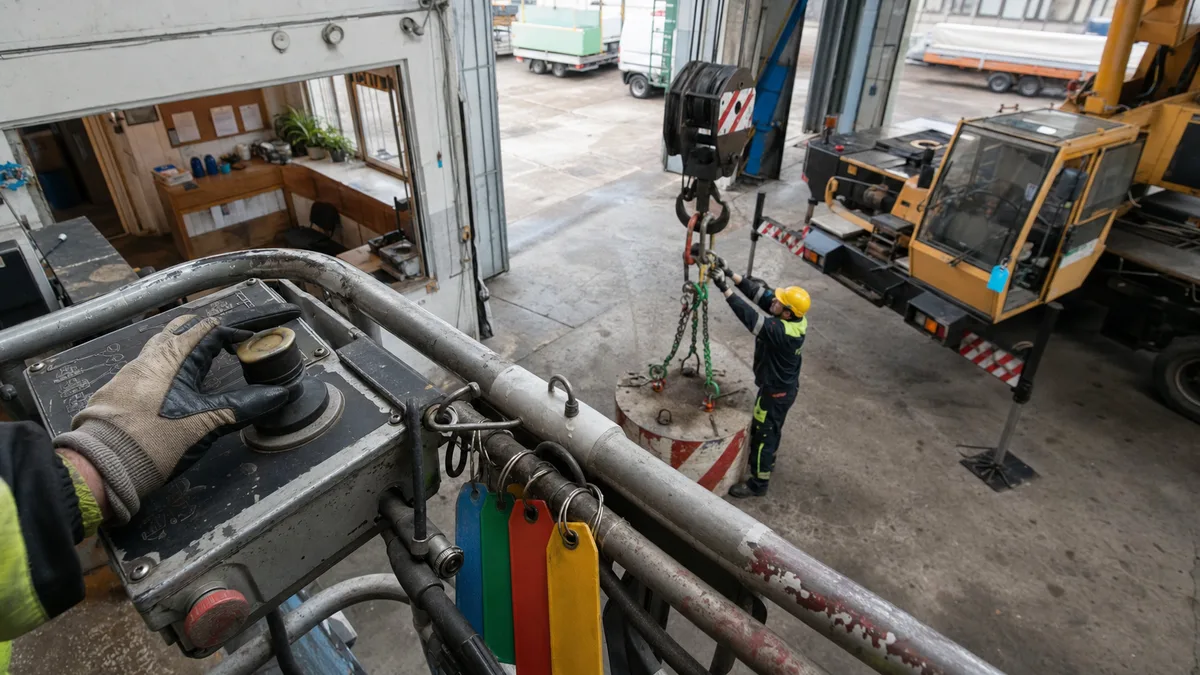
The short answer: The intervals for inspections, checks, examinations and tests of reserved lifting equipment are set out in Annex 2 to nařízení vlády č. 193/2022 Sb., as amended by nařízení vlády č. 175/2024 Sb. (version effective from 1 July 2024). For cranes and hoists, the intervals are based on the crane group: Group 1 requires an examination every four years and a test every eight years, while Group 4 requires an examination annually and a test every two years. For tower, mobile, loader and cable cranes, the annex specifies an examination once a year and a test once every two years. Mobile elevating work platforms and construction hoists require an operator inspection at the start of each shift, a check at intervals not exceeding three months and a test once a year. The accompanying documentation may require shorter intervals. These intervals do not change on 1 January 2026 — e-Sbírka records no more recent version of the regulation. What changes from 1 January 2026 is something else: Annex 1 to vyhláška č. 79/2013 Sb. expressly lists hoist operators and people who conduct examinations and tests among those performing work involving a risk to health.
An overhead travelling crane hangs in the workshop, a powered hoist is mounted beside the assembly bench, a scissor lift stands in the yard and a construction hoist operates on the building site. The owner entered all of them in the examination plan under a single line: “lifting equipment — examination once a year”. That is not a safe approach in either direction. For some equipment, an annual interval is unnecessarily strict; for other equipment, it overlooks quarterly checks and inspections performed by the operator during every shift.
Classify the equipment first, then determine the intervals
An interval can only be assigned once you know whether the equipment qualifies as reserved lifting equipment at all and which group it belongs to. The load-capacity and lifting-height thresholds, as well as the distinction between an equipment class and a crane group, are discussed in our article explaining what does and does not qualify as reserved lifting equipment. Equipment not covered by nařízení vlády č. 193/2022 Sb. is subject to a different regime — subsequent checks under nařízení vlády č. 378/2001 Sb. This article deals only with the second part: the intervals assigned to the individual items in Annex 2.
Cranes and hoists: the crane group is decisive
Item 2 of Annex 2 applies to cranes and hoists, including powered hoists with a load capacity exceeding 1,000 kg and manually operated hoists with a load capacity exceeding 5,000 kg. Table 1 under this item links the intervals to the crane group, which is determined by the load spectrum factor and class of utilization:
| Crane group | Factor | Class of utilization | Examination | Test |
|---|---|---|---|---|
| 1 | 0.125 | Q0 to Q2 | 4 years | 8 years |
| 2 | 0.25 | Q3 | 3 years | 6 years |
| 3 | 0.50 | Q4 | 2 years | 4 years |
| 4 | 1.00 | Q5 | 1 year | 2 years |
The difference is eightfold. A crane used in a workshop a few times a month and an equally large crane operating three shifts a day in a foundry should not have the same deadline in the plan. This is determined by their classification, not by personal opinion. The classification follows from the design and operational loading; the accompanying documentation and an assessment of actual operation provide the basis.
Item 2 expressly permits shorter intervals to be set on the basis of the accompanying documentation. A shorter interval specified in the manufacturer’s instructions therefore takes precedence over the longer interval in the table, never the other way around.
Special regimes for selected cranes
Not everything is governed by the group table:
- Tower, mobile, loader and cable cranes (item 2.2): examination once a year and tests once every two years. For these cranes over 14 years old, the annex requires only a test once a year.
- Stacker cranes with a vertically moving operator position (item 2.4): examination once a year and tests once every two years.
- Environment (item 2.3): the intervals must take the operating environment into account. The external influences assessment report provides the basis, as it does for electrical installations.
- Inspections and checks between examinations (items 2.5 and 2.6): an inspection at the start of every shift before use, plus checks at three-month intervals between examinations and tests.
- Relocation (item 2.7): a crane dismantled before relocation may only be put into operation after a test has been performed.
Platforms, construction hoists and stacker cranes
For the other items in the annex, the intervals are linked directly to the equipment type rather than to a group:
| Equipment type | Operator inspection | Check | Examination | Test |
|---|---|---|---|---|
| Cranes and hoists (item 2) | at the start of every shift | every 3 months | 1 to 4 years depending on the group | 2 to 8 years depending on the group |
| Tower, mobile, loader and cable cranes (2.2) | at the start of every shift | every 3 months | 1 year | 2 years; for cranes over 14 years old, only a test once a year |
| Stacker cranes with a vertically moving operator position (2.4) | at the start of every shift | every 3 months | once a year | once every 2 years |
| Powered mobile elevating work platforms with a lifting height exceeding 1.5 m (item 3) | visual inspection and functional test by the operator every day or at the start of the shift | routine inspection at intervals not exceeding 3 months | not specified separately under this item — check the annex for your equipment type | once a year |
| Construction hoists for transporting people and loads (item 4) | daily operator inspection | according to the manufacturer’s instructions, at intervals not exceeding 3 months | not specified separately under this item — check the annex for your equipment type | at least once a year; after dismantling and relocation, only after a test |
| Stacker cranes with vertically moving operator positions and their transfer cars (item 5) | daily inspection | at intervals not exceeding 3 months | between tests, at the intervals specified by the manufacturer, but at least once a year | check the annex for the interval applicable to your equipment type |
For stacker cranes, item 5.3 also determines the scope of the examination — according to the manufacturer’s instructions or the local operating rules. These rules are therefore not merely paperwork filed away in a binder; they are the document on which the examination technician bases the work. Take care with the terminology as well: a construction hoist under item 4 is not a passenger lift permanently installed in a building. Such lifts are subject to a different regime, described in our article about lifts in apartment buildings.
Change from 1 January 2026: medical examinations for operators and examination technicians
Nařízení vlády č. 193/2022 Sb. itself does not change on 1 January 2026 — its latest consolidated version dates from 1 July 2024, following the amendment introduced by nařízení vlády č. 175/2024 Sb., and the interval table remains unchanged. However, from January 2026, the lifting-equipment agenda is also affected by vyhláška č. 79/2013 Sb., on occupational health services, as amended by vyhláška č. 449/2025 Sb. In Annex 1, Part II, item 2, the existing wording “Crane operators” is supplemented by “and manually and power-operated hoists”, with a footnote referring directly to nařízení vlády č. 193/2022 Sb. The end of the item also adds “persons performing examinations and tests of reserved technical lifting equipment”.
Part II of the annex covers work involving a risk to health for which medical examinations are performed regardless of the work category. The item therefore now expressly includes hoist operators and the examination technicians themselves. This does not, however, create an automatic medical examination deadline on 1 January 2026: the amendment contains its own transitional provision, while the frequency and scope of examinations are determined by vyhláška č. 79/2013 Sb. — confirm the requirements for the specific classification with your occupational health service provider. The connection with work categorization and the information included in a medical examination request is discussed in our article on work categorization.
The authorized organization now provides education — and charges for it
The second change took effect two months earlier and concerns contractors. Zákon č. 318/2025 Sb. added a new point (h) to § 6 odst. 1 zákona č. 250/2021 Sb. The authorized organization now provides educational activities and issues certificates of completion; under § 14 odst. 1, the fee for this activity may not exceed CZK 4,100, while a fee of up to CZK 200 may be charged for each page of a duplicate certificate. This part of the amendment took effect on 1 November 2025, not in January 2026. For operators, this is primarily a budgeting consideration rather than a new obligation, as the contractor’s costs will be reflected in the price of examinations and training.
How to turn the requirements into entries in your plan
The table becomes useful only after the requirements have been assigned to specific machines:
- Inventory based on equipment plates. Manufacturer, type, serial number, year of manufacture, load capacity, lifting height and drive type. Classification cannot be completed without these details.
- Classification. Is it reserved lifting equipment under NV č. 193/2022 Sb., or other work equipment? Cranes must also be assigned to Group 1 through 4.
- Documentation. The accompanying documentation and external influences assessment report — both may require a shorter interval.
- Four columns, not one. Record separate deadlines for the operator inspection, check, examination and test, together with the responsible person.
- Entry in the annual plan. Lifting equipment should appear in the 2027 examination plan as separate entries with serial numbers, not as a single item labelled “lifting devices”.
Whether the plan is adequate comes down to step 4. An annual examination entered in the calendar without quarterly checks and records of pre-shift inspections provides an incomplete record of operation.
Frequently asked questions
Can we extend the interval from the table if we hardly ever use the crane?
Low utilization is already reflected in the crane’s group classification and therefore in the interval specified by the table. The rules allow intervals to be shortened on the basis of the accompanying documentation, but not extended. Discuss any disputed classification with the examination technician.
Who performs the quarterly check — a technician or our maintenance employee?
A check performed between examinations and tests is not the same as an examination. Its scope and the required competence depend on the equipment type, the manufacturer’s instructions and the local operating rules. The schedule should name the person responsible for performing it rather than simply stating “maintenance”.
We bought an older crane together with an examination report. Can we continue operating it until the deadline stated in the report?
The interval relates to the equipment and its operation, not to the delivery note. Item 2.7 also becomes relevant after relocation: a crane dismantled before relocation may only be put into operation after a test has been performed.
Sources for this article
- Occupational health and safety for businesses – a SOHE service.
- Reserved lifting equipment in a business: what is and is not included – load-capacity thresholds, equipment classes, contractor authorizations and certificates.
- Checks of machinery and technical equipment under NV 378/2001 Sb. – the regime for equipment not classified as reserved equipment.
- 2027 examination plan – an overview of intervals for electrical systems, lightning protection and occupational health and safety in one place.
- Work categorization – the connection with occupational medical examinations.
- Nařízení vlády č. 193/2022 Sb. – on reserved technical lifting equipment, as amended by nařízení vlády č. 175/2024 Sb.; latest version effective from 1 July 2024, Annex 2 (items 2 to 5 and Table 1). As of the verification date, e-Sbírka records no more recent version.
- Zákon č. 250/2021 Sb. – on occupational safety in connection with the operation of reserved technical equipment, as amended by zákon č. 318/2025 Sb. (version effective from 1 November 2025); § 6 odst. 1 písm. h), § 13 odst. 1 písm. p) and q), § 14 odst. 1.
- Zákon č. 318/2025 Sb. – amendment dated 23 July 2025; the part amending zákon č. 250/2021 Sb. concerning the educational activities of the authorized organization and the associated fees took effect on 1 November 2025.
- Vyhláška č. 79/2013 Sb. – on occupational health services, as amended by vyhláška č. 449/2025 Sb. (version effective from 1 January 2026); Annex 1, Part II, item 2.
- Nařízení vlády č. 378/2001 Sb. – detailed requirements for the safe operation and use of machinery and technical equipment.
The legal position was verified against e-Sbírka on 29 August 2026.
This article is provided for information only and does not constitute legal advice. The specific regime for inspections, checks, examinations and tests of lifting equipment must be established according to actual operating conditions, the manufacturer’s documentation, the operating environment and the risk assessment.
Do you operate a crane, hoist, platform or construction hoist and need to determine the next deadline? As part of our occupational health and safety services for businesses, we will review the equipment plates and documentation on site, classify the equipment and provide a schedule covering all four types of activity and the responsible persons. We can also include the topic in your employee training. Send us a non-binding enquiry or email info@sohe.cz.