
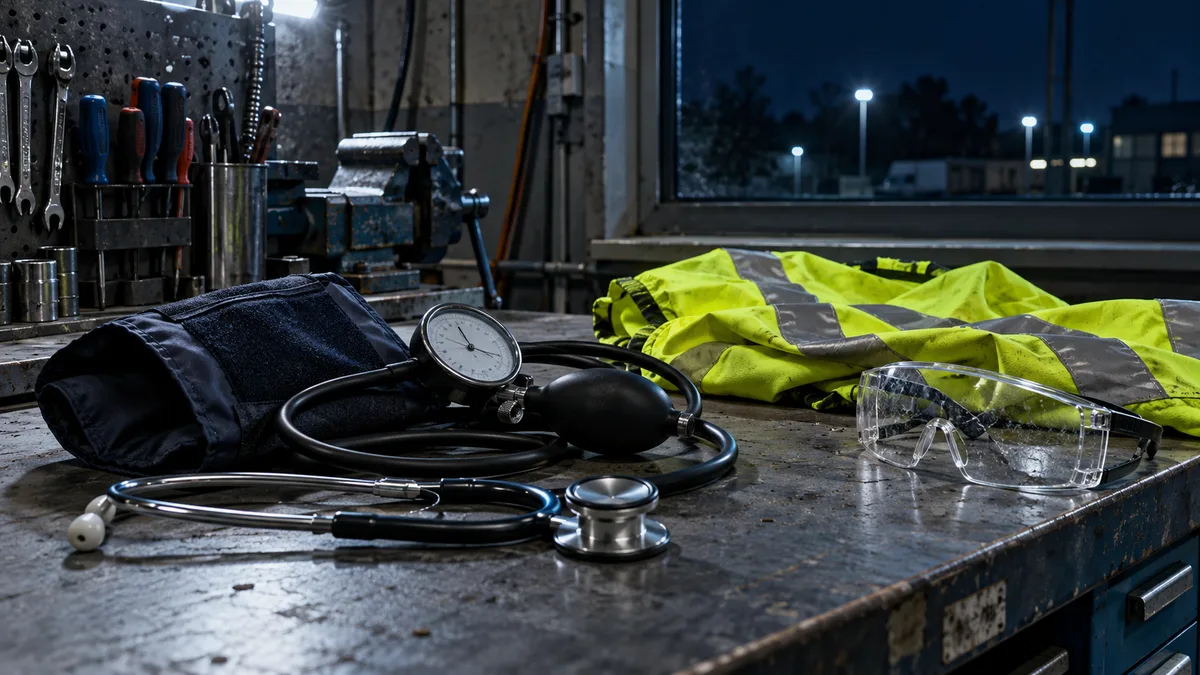
An e-commerce warehouse adds a night shift before Christmas, or a factory moves from two-shift to three-shift operation. The HR manager handles schedules and shift premiums, but the same change also raises OHS questions: who qualifies as a “night worker” under the law, who must see a doctor before their first night shift, how long the shift may be, and what must be available at the workplace after 10 p.m.
The answers are found mainly in § 94 of Zákoník práce (Zákon č. 262/2006 Sb.) and in Vyhláška č. 79/2013 Sb., o pracovnělékařských službách.
Night work and being a night worker are not the same
Zákoník práce distinguishes between two terms in § 78 odst. 1:
- night work (písm. j) is work performed during night-time, defined as the period between 10 p.m. and 6 a.m.,
- night worker (písm. k) means an employee who works at least 3 hours of their working time during night-time within a period of 24 consecutive hours, on average at least once a week during the period specified in § 94 odst. 1, which may not exceed 26 consecutive weeks.
Under § 96 odst. 1, the employer keeps records of the beginning and end of night work for everyone who performs it. However, the duties under § 94—concerning shift length, medical examinations, and workplace facilities—apply specifically to night workers.
| Shift schedule | Hours between 10 p.m. and 6 a.m. | Classification under § 78 odst. 1 |
|---|---|---|
| 6:00–14:30 | 0 | no night work |
| 14:00–22:30 | 0.5 | night work, but below the 3-hour threshold |
| 18:00–2:00 | 4 | night worker if this occurs on average at least once a week |
| 22:00–6:30 | 8 | night worker, subject to the same average-frequency requirement |
| 19:00–7:00 (12-hour shifts) | 8 | night worker, subject to the same average-frequency requirement |
A warehouse worker who works five nights every other week under a rotating schedule meets the average-frequency requirement. A maintenance technician who covers a night-time stocktake once a month generally does not average one night per week. Classification should therefore be based on the actual schedule over the entire averaging period, not on the job title.
Shift length: 8 hours or an average over 26 weeks
Under § 94 odst. 1 of Zákoník práce, a night worker’s shift may not exceed 8 hours within a period of 24 consecutive hours. Where operational reasons make this impossible, the employer must schedule the prescribed weekly working time so that the average shift length does not exceed 8 hours over a period of no more than 26 consecutive weeks. The law requires the average to be calculated on the basis of a five-day working week.
The law therefore does not rule out 12-hour shifts, but the operational reason and a schedule showing the average over the selected period should be documented. Under § 99, the employer must discuss measures relating to night work and OHS in advance with the trade union where one operates at the employer.
Medical examinations: pre-employment, periodic, and the referral
Under § 94 odst. 2 of Zákoník práce, the employer must ensure that a night worker is examined by an occupational health service provider in the cases and under the conditions laid down by Zákon č. 373/2011 Sb., o specifických zdravotních službách. The employer may not require the employee to pay for these services.
The specific conditions are set out in Vyhláška č. 79/2013 Sb. (current wording effective from 1 January 2026). In příloha č. 1, část II “Profesní rizika”, bod 10 covers night work performed by night workers under § 78 odst. 1 písm. k) of Zákoník práce. Conditions that the annex identifies as excluding medical fitness include, for example, seizure and collapse disorders or serious cardiac and respiratory diseases with an adverse prognosis. Conditions for which fitness may be confirmed only following a specialist examination include serious sleep rhythm disorders, regular long-term use of sleeping pills or sedatives, and serious metabolic disorders, including diabetes. Both pre-employment and periodic examinations include a basic examination.
Pre-employment examination. Under § 59 odst. 1 písm. b) of Zákon č. 373/2011 Sb., the employer must always arrange a pre-employment examination where the work is to include an activity for which an implementing regulation issued under § 60 lays down medical fitness requirements—in this case, Vyhláška č. 79/2013 Sb. The examination takes place before the employment relationship begins. A specific exception applies to payment: under § 59 odst. 2, the prospective employer must always pay for a pre-employment examination for night work, even if the applicant ultimately does not take up the position.
Periodic examination. The general interval for work involving an occupational risk under § 11 odst. 3 of the regulation is once every 4 years, or once every 2 years from the age of 50. Under § 11 odst. 4, however, this interval does not apply where příloha č. 1 provides otherwise—and for night work, the annex specifies a periodic examination once every 2 years, regardless of age. If the person also performs work in a category with a shorter interval, follow the shorter interval. Under § 11 odst. 5, periodic examinations must also be performed for the same work carried out under an agreement outside an employment relationship where it involves an occupational risk.
An existing employee moves to night work. From 1 January 2026, the regulation classifies transfer to different work under different conditions as a reason for an extraordinary examination (§ 12 odst. 1 písm. d) and § 12 odst. 2 písm. g); under § 10 odst. 2, a pre-employment examination continues to be performed before a change in the type of work. The occupational health service provider will determine which examination the specific change requires—the amendment is discussed in detail in the article on occupational health examinations from 2026. As a practical recommendation, send employees to the doctor before their first night shift, not after it. Under § 103 odst. 1 písm. a) of Zákoník práce, an employer must not allow an employee to perform work whose demands are inconsistent with the employee’s abilities and medical fitness.
What to include in the referral. Under § 15 odst. 1 písm. c) of the regulation, the referral must include, among other details, the weekly working time, working-time arrangement, and shift length. For night operations, provide specific information, such as “continuous operation, 12-hour shifts, alternating day and night shifts.”
Extraordinary examination and unfitness for night work
Under § 12 odst. 1 písm. a) of the regulation, an extraordinary examination is also performed where there are reasonable grounds to believe that medical fitness has been lost or changed. Under § 12 odst. 3 písm. a), it may be performed following a referral from the employer, either on the employer’s own initiative or at the employee’s request.
In night operations, the shift supervisor is often the first to notice a change: an operator repeatedly falls asleep at the production line, a forklift driver returns after a serious illness, or an employee reports that they have started taking sleeping pills regularly. The supervisor does not make a diagnosis, but should know who must be notified and who issues the referral. Under § 101 odst. 2 of Zákoník práce, responsibility for OHS is an integral part of the duties of managerial employees at every management level—including the night-shift supervisor. The article on OHS training for managerial employees explains how to incorporate this into their training.
If a medical opinion finds a night worker unfit for night work, the employer must transfer the employee to other work under § 41 odst. 1 písm. e) of Zákoník práce. While the employee is considered temporarily unfit for night work, § 53 odst. 1 písm. e) provides a protected period during which the employer may not give the employee notice of termination.
Pregnant and breastfeeding employees and young workers
Pregnant and breastfeeding employees, and mothers up to the end of the ninth month after childbirth. If a pregnant employee who works at night asks to be assigned to daytime work, the employer must comply under § 239 odst. 1 of Zákoník práce; under odst. 2, the same applies to an employee who is breastfeeding and to an employee who is a mother up to the end of the ninth month after childbirth. Transfer to other work at their request is also covered by § 41 odst. 1 písm. f). Under § 239 odst. 3, a compensatory benefit under separate legislation covers any reduction in earnings caused by the transfer through no fault of the employee.
Young workers. Under § 245 odst. 1 of Zákoník práce, young workers may not be employed in overtime or night work. As an exception, young workers over the age of 16 may perform night work for no more than 1 hour where this is necessary for their vocational training, under the supervision of an employee over the age of 18 where such supervision is necessary for their protection; this work must immediately follow their daytime shift. Young workers under the age of 15, or those who have not completed compulsory schooling, may not be employed between 8 p.m. and 10 p.m. either.
What must be provided directly on the night shift
Section 94 contains two duties that may appear to “take care of themselves” during the day:
- Appropriate welfare facilities, particularly access to refreshments (§ 94 odst. 3). A canteen that closes at 3 p.m. and a vending machine behind the locked doors of the administrative building are unlikely to meet this requirement.
- First-aid equipment, including means of calling emergency medical assistance (§ 94 odst. 4). In practice, this means a first-aid kit that remains accessible at night, a working telephone with a signal where the work is performed, a known address and access route for the ambulance service, and—most importantly—an answer to who will open the gate for the crew when the gatehouse is unstaffed at night.
This is complemented by the general duty under § 102 odst. 6 of Zákoník práce: depending on the type of activity and the size of the workplace, the employer must designate the necessary number of employees to organise first aid and summon the ambulance service, and must ensure their training and equipment in cooperation with the occupational health service provider. If all designated employees work the morning shift, none are available on the night shift. The article on the trauma plan explains how to document these designations, while workplace first-aid training covers the practical aspects.
What to include in the risk assessment and training
Under § 102 odst. 3 and 4 of Zákoník práce, the employer identifies and assesses risks and maintains the relevant documentation, while odst. 7 requires the employer to adapt measures to changing circumstances. Introducing a night shift is a typical example of such a change. The risk assessment should specifically address:
- fatigue and reduced alertness towards the end of the shift—whether high-risk tasks, such as operating a forklift, intervening in machinery, or working on electrical equipment, can be moved to the beginning of the shift or to daytime operations,
- lone working—who will notice that a security guard or operator in the production hall has not checked in for half an hour, and how quickly,
- availability of assistance—which incidents the shift may handle independently and when operations must be stopped,
- lighting and movement around the site—outdoor walkways, loading bays, and car parks.
For training, § 103 odst. 1 písm. f) of Zákoník práce is crucial: the employer must provide OHS information and instructions, among other situations, when an employee is transferred or working conditions change, and must keep records of them. Training under § 103 odst. 2 is also provided when the employee’s position or type of work changes and in circumstances that have or may have a material impact on OHS. Night-shift training should cover specific practical matters: who is designated to provide first aid during the shift, where the first-aid kit is located, how to call the ambulance service and provide access to the site, and what to do if a fault occurs while no maintenance staff are present. The article on OHS training for employees discusses training intervals.
Does anything change from 1 January 2027?
The version of Zákoník práce effective from 1 January 2027 has already been published in e-Sbírka. We compared all provisions cited in this article with that version, and their wording remains unchanged. Vyhláška č. 79/2013 Sb. and Zákon č. 373/2011 Sb. are cited in the wording effective from 1 January 2026.
Sources for this article
- OHS services for businesses – a service provided by SOHE.
- Occupational health examinations from 1 January 2026 – extraordinary examinations, referral requirements, and intervals by work category.
- Workplace OHS risk assessment – how to prepare the assessment and when to update it.
- Trauma plan – organising first aid and designating responsible persons for individual shifts.
- Zákon č. 262/2006 Sb. – Zákoník práce; definitions of night work and night workers (§ 78), shift length, medical examinations and facilities (§ 94), consultation with trade unions (§ 99), records (§ 96), transfer to other work (§ 41), protected period (§ 53), OHS (§ 101 až § 103), protection of female employees (§ 239), and young workers (§ 245).
- Vyhláška č. 79/2013 Sb. – o pracovnělékařských službách, in the wording effective from 1 January 2026; types of examinations, intervals, referrals, and příloha č. 1 část II bod 10 (night work).
- Zákon č. 373/2011 Sb. – o specifických zdravotních službách; § 59 on pre-employment examinations and their payment for night work.
This text is provided for information only and does not constitute legal advice. The specific arrangements for night work, medical examinations, and OHS measures must be tailored to the actual operation, the manufacturer’s documentation, the environment in which equipment is used, and the risk assessment.
Are you introducing a night shift or continuous operation? As part of our OHS services for businesses, we will review your risk assessment, first-aid arrangements, and links to medical examinations, and tailor employee training directly to night operations. Send us a no-obligation enquiry or email info@sohe.cz.