
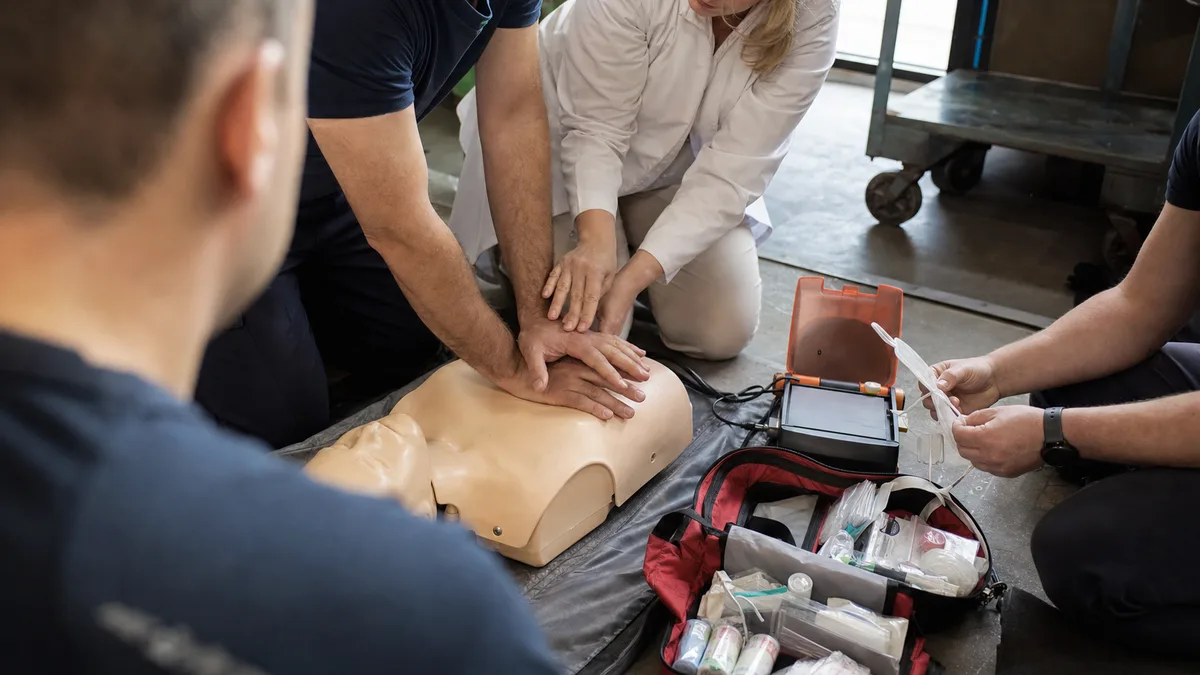
Ask who knows first aid in any company and the usual response is, “Anyone can handle it.” But when something actually happens, everyone waits for somebody else to call an ambulance. Zákoník práce anticipates this situation and addresses it simply: rather than expecting everyone to have a vague general knowledge of first aid, it requires specific, named and trained people to be present in the workplace who know what to do in a critical situation.
This is where the most common misunderstanding arises. Many companies believe they have fulfilled their duty by including a “first aid” section in standard BOZP training and placing a first aid kit in the corridor. But these are not the same thing. We will examine exactly what the legislation requires, how many people should be trained, what the training should cover, how often it should be repeated and how to document everything in case someone asks.
To answer the second part of the question in the title straight away: no legislation sets a uniform retraining interval—the employer determines it according to the risks in its operations. Anyone claiming that “the law requires it every two years” is quoting common practice, not a statutory provision.
In brief:
- Who must be trained: employees designated according to the type of activity and size of the workplace under § 102 odst. 6 zákoníku práce (zákon č. 262/2006 Sb.).
- How often training must be repeated: no legislation sets a uniform interval; the employer determines it according to operational risks.
- What the training should cover: assessing the situation and personal safety, practical CPR and severe bleeding control, emergencies associated with workplace risks, response coordination and links to company documentation.
What exactly does zákoník práce require?
The key provision is § 102 odst. 6 zákoníku práce (zákon č. 262/2006 Sb.). It requires the employer to adopt measures for dealing with emergencies and, among other things, to designate, according to the type of activity and size of the workplace, the necessary number of employees who will organise the provision of first aid, arrange for the emergency medical service, fire service and police in particular to be called, and organise the evacuation of employees.
The second part of the same provision explains how this must be done: the employer must arrange for these employees to be trained and equipped in cooperation with its occupational health service provider, to an extent appropriate to the risks present in the workplace. In addition, § 103 zákoníku práce includes arranging the provision of first aid to employees among the employer’s duties.
Three practical conclusions follow. First, the duty applies to every employer—from an office with five employees to a manufacturing facility operating three shifts; only the required scope differs. Second, the designated employees should be specific individuals, not an anonymous group described as “everyone who has been trained”. Third, their training is not merely an internal formality. It must be arranged in cooperation with the occupational health service provider—that is, the doctor with whom the company has an occupational health services contract.
Why a first aid section in BOZP training is not enough
Standard BOZP training for employees usually mentions first aid: where the first aid kit is kept, which emergency numbers to call and who the designated person is. That is appropriate—every employee should know these basics. However, this only fulfils the duty to provide information to everyone, not the duty to train designated employees under § 102 odst. 6.
The difference lies in both the depth of the training and the person’s role. A designated employee should not merely know that a first aid kit exists. They must be able to organise the provision of first aid: assess the situation, start CPR or control severe bleeding, instruct a specific person to call the emergency number, send someone else to the entrance to guide the ambulance crew, and maintain order at the scene until help arrives. This cannot be learned from a presentation—it requires practical training.
A two-tier model therefore works well in practice: all employees receive basic information as part of their BOZP training, while a smaller group of designated people complete a separate practical first aid course. During an inspection or after an actual accident, the question is not whether “everyone heard something about first aid”, but whether someone on the shift knew what they were doing.
How many people should be trained? No statutory number, but clear logic
No legislation sets a specific number or ratio such as “one first aider per twenty employees”. Zákoník práce refers to the necessary number according to the type of activity and size of the workplace—the employer must determine and be able to justify that number. A sensible guide looks like this:
| Factor | What to consider |
|---|---|
| Shifts | A designated person should be available on every shift, including nights and weekends |
| Separate workplaces | Each building, floor or remote workplace, such as a warehouse or branch, needs its own coverage |
| Absences | Allow for holidays, illness and remote work—appoint substitutes rather than relying on one person |
| Operational risks | Manufacturing, chemicals, work at height or electrical equipment increase the required number of people and the scope of their training |
| Staff turnover | If a designated employee leaves, a replacement must be appointed and trained rather than waiting for the next scheduled training cycle |
For a small office, this will typically mean two or three trained people to cover absences. Shift-based operations should have at least one or two trained people on every shift and at every workplace. The exact number should be based on a risk assessment—we explain how to prepare one in our article on company BOZP risk assessments. It is important to record the decision in writing: a list of designated employees, including the dates of their designation and training, is precisely the kind of document that matters during an inspection.
How often should the training be repeated?
As with periodic BOZP training, no legislation sets a uniform interval for repeating first aid training. The employer determines the interval according to operational risks and should record it in its internal documentation.
In practice, the most common interval is once every two years. In higher-risk operations—such as manufacturing, construction or work with chemicals—training is generally repeated once a year. The reasoning is straightforward: CPR and bleeding control are physical skills that fade without regular practice. A course completed five years ago is of little value in an emergency.
Training outside the regular schedule also makes sense:
- when a new employee is designated, for example after starting work or replacing a previous designated person,
- after a significant operational change, such as the introduction of new technology, new chemicals or a new workplace,
- after a real incident that exposed shortcomings—for example, an accident where the ambulance was delayed unnecessarily because no one knew who should do what.
Our article on workplace accidents and what to do immediately explains in detail what to do after an accident, who records it and when it must be reported to the inspectorate. First aid training is its practical counterpart: it covers the crucial minutes before the administrative work begins.
What should the training cover?
The content should reflect the risks of the specific workplace. This is why zákoník práce requires cooperation with the occupational health service provider, which is familiar with the company’s risks through occupational health examinations. A good course for designated employees usually covers:
- Assessing the situation and personal safety—first ensuring that the rescuer does not become another casualty, particularly after an electric shock or in an area with moving machinery.
- CPR with hands-on practice using a manikin, including the use of an AED if one is available.
- Controlling severe bleeding—applying a pressure dressing and practising on a model.
- Emergencies associated with operational risks—burns, chemical exposure and eye irrigation, electric shock, falls from height and choking.
- Coordinating the response—who calls 155/112, what to tell the operator, who guides the emergency crew and how to hand over the casualty.
- Links to company documentation—the emergency medical response plan containing important telephone numbers and first aid kit locations, and accident-reporting duties.
For designated employees, a presentation without practical exercises should be regarded as insufficient. E-learning can effectively cover theory and refresh knowledge, but physical skills—such as chest compressions or applying a pressure dressing—cannot be learned without hands-on practice using a manikin or model.
How to document the training
During an inspection, compliance is demonstrated with records, not recollections. It is advisable to keep the following documents together:
- written designation of the employees responsible for organising first aid, including a list of names, workplaces and shifts, the date and the employer’s signature,
- proof of training—an attendance sheet with signatures, the date, the instructor’s name and qualifications, and the course syllabus,
- the specified retraining interval in an internal policy, together with records of upcoming dates,
- evidence of cooperation with the occupational health service provider—typically an agreed scope for the training and first aid kit equipment,
- an emergency medical response plan displayed in the workplace and reflecting the actual situation, including current names and telephone numbers.
These are precisely the documents that oblastní inspektorát práce will request alongside BOZP training records. Our article on inspections by oblastní inspektorát práce explains everything such an inspection examines. An empty field marked “designated persons” is much harder to explain than a missing signature on an attendance sheet.
First aid kits: equipment is part of the duty
Equipment is also closely connected with training. Zákon č. 309/2006 Sb., o zajištění dalších podmínek BOZP, requires in § 2 odst. 1 písm. f) that workplaces be equipped, to the extent agreed with the relevant occupational health service provider, with resources for providing first aid and resources for contacting the emergency medical service.
The legislation does not prescribe a universal “statutory first aid kit contents list” for ordinary workplaces. The contents are determined according to the risks: an office may only need basic supplies, a workshop requires more dressings and wound-covering materials, and operations involving chemicals may need an eyewash station or irrigation solutions. A simple routine works well in practice: appoint one responsible person, typically a designated employee, check expiry dates twice a year and record each inspection. Expired disinfectant in a first aid kit is a minor issue, but during an inspection it can unnecessarily undermine an otherwise well-maintained set of records.
Who can provide the training and how to book it
First aid training for designated employees does not need to be organised as a separate event. The most practical option is to combine it with employee BOZP and PO training on the same date—the instructor only needs to visit the workplace once, operations are interrupted once, and all documentation is created together and consistently. Our article on the cost of BOZP and PO training explains how the price of such a training block is calculated and what to watch for when comparing quotations.
If you would like to arrange a date for your company, send us a non-binding enquiry with the number of employees, number of shifts and a brief description of your operations, such as office, manufacturing or warehouse work and any chemicals used. We will propose an appropriate scope—including how many designated people make sense for your workplace, what the practical exercises should cover and how the training will connect with your documentation, including the emergency medical response plan.
Frequently asked questions
How often should first aid training be repeated?
The law does not set an interval—the employer determines it according to operational risks and will usually record it in its BOZP documentation. In practice, offices often use a two-year interval, while higher-risk operations, such as manufacturing, chemical work, work at height and isolated workplaces, repeat the training annually. The key is for the chosen interval to be justified and then consistently observed by the company.
Is a first aid section in standard BOZP training sufficient?
For ordinary employees, yes; for designated employees, no. Under § 102 odst. 6 zákoníku práce, designated employees must receive training appropriate to the workplace risks, arranged in cooperation with the occupational health service provider. A general section within group training usually fails to meet this requirement because it does not include practical exercises.
How many employees must we designate?
The law does not specify a number. It must be determined according to the type of activity and size of the workplace so that a designated employee is available on every shift and at every separate workplace. As a practical guide, it is better to have two people per shift than one, because that one person may be on holiday or visiting a customer.
Must the training be delivered by a doctor?
The law states that the employer must arrange the training in cooperation with the occupational health service provider—it does not say that the instructor must be a doctor. The practical part is commonly led by a paramedic or another suitably qualified instructor. What matters is that the content reflects the risks in your operations and that compliance can be documented.
What if an accident occurs and no designated employee is present?
Apart from the harm to the injured person, this also creates a problem during an inspection. This is exactly what the inspectorate will examine: whether designated employees were available at the time of the accident. The number and distribution of designated people should therefore reflect the company’s shifts and separate workplaces, not merely its total number of employees.
Sources for this article
- Employee training – a SOHE service providing on-site BOZP, PO and first aid training.
- BOZP training for employees: when to repeat it and what it should cover – general BOZP training that includes a first aid section.
- Workplace accidents: what to do immediately – procedures after an accident, the accident register and reporting requirements.
- Zákon č. 262/2006 Sb., zákoník práce – § 102 odst. 6 (designation and training of employees responsible for organising first aid), § 103 (arranging the provision of first aid and employee training).
- Zákon č. 309/2006 Sb. – workplace requirements, including equipment for providing first aid and contacting the emergency medical service.
The legal position was verified as of 24 July 2026; both acts were consulted as amended. The legislation sets neither a retraining interval for first aid training nor uniform first aid kit contents for ordinary workplaces. The employer determines both according to the risks, with the equipment being agreed in cooperation with the occupational health service provider.
This article is for informational purposes and does not constitute legal advice. The appropriate number of designated employees, training content and first aid kit equipment must be determined according to the actual operations and risk assessment.
Unsure how many people to train or how to document first aid training? We can provide employee training covering BOZP, PO and first aid in a single on-site session—including practical exercises and documentation that will stand up to an inspection. Send us a non-binding enquiry or email info@sohe.cz, and we will arrange a date that suits your shifts, with everything covered in a single session.