
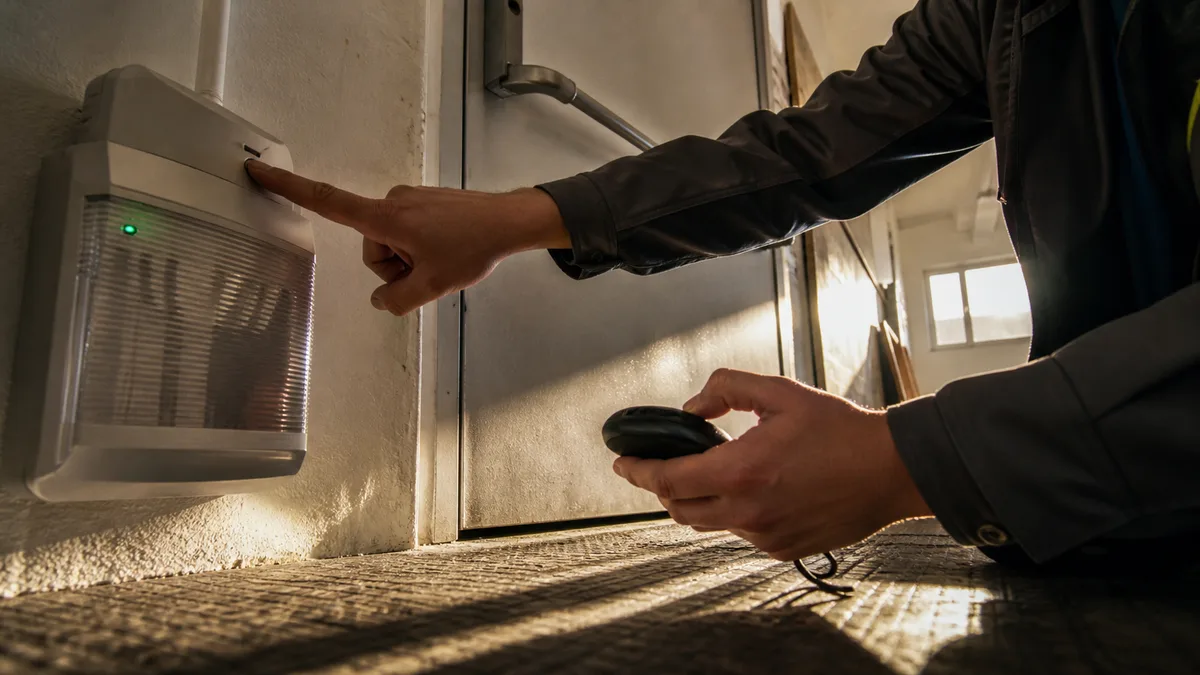
The green indicator above the emergency exit is on. The invoice for last year’s “inspection” is safely filed away. Yet the emergency lighting may still fail—the indicator on most luminaires merely shows that charging current is flowing to the battery, not that the battery will last for the duration the system was designed to provide. Only one thing reveals the difference between “it lights up” and “it lasts”: a test for the full rated duration.
Terminology adds another layer of confusion. An order for an “emergency lighting inspection” may cover three distinct activities, each with different deadlines and documentation. We will explain what this term can mean, which requirements come from the decree and which from the standard, what the technician should actually verify, what the inspection record must contain and how to recognise an inspection that will also stand up to scrutiny by the fire safety authority.
An “emergency lighting inspection” can mean three different things
In practice, the following are often confused:
- functional tests of individual luminaires — a brief monthly check that the system illuminates following a failure of the normal lighting,
- kontrola provozuschopnosti požárně bezpečnostního zařízení (operational readiness inspection of fire safety equipment) — an annual procedure under vyhláška č. 246/2001 Sb., o požární prevenci, with a record containing the prescribed information,
- inspection of the electrical installation and supply circuits — a separate activity performed by a qualified electrical inspection technician if required by the documentation or the intervals for periodic electrical inspections.
None of these replaces the others. A technician may verify that a luminaire illuminates when its test button is pressed without checking the battery capacity, the system’s response to a failure of the relevant lighting circuit or the condition of the installation supplying the system.
Vyhláška č. 246/2001 Sb., o požární prevenci, classifies emergency lighting as požárně bezpečnostní zařízení (fire safety equipment), specifically as equipment intended to assist the evacuation of people during a fire. The obligation to keep fire safety equipment operational follows from § 5 odst. 1 písm. a) zákona č. 133/1985 Sb., o požární ochraně. The operator must therefore be able to demonstrate operational readiness, not merely produce a service invoice.
When a business must have emergency lighting—and how to determine this
There is no universal table prescribing the same number of emergency luminaires for every office, shop or workshop. The requirements depend on the building’s požárně bezpečnostní řešení, approved design documentation, the way the building is used and the conditions of the specific operation.
The first step is therefore not to buy a few luminaires to mount above the doors. Begin by determining:
- whether emergency lighting is required by the building’s požárně bezpečnostní řešení,
- where the designated escape routes run and where they change direction, intersect or include stairs,
- the duration for which the system was designed to operate,
- whether the luminaires are self-contained, with their own batteries, or supplied by a central power source in accordance with ČSN EN 50171 ed. 2,
- which documentation and editions of the applicable standards were used to design the system.
If you do not have the documentation, request it from the building owner, facilities manager or the archive of the stavební úřad. Green pictograms on the walls do not in themselves prove that the current layout matches the approved design—after two refurbishments, the opposite is often true.
In leased premises, establish in writing who arranges the inspections and who is responsible for rectifying defects. The allocation of costs is usually governed by the lease, and silence in the agreement rarely works in the tenant’s favour. We discuss this in more detail in our article on landlord responsibilities for building inspections and fire safety.
Deadlines: what comes from the decree and what comes from the standard
The annual interval is established directly by legislation, while the shorter test intervals come from the standard. The distinction matters—and not merely as a formality.
Under § 4 odst. 1 zákona č. 22/1997 Sb., a Czech technical standard is not generally binding. It becomes binding through another legal or contractual basis. For fire safety equipment, one such link is provided by vyhláška č. 246/2001 Sb., o požární prevenci itself: § 7 odst. 2 a 4 refers to “normativní požadavky,” while § 1 písm. f) defines them as specific technical requirements contained in a Czech technical standard, compliance with which is deemed to satisfy the requirements of the decree. Standard-based requirements may also be made binding by the building’s požárně bezpečnostní řešení, approved design documentation, the manufacturer’s accompanying documentation or a contract. The intervals in the table therefore apply to the extent that one of these grounds makes them binding for the particular building; the text of the standard alone does not create a legal obligation.
| Interval | What is done | Basis |
|---|---|---|
| Daily | For a centrally supplied system, visually inspect the status indicators for power, faults and operating mode. The batteries are not discharged. | ČSN EN 50172 ed. 2—to the extent that it is binding for the building through a normative requirement under the decree, the PBŘ, documentation or the manufacturer |
| Monthly | Simulate a failure of the normal lighting for long enough to verify that all luminaires and illuminated safety signs light up. Also check that the system returns to normal operation. Keep the test brief to avoid unnecessarily discharging the batteries. | ČSN EN 50172 ed. 2—to the extent that it is binding for the building through a normative requirement under the decree, the PBŘ, documentation or the manufacturer |
| At least once a year | Perform a kontrola provozuschopnosti požárně bezpečnostního zařízení. Record the result in the inspection record. | § 7 odst. 4 vyhlášky č. 246/2001 Sb. |
| As part of the annual inspection | Test the system for its full rated duration—a discharge test, not merely switching the lights on for a few seconds. | ČSN EN 50172 ed. 2 as a normative requirement; the specific scope depends on the documentation and the manufacturer’s accompanying documentation |
| Shorter interval | If the manufacturer, approved design documentation, approved non-authorised documentation, implementation documentation or fire-risk assessment specifies a shorter interval, that shorter interval applies. | § 7 odst. 4 vyhlášky č. 246/2001 Sb., ve znění vyhlášky č. 467/2025 Sb. |
| After an alteration or repair | The scope of verification depends on the work performed. Changes to the layout, escape route, power supply or luminaire type will generally require updated documentation and new verification. | manufacturer’s documentation, design documentation, PBŘ |
One further point: a new edition of ČSN EN 50172, ed. 2, was published in January 2025. During a transitional period it applies concurrently with the older edition, which will cease to be valid on 27 May 2027. A similar overlap applies to ČSN EN 1838 ed. 2, published in April 2025, with the older edition remaining valid until 18 June 2027. The new edition introduces more detailed requirements for handover documentation and for verifying lighting parameters under ČSN EN 1838 ed. 2. Before accepting a quotation that includes “illuminance measurements in accordance with the standard,” ask the supplier to specify the edition and clause they will follow and the documents from which they derived the scope. The withdrawal dates of older editions are listed in the ČAS standards catalogue under the relevant standard.
For comparison with related obligations, the periodic electrical installation inspection intervals under ČSN 33 1500 run independently, while fire extinguisher inspections have their own procedures and records. The work can be combined into a single visit, but not into a single record.
Monthly emergency lighting functional test: step by step
The functional test is the brief monthly test. It verifies one thing: that the entire system illuminates following a failure of the normal lighting and returns to charging mode once power is restored. It does not verify battery capacity—that requires the annual test for the system’s full rated duration. The test is performed by a person appointed by the operator; ČSN EN 50172 ed. 2 refers to a competent person appointed by the operator to supervise the system, not necessarily an external technician.
Procedure under ČSN EN 50172 ed. 2:
- Schedule the test for a low-risk period. Even a brief discharge temporarily reduces battery capacity, leaving the system less resilient to another power failure until the batteries recharge.
- Simulate a failure of the normal lighting. Disconnect the supply to the relevant lighting circuits using a test device, key switch or circuit breaker, depending on how the system is wired. Pressing the test button on a luminaire verifies only that particular luminaire, not the system’s response to a circuit failure.
- Keep the test brief. It should last only long enough to walk through the premises and check every luminaire and sign. Unnecessary discharge shortens battery life.
- Walk the entire escape route. Check that every luminaire and illuminated safety sign is in the correct location, illuminated, clean, legible and unobstructed.
- Restore the normal lighting supply and verify that the system returns to normal operation.
- Check the indicators. The indicator on every luminaire must show that power and charging have been restored. For a centrally supplied system, also verify that the monitoring system works correctly.
- Enter the date and result in the operating log, including any defects found.
Self-testing luminaires perform the test automatically, leaving staff to review the stored results and reported error messages. This does not eliminate the need for a physical walk-through: an automated system cannot detect a concealed sign or a luminaire left in the wrong location after refurbishment.
Monthly functional test vs annual full-duration test
| Comparison | Monthly functional test | Annual full-duration test |
|---|---|---|
| Frequency | Once a month | At least once a year, as part of the operational readiness inspection |
| Duration | Brief—only long enough to check all luminaires and signs | For the full duration for which the system was designed; the test ends only after that period has elapsed |
| What is verified | Illumination of all luminaires and illuminated signs, their presence, cleanliness and legibility, return to normal operation and indication of charging | Everything covered by the monthly test, plus operation for the entire rated duration—thereby verifying actual battery capacity |
| What it establishes | That the system responds to a power failure | That the system will remain illuminated for as long as it was designed to |
| Condition after testing | Batteries are partially discharged and recharge quickly | Batteries are discharged; the system remains weakened until they recharge |
| Who performs it | A person appointed by the operator, following the manufacturer’s instructions | A person authorised to perform operational readiness inspections under the applicable legislation and the manufacturer’s accompanying documentation |
| Record | Date and result entered in the operating log | Inspection record containing the particulars required by § 7 odst. 8 vyhlášky, plus an entry in the operating log |
| Basis | ČSN EN 50172 ed. 2—to the extent that it is binding for the building | Annual interval under § 7 odst. 4 vyhlášky č. 246/2001 Sb.; test scope under ČSN EN 50172 ed. 2 and the manufacturer’s accompanying documentation |
If a test fails—a luminaire does not illuminate, goes out before the rated duration has elapsed or does not indicate charging after power is restored—record the defect and date in the operating log, have it rectified as soon as possible and introduce temporary measures along the affected section of the escape route until the repair is complete. Following an annual inspection, the inspection record must also state the defect and how and by when it will be rectified.
What the technician should actually verify during the inspection
Switching on each luminaire for a few seconds is not sufficient for an annual inspection. The scope follows from the legislation, normative requirements and the manufacturer’s accompanying documentation and must reflect how the system is wired.
The inspection focuses primarily on:
- activation of the system when a failure of the normal lighting is simulated,
- operation of every luminaire and illuminated safety sign,
- operation for the full rated duration, verified by a complete test rather than an estimate,
- the condition of batteries, charging and status indicators,
- mechanical damage, dirty covers and visible ageing of diffusers,
- the position and orientation of luminaires against the plan, including changes of direction along escape routes, stairs, doors and the locations of fire extinguishers and alarm call points,
- the legibility of pictograms and the correct direction of arrows,
- obstructions concealing signs or blocking light,
- the condition of the central power source, monitoring system and supplied circuits,
- the system’s return to normal operation after the test.
For escape routes, ČSN EN 1838 ed. 2 specifies a minimum illuminance of 1 lx along the centre line of the route and a start-up profile under which part of the required value must be available within a few seconds and the full value within one minute. This is why the system’s behaviour during the first few seconds is also observed, rather than only its condition after one minute.
The test button on a luminaire verifies its local transfer to battery power. It may not test the response to a failure of the lighting circuit—the precise scenario for which the system exists. The supplier must therefore know where and how to simulate the failure safely. In larger buildings, this requires coordination with an electrician and the facility’s operations team.
For automatic test systems—self-testing luminaires, central monitoring and DALI control under ČSN EN IEC 62386-202 ed. 2, implemented in accordance with ČSN EN 62034 ed. 2—the stored results and reported faults must also be evaluated. An automatic test cannot detect that new shelving has obscured a sign or that a luminaire was moved two rooms away during refurbishment.
What the inspection record must contain
A piece of paper merely stating that “the emergency lighting complies,” without identifying the equipment or providing results, is not a proper record. The required particulars of a kontrola provozuschopnosti are listed in § 7 odst. 8 vyhlášky č. 246/2001 Sb. It is useful to distinguish them from any additional records required by the documentation, manufacturer or applicable edition of the standard.
| Requirement under § 7 odst. 8 vyhlášky | What to look for in the record |
|---|---|
| Operator | Identification of the equipment operator. |
| Building | Address of the building in which the inspection was performed. The decree does not require the building’s purpose to be stated in this list. |
| Equipment | Location, kind, manufacturer’s designation and model designation; the serial number where necessary for precise identification. The year of manufacture is not among the particulars required by the decree. |
| Result | Defects found, together with the method and deadline for rectifying them. |
| Dates | The inspection date and the next inspection date—both are statutory particulars, not optional service extras. |
| Confirmation | A statement confirming the equipment’s operational readiness, with the identification and signature of the person who performed the inspection. |
In addition to the requirements of the decree, it is useful to maintain the following—and the specific documentation or applicable standard may require it:
| Document | What to look for |
|---|---|
| Operating log | Dates and results of monthly and annual tests, faults, repairs, battery replacements and system alterations. |
| Luminaire schedule | A list of individual luminaires with unique identifiers, locations, operating modes and power-supply types. |
| Handover documentation | System diagram, escape-route and luminaire plan, unique identification of each device, power-supply arrangement, instructions and initial verification results. |
| Electrical inspection report | A separate record for the electrical installation where an initial or periodic inspection of the relevant circuits has been performed. |
An important detail: a list of every individual luminaire is not a condition for the validity of the inspection record under the decree. The record must identify the inspected equipment, but it does not necessarily have to list every luminaire. In practice, however, such a schedule is highly advisable and may be required for a particular building by its documentation or the applicable edition of the standard. Without one, results cannot be assigned to specific luminaires, and a year later nobody will know which unit had its battery replaced. ČSN EN 50172 ed. 2 explicitly emphasises this schedule, including location, operating mode, power-supply type and spare parts. Emergency lighting is also among the matters documented as part of the fire safety documentation, so it is useful to keep all records in one place.
The most common defects and their technical causes
The green indicator is on, but the luminaire lasts for three minutes. On most self-contained luminaires, the indicator shows that power and charging current are present, not the battery’s capacity. A degraded battery continues to charge and the indicator remains on—the difference only becomes apparent during a full-duration test.
Incorrect replacement battery. Ni-Cd cells are still commonly used in emergency luminaires because they tolerate continuous trickle charging and higher temperatures, while newer luminaires often use LiFePO4 batteries. The charging circuit is designed for a particular chemistry, voltage and capacity. Installing a “similar-looking” battery with different chemistry causes incorrect charging and a short operating duration, even though the luminaire responds obediently when the test button is pressed.
Temperature. A luminaire above a heater, beneath a sheet-metal roof or in a plant room ages faster than the same luminaire in a corridor. Conversely, in an unheated warehouse or freezer, a battery cannot deliver its rated capacity at low temperatures. Even a new battery will therefore fail to provide the declared duration if the luminaire is not designed for that environment.
Permanent supply connected to a switched circuit. This is a classic problem in DIY installations: a luminaire requiring a permanent charging supply is connected to a circuit switched off by the main switch at the end of every shift. The system enters emergency mode every night, discharges and begins each morning only partly charged. Power supplies for safety services are covered by ČSN 33 2000-5-56 ed. 3—and this is precisely why.
Building alterations. Relocated partitions, new doors, tall shelving or a changed direction of escape can leave a perfectly functional luminaire illuminating an area through which nobody can evacuate, while an arrow points towards a bricked-up doorway.
Central systems. A single circuit fault can disable an entire branch of luminaires at once. The risk is compounded when the monitoring system diligently sends fault reports to the former facilities manager’s email inbox—the alerts arrive, but nobody reads them.
How much does an emergency lighting inspection cost?
A quotation usually consists of a base charge for travel and documentation, plus an amount based on the number of luminaires. Quoting a universal price per luminaire would be misleading: the cost varies with the system type, accessibility of the units and the amount of additional work required.
The main factors increasing the price are:
- a large number of luminaires or difficult access, such as height, active production areas or cleanrooms,
- a central battery system rather than self-contained luminaires,
- the absence of an equipment schedule and identifiers, which must first be created,
- a requirement to measure illuminance,
- work outside normal operating hours,
- replacement of batteries and defective luminaires,
- completion or updating of documentation.
A suspiciously cheap quotation often covers little more than briefly switching on the luminaires and issuing a piece of paper. Before placing an order, ask whether the price includes a full-duration test, inspection of all equipment, an entry in the operating log and a record containing the particulars required by § 7 odst. 8 vyhlášky. If you do not want to manage the deadlines and documentation yourself, we provide fire safety services for businesses, including operational readiness inspections—and our quotation clearly lists which tests and documents are included in the price.
How to recognise an inspection that will stand up to scrutiny
Before arriving, the technician asks for the number of luminaires, the system type, previous records and available design documentation. Every luminaire is identified, and the technician can assign the relevant result to it.
The annual test is scheduled for a period when a subsequent power failure would not create an increased risk. Batteries need time to recharge following a discharge test, and the system remains weakened until they do. Warning signs include a “desk-based inspection,” a check performed without simulating a power failure, a report containing no list of defects, a record without the next inspection date or a document that does not make clear which equipment it covers. If the work also includes an inspection of the electrical installation, verify that it is performed by a qualified electrical inspection technician with the appropriate scope of authorisation under zákon č. 250/2021 Sb. and nařízení vlády č. 190/2022 Sb.
If a particular luminaire fails the test, the defect must be included in the record together with the method and deadline for rectification. Temporary measures should be introduced while the equipment is unable to perform its function—and documented, because this is precisely the record people look for after an incident.
What to prepare before the technician arrives
Prepare the požárně bezpečnostní řešení, escape-route plan, most recent inspection record, operating log and manufacturer’s instructions. Ensure access to the distribution board, central power source and every luminaire—including those above shelving and in a storeroom for which only the storekeeper has a key.
Tell the technician in advance about layout changes, DIY luminaire replacements and recurring fault reports. If operations cannot be restricted during testing, agree on temporary measures and allow time for the batteries to recharge. To prepare a quotation, the supplier will need the building address, approximate number of luminaires, whether they are self-contained or centrally supplied and the most recent available record.
Sources for this article
- Požární ochrana ve firmě – a service provided by SOHE.
- Kontrola hasicích přístrojů ve firmě: lhůty a evidence – a related fire safety equipment obligation with its own deadlines and records.
- Dokumentace požární ochrany: kdy a kdo ji zpracuje – where operational readiness records belong and who looks for them during an inspection.
- Povinnosti pronajímatele: revize a požární ochrana budovy – how responsibility is divided between the owner and tenant.
- Lhůty revizí elektroinstalace podle ČSN 33 1500 – the related electrical inspection requirements for supply circuits.
- Zákon č. 133/1985 Sb. – o požární ochraně; § 5 odst. 1 písm. a) establishes the obligation to keep fire safety equipment operational.
- Vyhláška č. 246/2001 Sb. – o požární prevenci; § 1 písm. f) defines a normative requirement, while § 7 governs operational readiness verification, the annual interval and the required particulars of the inspection record.
- Zákon č. 22/1997 Sb. – o technických požadavcích na výrobky; § 4 odst. 1 states that a Czech technical standard is not generally binding.
- Zákon č. 250/2021 Sb. – o bezpečnosti práce v souvislosti s provozem vyhrazených technických zařízení; the legal framework for electrical equipment inspections.
- Nařízení vlády č. 190/2022 Sb. – o vyhrazených technických elektrických zařízeních a požadavcích na zajištění jejich bezpečnosti.
- ČSN EN 50172 ed. 2 – systémy nouzového únikového osvětlení: daily, monthly and annual testing procedures and documentation requirements; applicable to the extent that it is binding for the particular building.
- ČSN EN 1838 ed. 2 – světlo a osvětlení, nouzové osvětlení: lighting parameters and system start-up requirements.
- ČSN EN 50171 ed. 2 – Centrální bezpečnostní napájecí systémy.
- ČSN 33 2000-5-56 ed. 3 – electrical installations for safety services, including emergency lighting power supplies.
- ČSN EN 62034 ed. 2 and ČSN EN IEC 62386-202 ed. 2 – automatic testing systems and DALI control of emergency luminaires.
This article is for information only and does not constitute legal advice. The specific emergency lighting inspection regime must be established according to the actual operation, the manufacturer’s documentation, the environment of use and the risk assessment.
We provide operational readiness inspections of emergency lighting and fire extinguishers, along with the rest of your fire safety requirements, including documentation and deadline monitoring so that no inspection becomes overdue. Send us the building address, approximate number of luminaires and whether the system uses self-contained luminaires or a central power source—through our no-obligation enquiry form or at info@sohe.cz. You will receive a quotation clearly stating which tests, measurements and documents it includes.