
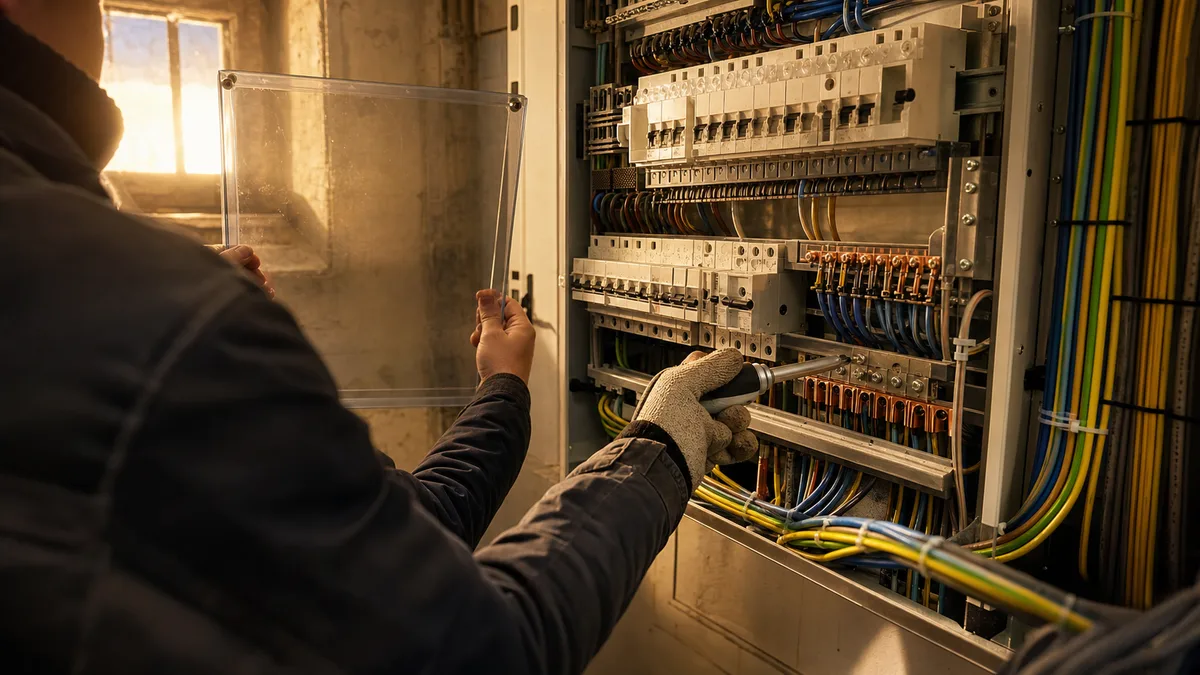
A tenanted building is a peculiar kind of operation: the owner often does not sit in it at all, yet a substantial part of its technical condition is their responsibility. Tenants come and go, partitions get moved, air conditioning has appeared on the roof — but the main distribution board, the service connection, the lightning protection system and the corridors stay the same and still belong to the building. And it is precisely in these places that an inspection or a loss most often reveals that nobody has looked after them for years: every tenant dealt with their own unit and everyone assumed that “the rest of the building is someone else’s job”.
We covered the tenant’s side — who pays for the inspection inside a leased unit, what to look for in the contract and how the costs are split — in the article on who pays for the electrical inspection in a leased warehouse. Today we look at the same building from the other direction: what typically stays with the landlord in terms of inspections and fire safety, how to divide up the rest by contract, and why it pays for the owner to have the whole building inspected by a single provider.
What stays with the owner even when the building is full of tenants
Act No. 250/2021 Sb. on designated technical equipment ties operating duties to the operator, not automatically to the owner. Where equipment is operated by someone other than the owner, that person is responsible for its proper use and operation from the day of documented handover (§ 20 odst. 7). For a building owner this produces a mirror-image logic that is easy to forget: whatever no tenant has demonstrably taken over is still operated by the owner. A contract and a handover protocol can transfer a sub-distribution board or the installation inside a unit — but never the whole building.
In practice, the landlord is typically left with:
- the main distribution board and shared wiring — the backbone of the building from the service connection to the sub-distribution boards of the individual units,
- common areas — corridors, staircases, cellars, garages, lift and plant rooms and their lighting,
- the service connection and metering — the section from the boundary with the distribution system, which is never handed over to tenants,
- the lightning protection system — the air-termination system, down conductors and earthing are part of the structure; no tenant “takes them over” and none has any way of operating them,
- building services — the boiler room, heat exchanger station, ventilation or emergency lighting, where the property has them.
The framework for initial and periodic inspections of electrical installations is set by ČSN 33 1500 (Czech technical standard) together with the regulations on designated technical equipment. Which intervals are typically used for offices and ordinary buildings, and what exactly gets inspected in a property, we set out in the article on electrical inspections in office buildings and homeowner associations — here only one reminder belongs: the intervals run according to the property and its environment, not according to the lease agreements. The fact that three tenants have passed through the warehouse has not replaced a single inspection of the shared wiring.
With lightning protection the situation is the clearest of all. Protection against lightning protects the entire structure and everyone working in it, and its condition is assessed for the property as a whole. When a full inspection is required, when a visual check is enough and what the technician verifies on the system, we discuss in the article on lightning protection inspection intervals.
Fire safety: in shared areas the default rule is “the owner”
The Fire Protection Act (No. 133/1985 Sb.) rests on the principle that every legal entity or self-employed person fulfils fire safety duties in the premises they use to carry on their business. So within their own unit the tenant handles the categorisation of their activities by fire hazard, staff training and equipment themselves — an overview of those duties is given in the article on fire safety in a company.
As soon as several companies operate in one property, however, § 2 odst. 2 of the Act adds a rule for places they use jointly: fire safety duties there are fulfilled by the owner of the premises, unless otherwise agreed in a contract between the parties concerned. And if the parties do agree on a different split, the Act expressly requires the contract to also name the person responsible for fulfilling fire safety duties.
Translated into the running of a building: corridors, staircases, escape routes and shared plant areas are the owner’s concern by default. That includes the fire extinguishers positioned in common areas — the owner is the one who orders their periodic operability checks under Decree No. 246/2001 Sb.; we described the intervals and the form of the records in the article on fire extinguisher checks in a company. The same applies to signage and to keeping escape routes clear in the shared parts. If the lease agreements are silent, the owner will continue to carry the duties for the shared areas — even if they assumed all along that “fire safety is the tenants’ business”.
What works in practice is a simple division written into the contract: the tenant fulfils fire safety duties inside the unit for their own activity, the owner for the common areas — and the contract names a specific responsible person, so that during an inspection or an emergency there is someone to point to.
What to cover in the contract while there is still time
We went through the contractual wording from the tenant’s point of view in the article on leased warehouses mentioned above. From the owner’s point of view, the checklist looks like this:
- A technical boundary in the handover protocol. List the distribution boards, circuits and equipment the tenant is taking over, with the date of handover. From that day they are the operator; whatever is missing from the protocol stays yours.
- Who orders and pays for which inspections. A separate provision for the fixed installation, appliances, lightning protection and fire safety equipment — not one vague sentence about “routine maintenance” that can be stretched to cover anything.
- The tenant’s duty to submit documents. Ask for copies of inspection reports for the equipment taken over on an ongoing basis, not after a loss. The owner is the only one who can hold a complete picture of the building — the insurer and the authorities will ultimately ask them.
- Consent to interventions in the installation. New circuits, air conditioning or charging stations only with your consent, with an initial inspection and as-built documentation; at the end of the lease the documentation is handed back together with the space.
- Naming the person responsible for fire safety. If you are transferring the duties for shared areas by contract, name the responsible person in it — without that, the arrangement does not meet the requirement of the Fire Protection Act.
- Right of access for technicians. The backbone wiring also runs through leased premises and a lightning protection inspection needs the roof; without agreed access, due dates are hard to keep and surveys get postponed.
- Substitute performance. Reserve the right to order an inspection at the tenant’s expense if they fail to arrange it despite a written request. It is a cheaper safeguard than a dispute over liability after a loss.
A well-drafted contract does not just settle who pays for what. Above all, it makes sure that no piece of equipment is forgotten — because every item has its operator, its due date and its payer.
Why one provider should inspect the whole building
The typical state of a property with five tenants: each has their own inspection technician, a different due date and a different report format. The installations inside the units have their paperwork, but nobody inspects the main distribution board, because nobody has taken it over. Each technician interpreted the line between “mine” and “shared” slightly differently, the lightning protection system is waiting for someone to remember it, and the fire extinguishers in the corridor carry a label from the previous facility manager’s era. Then, when an inspection or a loss adjuster arrives, the owner is left assembling a mosaic from documents that do not join up — and the gaps land on them, because it is their building.
Having the whole building inspected by a single provider solves this problem at the root:
- one survey covers the shared wiring, the lightning protection system and the tenants’ premises, so no untested gaps open up at the boundaries,
- the due dates for all equipment come together in one register and are tracked by one party,
- the reports have a uniform structure and follow on from each other — for an inspection or an insurance claim they are submitted as a single whole,
- call-outs are combined, so you are not paying travel costs several times over for several small inspections,
- defects at the interfaces (sub-distribution board, supply to a unit) have a clear addressee and are not batted back and forth between tenants.
This is exactly how building inspection management from SOHE works: we walk the property, compile an asset register of equipment and due dates, and then track what is needed and when throughout the year — electrical inspections, lightning protection systems, appliances and fire safety in the common areas. If you want to know what that would mean for your building, send us a no-obligation enquiry with the address of the property and the number of leased units — we will come back with a specific scope and an itemised quotation, not a flat rate per square metre.
The most common landlord mistakes
A few situations come up again and again during surveys of buildings before they are taken into inspection management, and they are easy to avoid:
- “We have the inspections, the tenants send them in.” The documents from tenants cover their own units — the shared wiring, the lightning protection system and the corridors are not in them. The owner ends up with a folder full of paper and their own part of the building uncovered.
- A handover protocol without an electrical boundary. Keys and meter readings were handed over, but not the distribution boards and circuits. Years later there is no way to determine who operates which circuit, and every fault ends in an argument.
- Tenant alterations without documentation. Partitions, air conditioning, new socket circuits — with no initial inspection and no as-built documentation. The next periodic inspection then takes longer and costs more, because the technician has to work out what is actually in the building.
- Overdue fire extinguisher checks in the corridors. Every tenant deals with their own premises and never gets to the shared ones. Yet these are precisely the places everyone runs through in a fire.
- No register of due dates. The inspection reports sit in a binder, but nobody tracks when each interval expires. The first reminder then comes in the form of an inspection or a loss event.
None of these mistakes is ill will — they follow from the fact that a multi-tenant building has no natural “owner of the agenda”. Either that is the facility manager or an external provider, or in the end it is chance.
Sources for this article
- Electrical inspections and fire safety – SOHE services for companies and facility managers.
- Who pays for the electrical inspection in a leased warehouse or office – the same building from the tenant’s point of view: the contract, the handover protocol and the split of costs.
- Electrical inspections in offices, administrative buildings and homeowner associations – everything that gets inspected in a building and the intervals typically used.
- Fire safety in a company – categorisation of activities, documentation and the duties of individual companies.
- Fire extinguisher checks in a company – operability check intervals and usable records.
- Lightning protection inspections: how often – full inspections and visual checks of the lightning protection system.
- Zákon č. 133/1985 Sb. – the Fire Protection Act; § 2 odst. 2 governs the fulfilment of duties in jointly used areas and the requirements for the contract, including naming the responsible person.
- Vyhláška č. 246/2001 Sb. – the decree on fire prevention; used in the wording effective from 1 January 2026 following amendment No. 467/2025 Sb.
- Zákon č. 250/2021 Sb. – on occupational safety in connection with the operation of designated technical equipment; § 20 odst. 7 ties responsibility to the operator from the day of documented handover.
- ČSN 33 1500 – inspection of electrical installations; the framework for initial and periodic inspections.
The legal position was verified as of 12 August 2026.
This text is for information only and does not replace legal advice. The specific division of duties between landlord and tenant needs to be set according to the actual operation of the building, the contracts concluded, the documentation and a risk assessment.
Do you lease out a warehouse, offices or an entire site and are not sure which inspections are down to you and which to your tenants? We will go through the contracts and the actual condition of the building and set up inspection management in which every piece of equipment has its due date and its responsible person. Send us a no-obligation enquiry or write to info@sohe.cz and we will arrange a survey of the property.