
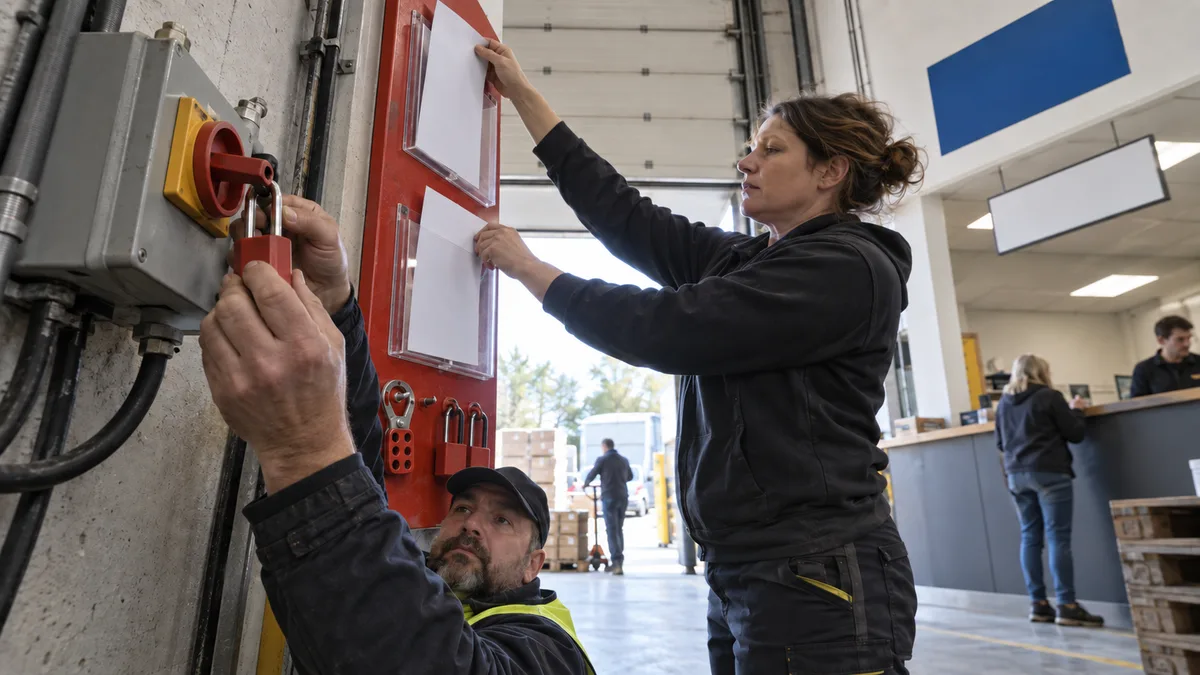
Sixteen people, one production hall, and one maintenance technician with a valid professional qualification certificate. When the gate stops opening on a Friday, he goes to the switchboard, disconnects the supply, secures the workplace, replaces the contactor, and has production running again within an hour.
He has two documents: proof that he passed his examination and the latest inspection report. What should accompany them under § 8 of Nařízení vlády č. 190/2022 Sb. (Government Regulation No. 190/2022 Sb.) has never been created in most such companies—and it is not another training course or inspection. It consists of two appointments of specific people and three records that must be created as the work is performed. Section 8 lists the organisational measures that an operator of reserved electrical equipment must establish before work on the equipment begins.
Two different “section eights,” only one of which concerns work organisation
§ 8 Nařízení vlády č. 194/2022 Sb. concerns the qualifications of an individual—the professional competence of an electrical inspection technician. This is the “section” that people qualify for personally, just like § 4, § 6, and § 7. The route to these qualifications is explained in the article on how to obtain electrical qualifications, while the article on professional competence in electrical engineering explains what each person is authorised to do.
§ 8 Nařízení vlády č. 190/2022 Sb. is addressed to the company as the equipment operator. It is not a qualification that an individual can “obtain”—it is a list of organisational measures for the entity operating the equipment.
When an activity becomes work on reserved electrical equipment
Under § 2 písm. b) of the regulation, work on reserved electrical equipment includes installation, dismantling, repair, examination, inspection, maintenance, testing, measurement, and formal inspections—as well as, explicitly, all actions required to secure and release a workplace.
That final part surprises most people. The assumption that disconnecting and securing the supply for a colleague “does not yet count as work on the equipment” is inconsistent with the wording of the regulation.
Section 2 písm. h), i), and j) of the regulation then defines three working arrangements: work according to instructions, work with oversight, and work under supervision. The same restriction applies to all three—instructions may be issued, and oversight or supervision provided, only by a knowledgeable person.
Person responsible for electrical equipment: a role created by appointment
The first role is established by § 8 písm. d). The operator designates a natural person responsible for the electrical equipment, whose duties include ensuring the safe operation of the reserved electrical equipment—on the basis of a written appointment issued in paper or electronic form by the legal entity or self-employed natural person operating the equipment.
This single sentence has several implications that are often overlooked in practice:
- The role is created by a document, not by custom. Saying “Karel looks after the electrics here” is not an appointment under § 8 písm. d).
- An electronic document has the same standing as a paper document: an electronically signed appointment stored in the personnel system is acceptable.
- The appointment is issued by the entity that operates the equipment. It is not a document supplied to the company by its inspection contractor.
- Under § 8 písm. a), only a professionally competent natural person may be appointed—unless the manufacturer has specified additional professional competence requirements due to the risks associated with the activity.
The final condition is why there is little point in drafting the appointment before it is clear which equipment the company operates and what the manufacturer’s documentation requires. The article on accompanying and operational documentation explains where this documentation comes from.
Person in charge of work: designated for each job, not once a year
The second role appears in § 8 písm. e) and works differently. The operator must ensure that a person in charge of work is designated for every job on reserved electrical equipment; that person is responsible for properly securing the activity. Before work begins, its complexity must be analysed so that someone with suitable professional competence can be selected. Only a knowledgeable person may act as the person in charge of work.
The regulation does not define a knowledgeable person; the law does. Under § 19 odst. 1 Zákon č. 250/2021 Sb., a distinction is made between knowledgeable persons, instructed persons, and trained (familiarised) persons. Knowledgeable persons include those qualified for independent work, those qualified to manage activities, and electrical inspection technicians. An instructed person therefore cannot act as the person in charge of work—this is the boundary most often crossed by companies with one electrician and several instructed employees. The distinction is explained in the article on who qualifies as an instructed person under § 4.
Pay attention to the form of the appointment. For the person responsible for electrical equipment, the regulation explicitly requires a written document. For the person in charge of work, it requires “designation” for each job and an analysis of its complexity before work begins, but it does not prescribe a form. In both cases, however, the only evidence available afterwards is whatever was recorded in writing.
Electrical risk assessment determines how the work will be performed
The third requirement, § 8 písm. b), is usually the rarest item in company records. It requires an electrical risk assessment before work on or operation of the equipment begins—and this assessment must determine how the work or operation will be performed and which measures will be implemented.
This is not the same as a risk register that the company prepared once and keeps in its occupational health and safety files. A general risk assessment maps workplaces and occupations; an electrical risk assessment relates to a specific job or operating activity and results in a decision on the procedure—which working arrangement will apply and what measures will be taken.
The complexity analysis under písm. e) and the risk assessment under písm. b) are two separate requirements, but they are performed at the same time. Keeping them on a single form is therefore practical.
Personal protective equipment and a record signed by two people
The fourth record is found outside § 8, in § 7 odst. 6 of the same regulation, and is the most specific requirement in the entire set. Work may be performed only by a professionally competent person who has the necessary personal protective equipment and has been instructed in its use. A record of this instruction must be prepared and signed by both the professionally competent person and the person who provided the instruction.
Two signatures on one document are the key requirement. A personal protective equipment issue record in which an employee confirms receipt of gloves does not establish that someone instructed them in their use or identify who provided that instruction. The article on personal protective equipment in the workplace explains how to connect this record to the relevant equipment list and issue records.
Training is not only for electricians
The fifth requirement, § 8 písm. c), has a discreetly broad scope. It requires every natural person carrying out activities on, with, or near the equipment to receive training on occupational health and safety regulations—including local operational safety rules relating to their activities.
The wording “with or near the equipment” is why workplace electrical safety training is not limited to maintenance personnel. The second half of the sentence makes clear that general occupational health and safety training alone is insufficient: training must also cover local operational safety rules—in other words, the rules drawn up by the company itself.
What an appointment should contain to stand up to scrutiny
The regulation does not prescribe a template or form. It is nevertheless possible to identify the questions an appointment should answer to demonstrate compliance with § 8 písm. d):
- Who issues the appointment—identification of the equipment operator.
- Who is appointed—identification of the natural person accepting the role.
- What role they are appointed to—expressly, the role of the person responsible for electrical equipment under § 8 písm. d) NV č. 190/2022 Sb., with responsibility for ensuring safe operation.
- Which equipment it covers—the scope: buildings, facilities, or equipment types. Without a defined scope, it is impossible to determine the limits of responsibility at a site with several buildings.
- How professional competence is documented—a reference to the examination certificate, including its number and validity. Under § 8 písm. a), only a professionally competent person may be appointed.
- Date, signatures, and format—paper or electronic; for an electronic document, it must be clear where it is stored and who can access it.
Copying someone else’s template and adding a name is the quickest route to a document that solves nothing: it usually omits the scope and contains no reference to proof of professional competence.
Where to store the documents and when to review them
Appointments, electrical risk assessments, and records of instruction in the use of personal protective equipment belong with the equipment’s operational documentation—where the company keeps its inspection reports and the protocol determining external influences. During an inspection or after an injury, the company must demonstrate the connection between the equipment, the individual, and the procedure, which is far harder when the evidence is spread across three separate files.
There is no need to invent a review date. Under § 19 odst. 2 písm. b) Zákon č. 250/2021 Sb., a certificate confirming successful completion of an examination of professional competence to perform electrical activities is valid for three years from its date of issue. An appointment referring to such a certificate therefore has a natural review date: the day the certificate expires. The article on employees’ electrical qualifications explains how to maintain these records for an entire team.
Small company and manufacturing plant: the same requirements on a different scale
A company with one electrician. There is one appointment, held by that individual. The person in charge of work is designated for each job and will usually be the same person—which is acceptable if they are knowledgeable and if the designation is genuinely made before the work rather than merely assumed. The weak point lies elsewhere: when that person goes on holiday or leaves the company, no one is available to take over the role. A one-page appointment of a deputy will solve more than another training course.
A manufacturing company with in-house maintenance staff and external contractors. There is more equipment and there are more areas of responsibility. Responsibility is usually divided by building or operation, making the scope the most important part of each appointment. A person in charge is designated for every job, so there may be dozens of designations each month. Without a form that keeps the complexity analysis, risk assessment, and signatures in one place, the system will stop working after the second week.
What inspectors will notice first
- The appointment is completely missing. The company has a qualified person and assumes that this satisfies the requirement, but § 8 písm. d) requires an appointment, not merely a qualification.
- An appointment without a defined scope. The document does not show which equipment it covers.
- A person in charge of work designated “in general.” A policy states that the maintenance manager holds the role, but individual jobs are not addressed; the regulation requires designation for each job.
- A person in charge of work who is not knowledgeable. An instructed person cannot perform this role under § 8 písm. e).
- No electrical risk assessment. An occupational health and safety risk register exists, but there is nothing for individual jobs.
- A personal protective equipment issue record instead of a record of instruction. The signature of the person who provided the instruction is missing.
Frequently asked questions
Can an external company be the person responsible for electrical equipment?
Under § 8 písm. d), a natural person is appointed, and the appointment is issued by the entity operating the equipment. The role is not created by a contract with a supplier but by appointing a specific individual.
Is it enough for the person to hold a valid examination certificate under § 6?
Proof of professional competence is a prerequisite, not an appointment. Section 8 písm. a) states that activities may be entrusted only to professionally competent natural persons; the appointment itself is created by the document required under § 8 písm. d).
Must the designation of the person in charge of work be in writing?
The regulation requires a person in charge of work to be designated for each job and the complexity of the job to be analysed before it begins. Unlike the appointment under § 8 písm. d), it does not expressly require a written document. Without a record, however, you cannot prove that the designation and analysis took place.
Who may issue instructions and provide oversight or supervision?
Only a knowledgeable person. This follows from § 2 písm. h), i), and j) of the regulation, which defines work according to instructions, work with oversight, and work under supervision.
Sources for this article
- Employee training – a SOHE service.
- Professional competence in electrical engineering – who qualifies as an instructed person, knowledgeable person, or electrical inspection technician and what each may do.
- How to obtain electrical qualifications – the route to § 4, § 6, § 7, and § 8 NV 194/2022 Sb., meaning an individual’s qualifications.
- Electrical safety training in a company: who is an instructed person – the boundary between instruction and knowledge that determines who may act as the person in charge of work.
- Employees’ electrical qualifications: document records and checks – how to manage the documents referenced by appointments.
- Accompanying and operational documentation for electrical equipment – where to store appointments and records and what other documentation belongs with them.
- Personal protective equipment in the workplace: list, policy, and issue records – how to connect the record of instruction in the use of personal protective equipment to existing documentation.
- Nařízení vlády č. 190/2022 Sb. – reserved electrical equipment and requirements for ensuring its safety, as effective from 1 July 2024; § 2 písm. b) defines work on equipment, § 2 písm. h), i), and j) define work according to instructions, with oversight, and under supervision, § 7 odst. 6 covers personal protective equipment and the record of instruction, § 8 písm. a) covers the appointment of professionally competent persons, písm. b) electrical risk assessment, písm. c) training, písm. d) the person responsible for electrical equipment, and písm. e) the person in charge of work.
- Nařízení vlády č. 194/2022 Sb. – professional competence to perform activities on electrical equipment, as effective from 1 July 2024; § 8 covers the professional competence of electrical inspection technicians, meaning a different “section eight” from the one governing work organisation.
- Zákon č. 250/2021 Sb. – occupational safety in connection with the operation of reserved technical equipment, as effective from 1 November 2025; § 19 odst. 1 covers knowledgeable, instructed, and trained persons, while § 19 odst. 2 písm. b) establishes that an examination certificate is valid for three years from its date of issue.
This article is for informational purposes and does not constitute legal advice. The specific arrangements for appointments, the designation of a person in charge of work, and the related records must reflect actual operations, the manufacturer’s documentation, the environment in which the equipment is used, and the risk assessment.
Do you lack an appointment for the person responsible, or does the document fail to show which equipment it covers? As part of our employee training, we will review who actually works on electrical equipment in your company, what evidence is required, and which records must be created during the work. Email info@sohe.cz or send a no-obligation enquiry—all we need is the number of items of equipment and how many people interact with them.