
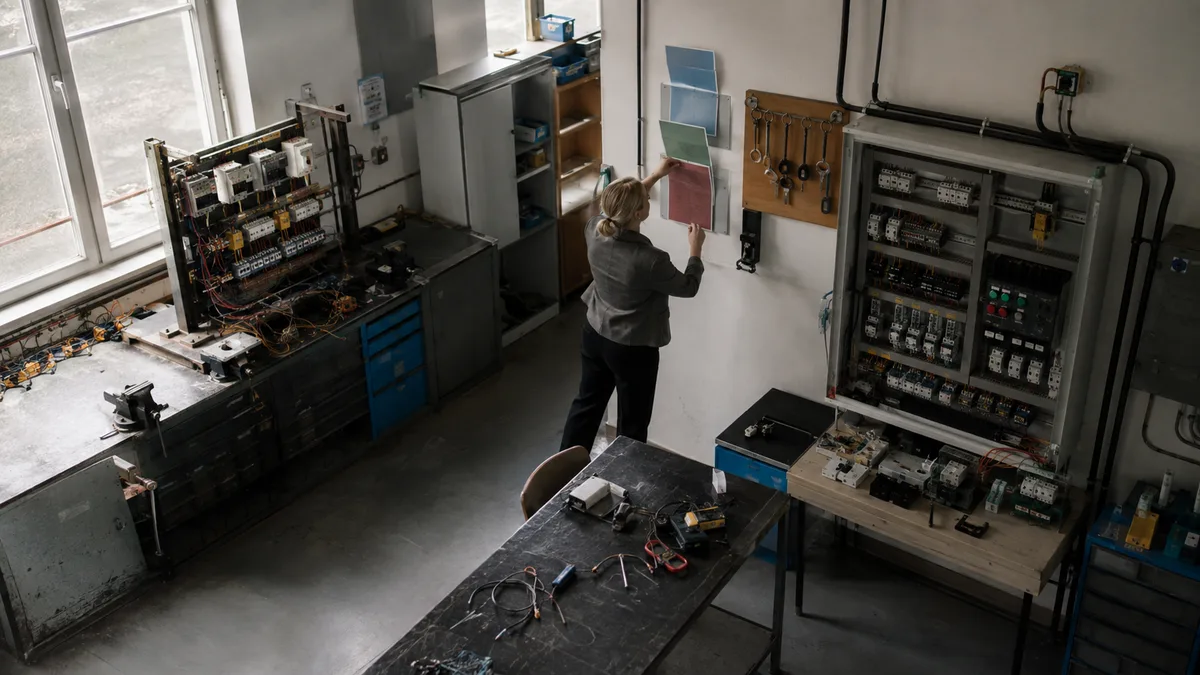
A company with twenty employees can usually be certain of two things: electrical inspections are handled by a contractor, and occupational health and safety training took place at some point. The third issue—who among those twenty people is permitted to work on electrical equipment and how the company can prove it—is often scattered across personnel files, a supervisor’s drawer, and the memory of a single maintenance technician. When that person leaves, the overview leaves with them.
This article is intended for the person who pays for and signs off on examinations and training. We explain how to obtain the relevant qualification in the article how to obtain electrical qualifications; here, we focus on which documents the company should retain after the examination and what inspectors will want to see.
Quick answer
Under § 3(1) of nařízení vlády č. 194/2022 Sb., a company must ensure that, in the prescribed cases, activities and the management of activities on or near electrical equipment are performed only by professionally competent persons. Under § 3(4), it must also ensure their regular training—in accordance with its own internal regulations or, if it has not prepared such regulations, at least once a year. Under § 19(2)(b) of zákon č. 250/2021 Sb., a certificate confirming that a skilled person has passed the examination is valid for three years from its date of issue. For an instructed person, the instruction and verification of knowledge must be repeated within the period stated in the record, which under § 19(3)(b) of the same act must not exceed three years. Inspectors will not simply ask who knows how to do what—they will ask how you can prove it: through a certificate, a written record, and the identity of your responsible person under § 2(f) of the regulation.
Which qualification level does each employee need?
The required level cannot be assigned based solely on a job title—the deciding factors are the activities the person actually performs and the risk assessment. The table therefore shows typical situations, not a universal rule.
| What the person does with electricity | Typical classification | How the company documents it |
|---|---|---|
| Switches on a computer, starts a machine with a button, or plugs an appliance into a socket | Normal operation of extra-low-voltage and low-voltage equipment—under § 3(2) of NV 194/2022 Sb., this is not an activity requiring professional competence under this regulation | No certificate is issued under this regulation |
| Operates machinery or works in a warehouse—resets circuit breakers, replaces fuse links, or operates designated parts of a switchboard | Typically an instructed person (§ 4) | Record of instruction and verification of knowledge (§ 4(3)) |
| Maintenance technician or plant electrician—works independently on electrical equipment | Typically an electrician (§ 6) | Certificate of passing the examination, using the template in Annex No. 2 to the regulation |
| Maintenance manager or supervisor—manages activities and operations involving electrical equipment | Typically a senior electrician (§ 7) | The same certificate, with the scope stated as “osoba znalá pro řízení činnosti” |
| Performs inspections of designated electrical equipment | Inspection technician (§ 8) | Valid TIČR inspection certificate in addition to competence under § 7 |
The exception in § 3(2) is misinterpreted in both directions: some companies use it as a reason not to train anyone, while others send the entire company, including the accounting department, for instruction. It means exactly what it says—and it does not cancel the obligation to train employees under other regulations.
Older certificates are addressed by § 10 of the regulation: certificates issued before the regulation took effect are regarded as certificates under the regulation. A pracovník znalý and a pracovník znalý pro samostatnou činnost are regarded as electricians, while a pracovník pro řízení činnosti, pracovník pro řízení činnosti prováděné dodavatelským způsobem, and pracovník pro řízení provozu are regarded as senior electricians. The repealed vyhláška č. 50/1978 Sb. therefore survives today only in the old names of the qualification levels. We explain which tasks may be assigned to an instructed person in the article about instructed persons under § 4.
What § 3 of NV 194/2022 Sb. requires from employers
The company’s entire obligation is contained in a single section, and it is worth reading paragraph by paragraph.
Paragraph 1 requires the company to ensure that activities and the management of activities involving electrical equipment are performed only by persons professionally competent under § 19 of the act who meet the requirements of § 4, § 6, and § 7 of the regulation, and by persons under § 11 of the act who meet the requirements of § 8. This is not merely an obligation to “provide training”; it is an obligation to achieve the required result.
Paragraph 3 introduces the responsible person. This person checks that activities are performed only by individuals professionally competent for the activity concerned under § 4 through § 8. Some of the responsible person’s activities listed in § 2(f) may be delegated to others. Under § 2(f), this is a person appointed by the company operating the electrical equipment whose duties include ensuring safe operation and establishing rules for individual activities. In practice, this is a name without which even the examination certificate cannot be completed—the template in Annex No. 2 includes it.
Paragraph 4 is the provision that most often causes disagreements with clients. The company must ensure that persons under § 4, § 6, and § 7 regularly receive training on the legal and other regulations governing occupational health and safety that relate to their activities, in accordance with the company’s internal regulations. Only the second sentence adds that if the company has not prepared such regulations, it must provide training of the specified scope at least once a year. The annual interval is therefore not the basic rule but a fallback regime for companies that have not established their own intervals.
Paragraph 5 applies to companies that accept apprentices for practical training: before starting work, students in electrical engineering programmes must be trained under § 9(1) to the extent relevant to their activities, their knowledge must be verified and recorded, and they must work under the supervision of a designated person with the appropriate competence.
Records that withstand inspection: what to keep in your files or system
The following items form a complete, verifiable record—each one on its own leaves a gap.
Certificate of passing the examination. The template in Annex No. 2 to the regulation includes a registration number, the person’s name and date of birth, qualifications, length of experience, scope (“osoba znalá pro samostatnou činnost” / “osoba znalá pro řízení činnosti”), scope of competence by voltage and by whether the premises present an explosion hazard, date of issue, the “Platnost: do” field, the examination board chairperson—and, for an inspection technician, their certificate number—the name and company registration number of the company that sent the person for examination, and the responsible person. One detail for HR staff: under § 19(2)(c) of zákon č. 250/2021 Sb., one copy belongs to the person examined and one to the company for which the activities are performed. The company should therefore retain its own copy, not a photograph from the employee’s phone.
Examination report—and knowledge of where it is kept. Under § 9(4) of the regulation, the examination board chairperson prepares a report on the course and content of the examination and ensures that it is retained for at least six and no more than seven years by the company where the examination takes place—usually the examination provider, not your company. For each certificate, therefore, record who organised the examination and request copies of the reports when changing providers.
Record of instruction. Under § 4(3) of the regulation, this record is prepared by the skilled person who provided the instruction and verified the participant’s knowledge. It must precisely define the scope of the instruction and specify the workplace. Section 19(3)(b) of the act also requires the signatures of both the instructed person and the skilled person, a repetition period of no more than three years, and a threshold of 80% correct answers for a “pass” result. A record without the workplace and repetition period is incomplete—and that is exactly what most freely downloaded templates look like.
Evidence of education and experience. Under § 9(5) of the regulation, applicants must present their qualifications before the examination, either as an original or an officially certified copy, together with evidence of the length of their professional experience in the form of an employer’s confirmation or a statutory declaration. If the document does not clearly demonstrate electrical engineering education, confirmation from the school or ministerstva školství must also be provided.
Local operational safety regulations. Under § 6(2) of the regulation, the responsible person uses this document to establish the electrician’s minimum required experience in accordance with the risk assessment. For persons without electrical engineering experience, it must require supervision by a skilled person with at least two years of experience for a minimum period of one year. Passing the examination therefore does not automatically make a new electrician ready to work independently—and the identity of the person supervising them for that year must be documented.
Confirmation under § 6(7), if you use it. Based on the risk assessment, the responsible person may use this confirmation to substitute professional qualifications for the specified type of activity; the template is provided in Annex No. 1. The resulting authorisation is limited to activities involving voltages up to 1 kV AC or 1.5 kV DC in premises without an explosion hazard and is valid only within that specific company.
Periodic training records and the regulations establishing the interval. Without such regulations, you fall under the annual regime set out in § 3(4). Section 9(6) of the regulation also permits part of the training and examination within the scope of § 9(1)(c) to be replaced with confirmation from the responsible person that the person concerned regularly completes training with verification of knowledge at intervals established by the internal regulations; the template is provided in Annex No. 4.
Expiry dates and individual responsibility for monitoring them. Do not assign responsibility merely to “the HR department.” Assign a specific person, maintain a specific table, and set an alert at least two months in advance. Arranging an examination at the last minute during the holiday season is rarely possible.
When a certificate expires and what this means in practice
The date is printed in the “Platnost: do” field on the certificate and follows from § 19(2)(b) of zákon č. 250/2021 Sb.—three years from the date of issue. For instructed persons, the period stated in the instruction record applies and may not exceed three years. Details of renewal and re-examination are provided in the article on renewing electrical certificates.
In addition to the date, check the scope. Under § 6(6) and § 7(7) of the regulation, the examination board may limit it according to the activities actually performed. For a senior electrician, the scope of the examination under § 7(3) is established in accordance with the authorisations in Annex No. 3 to nařízení vlády č. 190/2022 Sb.—which is where designations such as E1A, E2A, and E3B on certificates come from. A valid certificate that does not cover the activity you expect the person to perform is just as problematic as an expired one.
How an inspection proceeds and what inspectors ask
Under § 4 of zákon č. 250/2021 Sb., public administration in the field of safe operation of designated technical equipment is carried out by Ministerstvo práce a sociálních věcí, Státní úřad inspekce práce, and oblastní inspektoráty práce. We describe the general inspection process in the article about inspections by the labour inspectorate; here, we will focus on professional competence documents. The obligations described above indicate the questions you can expect:
- Who is your responsible person under § 2(f) and § 3(3) of the regulation—the person must be identified by name and appointed in writing, with a clear definition of which duties have been delegated to others.
- Certificates of skilled persons: validity, scope by voltage and environment, examination board chairperson, and the company that sent the person for examination.
- Records for instructed persons: scope of instruction, workplace specification, repetition period, and signatures of both parties.
- Periodic training records under § 3(4) and the regulations establishing the training interval.
- Consistency between the scope of the certificate and the work the person actually performs—this can be checked simply by comparing the job description with the scope field.
- For designated electrical equipment, § 20(2)(d) of zákon č. 250/2021 Sb. additionally requires the operator to ensure that tests, inspections, installation, repairs, or operation are performed only by professionally competent natural persons and, where prescribed, certificate holders.
Ask one compliance question before ordering the examinations: under § 19(4) of zákon č. 250/2021 Sb., an external examination provider must list the provision of training and examinations or the verification of knowledge among its registered business activities. This can be checked in the public register in a minute. We explain the examination itself in the article about the professional competence examination.
How to arrange everything for the whole team at once
For a company handling qualifications for several people at the same time, it makes sense to combine the levels into a single order:
- Group instruction under § 4 at your company—indicatively from CZK 300 excluding VAT per person, including a written record defining the scope and specifying the workplace.
- § 6 and § 7 examinations for new electricians—indicatively CZK 2,500 excluding VAT per person; the price includes training, an examination before a three-member board chaired, under § 6(3) and § 7(4) of the regulation, by a person professionally competent to perform inspections, and the issued certificate.
- Online re-examination after three years—indicatively CZK 1,400 excluding VAT per person, with no travel and no full-day absence from work.
Open sessions in Brno are scheduled regularly (current dates are on the Electrical training and examinations page). We arrange individual online sessions for groups of two or more and can also train a group at your company by agreement. Current rates are available in the price list; the exact price depends on the number of participants, qualification levels, and venue. We record the issue date of every certificate and contact you before the end of its three-year validity period with an available date—details are available on the Electrical Training and Examinations page.
Sources used for this article
- Electrical Training and Examinations – a service provided by SOHE.
- How to obtain electrical qualifications – the process for individuals, from selecting the scope and preparing documents to the examination and issuance of the certificate.
- Renewing electrical certificates: deadlines and re-examination – validity periods for individual levels, the renewal process, and the consequences of an expired certificate.
- Electrical safety training in a company: who is an instructed person under § 4? – what an instructed person may do, who may provide the instruction, and what the record must contain.
- Inspection by the labour inspectorate – how an inspection proceeds and which other documents the inspector will want to see.
- Nařízení vlády č. 194/2022 Sb., ve znění pozdějších předpisů (naposledy NV č. 175/2024 Sb.) – governing the professional competence required for work on electrical equipment and professional competence in electrical engineering; § 2(f) covers the responsible person, § 3 the company’s obligations including periodic training, § 4 instructed persons and written records, § 6 and § 7 electricians and senior electricians, § 9 examinations and retention of examination reports, § 10 the transitional provision, and Annexes No. 1 through 4 the templates for confirmations, certificates, and reports.
- Zákon č. 250/2021 Sb., ve znění pozdějších předpisů (naposledy zákonem č. 318/2025 Sb.) – governing occupational safety in connection with the operation of designated technical equipment; § 4 covers public administration authorities, § 19 the professional competence of skilled and instructed persons, including the certificate’s three-year validity and the required elements of the instruction record, and § 20 the operator’s obligations.
- Nařízení vlády č. 190/2022 Sb. – governing designated technical electrical equipment and the requirements for ensuring its safety; Annex No. 3 is the source of scope designations such as E1A through E3B.
This article is for informational purposes and does not constitute legal advice. The appropriate level of professional competence for each position, the scope of instruction, and the periodic training interval must be established according to the actual operation, the manufacturer’s documentation, the environment in which the equipment is used, and the risk assessment.
Do you need to standardise the qualifications of your entire team at once and obtain documentation that will withstand inspection? We can provide electrical training and examinations for § 4, § 6, and § 7—at an open session in Brno, at your company, or as an online re-examination. Email info@sohe.cz or send a non-binding enquiry stating the number of people and the qualification levels you need; we will get back to you with an available date, price, and a list of the documents you need to prepare.