
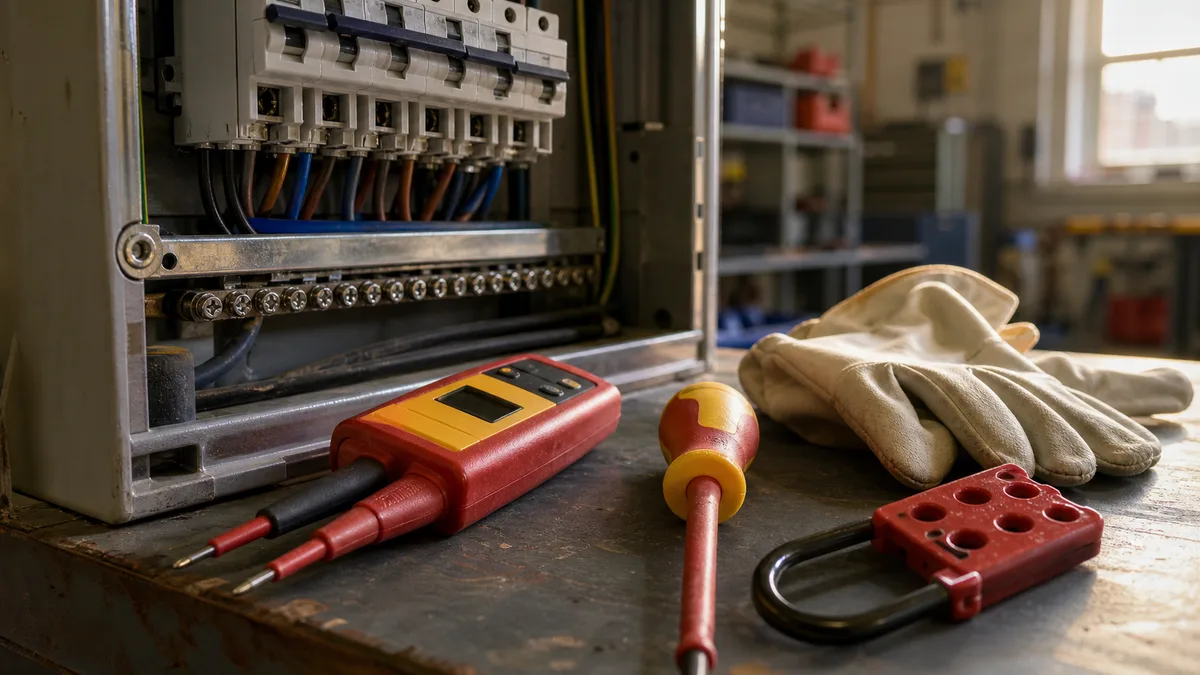
When someone in a company says “electrical training,” most executives picture electricians, exams, and certificates. However, it’s the rest of the company that works daily with electrical equipment: production machine operators, maintenance, warehouse staff at forklift charging stations, and cleaners in technical rooms. None of these people are electricians — yet Government Decree No. 194/2022 Coll. provides a separate category for them: the instructed person under § 4.
This is the role most often overlooked in practice. A company has its revisions and electricians’ documentation in order, but has no answer to the question, “Who resets the circuit breakers on your line, and where is the record of that?” We’ll walk through who needs instruction, who can conduct it, what it should contain, how to document it, and how to set up refresher training. If, on the other hand, you’re dealing with electricians, exams under § 6 and § 7, and the validity of their documents, that’s a different topic — we cover it in the article on professional competence in electrical engineering.
Layperson, instructed person, and knowledgeable person: what’s the difference
The legal framework effective from 1 July 2022 — Act No. 250/2021 Coll., as amended, and Government Decree No. 194/2022 Coll., as amended by Government Decree No. 175/2024 Coll. — replaced the repealed Decree No. 50/1978 Coll. (valid until 30 June 2022) and distinguishes three levels based on what a person actually does with electrical equipment:
| Level | Who it is | What they are typically allowed to do |
|---|---|---|
| Layperson — trained (familiarized) person | A regular employee with no electrical qualification, trained within OSH and internal rules | Only ordinary operation of low and extra-low voltage equipment — turning on a computer, a machine with a button, plugging an appliance into a socket |
| Instructed person (§ 4 of NV 194/2022 Coll.) | An employee trained and examined by a knowledgeable person, with a documented record | Independent operation of designated parts of equipment, defined work in a de-energized state, defined activities near electrical installations |
| Knowledgeable person (§ 6–8) | An electrical engineer, chief electrical engineer, inspection technician — with professional education and a valid examination certificate | Professional activities on electrical installations within the scope of the certificate; inspection technician performs revisions |
An instructed person is therefore an intermediate level: more than a layperson, less than an electrician. According to § 4, they may — in simplified terms — independently operate electrical equipment without voltage limits (but may only touch parts designed for operation), work on de-energized extra-low and low voltage equipment according to instructions, work on de-energized high voltage equipment only under the supervision of a knowledgeable person, and, in defined cases, work near uncovered live parts — for low voltage with supervision, for high voltage under the oversight of a knowledgeable person. The regulation distinguishes “supervision” and “oversight” as two different regimes for the presence of a knowledgeable person.
Equally important is what an instructed person must not do: work independently on live equipment, interfere with a switchboard beyond designated operation, or perform revisions. Anyone asking an “instructed maintenance worker” to do these things actually needs a knowledgeable person.
Who in the company needs instruction under § 4
There is no universal list of professions — the activity determines the need, not the job title. In practice, however, instruction typically concerns these roles:
- Production machine and line operators — if, besides starting a machine with a button, they also switch on the main power supply, reset circuit breakers in the machine’s control switchboard, or replace fuse links.
- Non-electrical maintenance — a fitter or setter who cleans and adjusts a machine disconnected from power, works near switchboards, or performs defined simple tasks according to instructions.
- Warehouse and logistics staff — operators of traction battery charging stations and handling equipment.
- Cleaning and facility staff — routine office cleaning does not require instruction, but cleaning in a substation, machine room, or behind technology means working near electrical equipment.
- Professions working near electrical installations — typically construction or assembly work near uncovered live parts, where § 4 expects supervision or oversight by a knowledgeable person.
Conversely, an employee who only ordinarily uses electrical equipment — a computer, printer, kettle — remains a layperson and only needs proper OSH training with familiarization with local rules.
A good procedure for a company: go through the operation activity by activity and write down who does it and with what qualification. According to § 3 of NV No. 194/2022 Coll., it is the employer’s responsibility to ensure that activities on electrical installations are only performed by professionally competent persons — and this simple overview is the first thing an inspection or post-accident investigation asks for.
Who can provide instruction
This is where practice makes the most mistakes. Instruction under § 4 is provided by a knowledgeable person — meaning an electrical engineer with a valid certificate, either internal or external. This includes a knowledge verification and familiarization with first aid procedures for electric shock. The record of instruction and knowledge verification is drawn up precisely by the knowledgeable person who conducted them.
This implies what is not instruction: a general OSH e-learning with a test, an HR presentation during onboarding, or a signature on an “electrical training” attendance list without knowledge verification. Such documents won’t hold up during an inspection or after an accident, as the essential elements are missing — a qualified trainer, a defined scope, and verification.
The regulation does not prescribe the content and scope of instruction universally; it is determined by the employer (the equipment operator) according to the nature and risk of the activity the instructed person will perform. The instruction for a CNC machine operator therefore looks different from that for a warehouse worker at a charging station — and that’s exactly how it should be.
What instruction should contain
Four mandatory building blocks can be derived from § 4 of NV No. 194/2022 Coll., supplemented by the specific conditions of your operation:
- Legal and other regulations to ensure OSH for activities on and near electrical installations — within the scope of the activity performed, not the entire legal code.
- Risks and their sources — where in a given operation there is a risk of electric shock, what damaged insulation, moisture, or an open switchboard means, and a warning about possible hazards from electrical equipment.
- Specific work procedures — what exactly the person is allowed to do alone, what only according to instructions, what with supervision, and where the boundary is beyond which they must call an electrician.
- First aid for electric shock — rescue without endangering the rescuer, resuscitation, calling for help.
The instruction concludes with knowledge verification. The form is not prescribed — in practice, a short test or oral examination supplemented by a practical demonstration directly at the workplace works well: show me where you turn off the machine, what you do if a circuit breaker trips, what you do if a colleague gets shocked.
How to document instruction: record and syllabus
Without documentation, instruction legally does not exist. The basis is a record of instruction and knowledge verification, drawn up by the knowledgeable person, which must define the scope of instruction and the workplace for which it is valid. A usable record in practice contains:
- the name of the instructed person and their job title,
- definition of the activities and workplaces to which the instruction applies (specifically: “operation of L2 press including resetting of circuit breakers in the control switchboard,” not “work on electrical equipment”),
- date of completion, content or reference to the syllabus, method and result of the knowledge verification,
- the date or interval for the next instruction, if set by the employer,
- the name, qualification, and signature of the knowledgeable person who conducted the instruction and verification, and the signature of the instructed person.
The record is accompanied by the instruction syllabus — one page is enough, but it must correspond to the actual activity. It’s worth attaching it to the record or referencing it so that it is always documentable what exactly the content was.
Store documents so they survive the departure of the responsible person: together with the electricians’ documents and the validity matrix we describe in the article on renewal and re-examination of electrical competence. For instructed persons, record at least the name, scope, instruction date, and planned refresher date.
How often to repeat instruction
The honest answer: the regulation does not set a fixed interval for repeating instruction. The interval is determined by the employer based on the risk of the activity and should be stated in an internal regulation or directly in the record. In practice, it’s common to work with repeated instruction no later than every three years — analogous to the three-year validity of electricians’ certificates — and more frequently for higher-risk operations.
Alongside this runs a second obligation, which § 3 of NV No. 194/2022 Coll. explicitly states: periodic training of professionally competent persons (thus also instructed persons) on OSH regulations according to the employer’s internal regulation — and if the company hasn’t developed one, at least once a year.
Regardless of the interval, new instruction is appropriate whenever conditions change: a new machine or technology, transfer to another workplace, change in the scope of activity, a longer interruption of work, or an event that revealed gaps in knowledge. Instruction is tied to a specific activity and workplace — if an employee moves, the old record does not cover them.
Most common mistakes in practice
- “We have OSH training, that’s surely enough.” It’s not. Periodic OSH training under the Labour Code and instruction under § 4 are two different obligations with different content and a different trainer.
- Instruction “conducted” by an HR person or e-learning. Instruction and knowledge verification are conducted by a knowledgeable person. A document without one is worthless.
- A record without a defined scope. The wording “instructed on electrical safety” says nothing about what the person is allowed to do. The scope and workplace are the core of the record.
- Instructed person used as a cheap electrician. Independent work on live parts, interference in switchboards beyond operation, or even repairs — that’s work for a knowledgeable person. Allowing an instructed person to do this risks both injury and liability.
- Once and for all. Without a set interval, without annual training under § 3, and without new instruction when a machine changes, even a nice record is just a piece of paper after a few years.
We need to sort this out — how to do it
If you currently don’t know who among your people should be an instructed person and where the records are, the fastest path is to walk through the operation with a knowledgeable person: map the activities, divide people into laypersons, instructed, and knowledgeable persons, conduct instruction with verification, and set up records with dates. This is exactly what we do as part of our employee training service — our electrical engineers conduct the instruction, and you receive records and syllabi in a form that will hold up during an inspection. Send us a non-binding inquiry and we’ll review your operation.
What the article is based on
- Employee training – SOHE service: instructing persons, electrician examinations, date tracking.
- Professional competence in electrical engineering – who is allowed to work on electrical equipment: electrical engineer, chief electrical engineer, inspection technician (§ 6–8).
- Renewal of electrical certificates: deadlines and re-examination – document validity and qualification matrix within the company.
- OSH training for employees – general occupational safety training, which instruction under § 4 does not replace.
- Government Decree No. 194/2022 Coll., as amended by Government Decree No. 175/2024 Coll. – requirements for professional competence in electrical engineering; § 3 employer’s obligations and periodic training, § 4 instructed person.
- Act No. 250/2021 Coll., as amended (most recently by Act No. 318/2025 Coll.) – occupational safety related to the operation of reserved technical equipment; professional competence (§ 19), repeal of Decree No. 50/1978 Coll.
The legal status was verified against the official e-Sbirka as of 26 July 2026. Government Decree No. 194/2022 Coll. is used as amended by Decree No. 175/2024 Coll., effective from 1 July 2024; Act No. 250/2021 Coll. as amended (amendment No. 318/2025 Coll. is effective from 1 November 2025). Decree No. 50/1978 Coll. was repealed on 1 July 2022 and is cited in the text only historically.
The text is for informational purposes and does not replace a legal opinion. The scope of instruction, role distribution, and refresher intervals need to be set according to the actual activities, equipment, and risks of the specific operation.
Don’t know who in your company should be an instructed person and where the records are? We map activities, provide instruction by a knowledgeable person, and set up date tracking — from individuals to entire operations. Send us a non-binding inquiry or email us at info@sohe.cz, and we’ll arrange the scope according to your operation.