
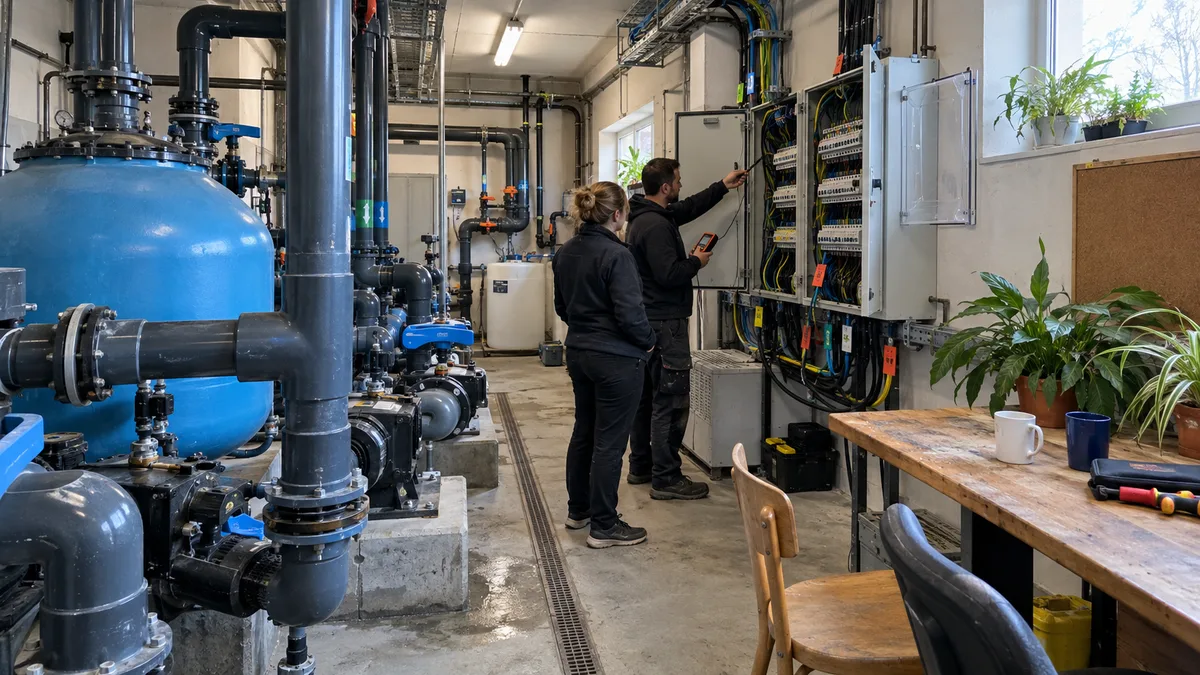
A missing design does not mean that the electrical inspector cannot visit the site. First, however, they need to determine whether a single document has been lost or whether the installation lacks drawings, previous inspection reports, the external influences assessment and records of alterations.
Nařízení vlády č. 190/2022 Sb. lists the supporting documents for initial, periodic and extraordinary inspections of designated electrical equipment in Annex 2. The required documents differ between the individual types of inspection. For an initial inspection, the as-built documentation is also important for comparing the completed installation with the design.
Without a complete set of records, the inspector can examine accessible parts of the installation, perform the appropriate tests and map the distribution boards and circuits. However, they cannot reliably confirm compliance with a diagram, design or original conditions if the relevant documents are unavailable.
First, determine exactly what is missing
Divide the documents into three groups:
- available – the document is available and reflects the current installation,
- to be located – a copy may be held by the building owner, facility manager, designer, installation contractor or previous electrical inspector,
- unavailable – the document was probably never created or a usable version can no longer be obtained.
It is also important to distinguish between a lost inspection report and a design that never existed. A copy of an inspection report can sometimes be obtained from the client who commissioned it or the person who prepared it. A missing as-built drawing, by contrast, may require the installation to be surveyed and new documentation created.
What can be verified on site
The specific procedure will be determined by the electrical inspector according to the type of equipment, the scope of the assignment and the operating conditions. For an accessible installation, they can usually:
- identify distribution boards, protective devices and accessible final circuits,
- compare circuit-breaker labels with the parts of the premises they actually supply,
- inspect enclosures, terminals, labels, protective bonding and visible damage,
- measure protective-conductor continuity and insulation resistance,
- verify the conditions for protection by automatic disconnection,
- test residual-current devices and other protective devices,
- check polarity, phase sequence or the operation of selected circuits where relevant to the inspection scope.
Testing cannot, however, reliably reconstruct the route of every cable concealed beneath plaster, the original design calculations or the condition of enclosed structures. A working socket alone also does not prove that the protective device or conductor cross-section is correct or that protection against electric shock is effective.
The outcome of the first visit may therefore be a completed inspection, but it may also be a list of missing documents, inaccessible areas and steps required for a proper assessment of the entire agreed scope.
What to prepare for each type of inspection
| Type of inspection | Important documents | How their absence may affect the inspection |
|---|---|---|
| Initial | As-built documentation, technical report, external influences assessment, records of inspections and tests performed during installation, partial inspection reports and available documents for incorporated products | Without documentation, the new or modified installation cannot be compared with its design and as-built condition to the required extent. |
| Periodic | Operating, design or drawing documentation, previous inspection report, external influences assessment and records of alterations, repairs and rectification of defects | Testing can verify part of the current condition, but it is more difficult to assess changes since the previous inspection and their relationship to the original conditions. |
| Extraordinary | Documents used for a periodic inspection and a description of the event or intervention that prompted the inspection | Unless the event is clearly defined, it may not be apparent which parts of the equipment require more detailed examination. |
If the assignment includes the electrical installation, photovoltaic system, machinery or lightning protection, the individual parts may require different documents and appropriately qualified inspection work.
Checklist before placing an order
| Document or information | Available | To be located | Unavailable |
|---|---|---|---|
| Most recent inspection report | □ | □ | □ |
| Older inspection reports | □ | □ | □ |
| Records of previously rectified defects | □ | □ | □ |
| Design or as-built drawing | □ | □ | □ |
| Single-line diagram of the distribution board | □ | □ | □ |
| Current circuit schedule | □ | □ | □ |
| External influences assessment | □ | □ | □ |
| Instructions and maintenance requirements for important equipment | □ | □ | □ |
| Records of repairs and installation extensions | □ | □ | □ |
| Documentation from installation or reconstruction work | □ | □ | □ |
| Available documents for distribution boards and other products | □ | □ | □ |
| Description of the reason for the extraordinary inspection | □ | □ | □ |
| Access to all areas within the inspection scope | □ | □ | □ |
| Possibility of an agreed shutdown | □ | □ | □ |
For each item marked “to be located”, note who may hold it. The inspector can then determine whether to wait for the documents or recommend that replacements be prepared.
What may need to be added
The scope of replacement documentation depends on the specific installation and what must be verified during the inspection. It may most commonly include:
- an as-built drawing,
- a single-line diagram of the distribution board,
- a current circuit schedule,
- preparation or updating of the external influences assessment,
- labelling of distribution boards, circuit breakers, circuits and terminals,
- operating instructions and maintenance requirements,
- records of completed alterations,
- retrieval of information about protective devices, wiring or incorporated products,
- targeted opening of an area whose condition cannot reasonably be verified by other means.
Redrawing a single distribution board does not replace documentation for the entire installation. At the same time, there is no reason to document parts of the building automatically if they fall outside the agreed inspection scope. The inspector should explain which document is required and what cannot be verified without it.
Completing the documentation is also a different task from correcting identified technical defects. If the inspection reveals exposed live parts, a distribution board damaged by heat or another condition presenting an immediate risk, continued use must not rely solely on a promise that a drawing will be added later.
If you first need to map the current condition and define the missing documents, this can be arranged as part of an electrical inspection. The quote should distinguish between the inspection itself, circuit mapping, preparation of documentation and any repairs.
What to provide for comparable quotes
Include the following with your enquiry:
- the address, use and basic description of the building,
- the required type of inspection,
- the number and designations of the distribution boards,
- the approximate number of circuits,
- the completed documentation checklist,
- photographs of closed distribution boards, rating plates and labels,
- information about access to individual areas,
- shutdown options and restrictions,
- an overview of known alterations, faults or previous defects.
Do not open a distribution board merely to take a photograph unless you have the appropriate qualifications and safe working conditions. For an initial quotation, legible labels, an overall view and an accurate description of the scope are more useful than a dangerously obtained photograph of internal components.
The quote should distinguish between:
- visual inspection, testing and preparation of the inspection report,
- identification of unlabelled circuits,
- creation or updating of documentation,
- rectification of defects and subsequent verification,
- travel, shutdowns and work outside normal operating hours.
The price of inspecting one distribution board is not comparable with the price of inspecting an entire installation, including final circuits. Before placing the order, therefore, obtain written confirmation of the equipment covered, the expected deliverables and the number of visits.
What to check in the inspection report
The inspection report must clearly define the equipment inspected and the scope of the inspection performed. Under Annex 2 to Nařízení vlády č. 190/2022 Sb., it must also record the documents used, the work performed, measurement results, identified defects and the inspection conclusion.
For an assignment involving incomplete documentation, pay particular attention to:
- which distribution boards, circuits and areas were included,
- which documents were available to the inspector,
- which parts were inaccessible or could not be verified,
- how the absence of documentation was assessed,
- what needs to be added and what must be verified again.
A description such as “building inspection” without further detail may not clarify whether offices, storage areas, outdoor wiring or tenant equipment were included. If you also commissioned supplementary documentation, accept the drawings and other documents as separate deliverables in the agreed format.
Short answer
An electrical inspection without the original documentation can begin with a visual inspection, testing and mapping of the actual condition. Whether the entire agreed scope can be assessed depends on the type of inspection, the installation and the significance of the missing documents.
Before requesting a quote, divide the documents into “available / to be located / unavailable”. The quote should then define the inspection, supplementary documentation and any repairs as separate items.
Frequently asked questions
Can an inspection report be issued without a design?
It depends on the type of inspection, the scope of the equipment and which document is missing. The inspector can carry out the available visual inspection and testing, but cannot confirm compliance with documentation they did not have. For an initial inspection, completing the as-built documentation may be essential to verify the entire scope.
Is the latest inspection report sufficient for a periodic inspection?
The previous report is an important supporting document, but it may not replace operating and drawing documentation. You should also prepare any available records of alterations, repairs, maintenance and rectification of previous defects.
Who can replace missing documentation?
That depends on the type of document. Circuit identification and simple drawings can be commissioned as part of the assignment, while design documentation or a professional external influences assessment requires the appropriate expertise. Confirm the author, scope, purpose and delivery format in advance.
Do walls need to be opened for the inspection?
A standard visual inspection and testing usually begin without destructive work. Targeted opening may be proposed if important information or the condition of a specific part cannot reasonably be verified in another way. The location, reason and subsequent reinstatement of the structure should be agreed in advance.
Why is an inspection without documentation more time-consuming?
Additional time is needed to identify circuits, verify labels and determine the actual installation. Creating drawings, labelling distribution boards or completing operating documents may constitute further separate work.
Sources for this article
- Electrical inspections – a service provided by SOHE.
- Accompanying and operating documentation for electrical equipment – an overview of documents used during equipment operation.
- Required contents of an inspection report – checking the scope, supporting documents, defects and inspection conclusion.
- Nařízení vlády č. 190/2022 Sb. – requirements for designated electrical equipment, supporting documents for inspections and the contents of inspection reports.
This article is provided for informational purposes and does not constitute legal advice. The specific inspection arrangements and supplementary documentation requirements must be determined according to the actual operation, the manufacturer’s documentation, the operating environment and the risk assessment.
Do you need to define the scope of the installation, arrange an electrical inspection and determine which documents must be added? Send us a no-obligation enquiry or email info@sohe.cz.