
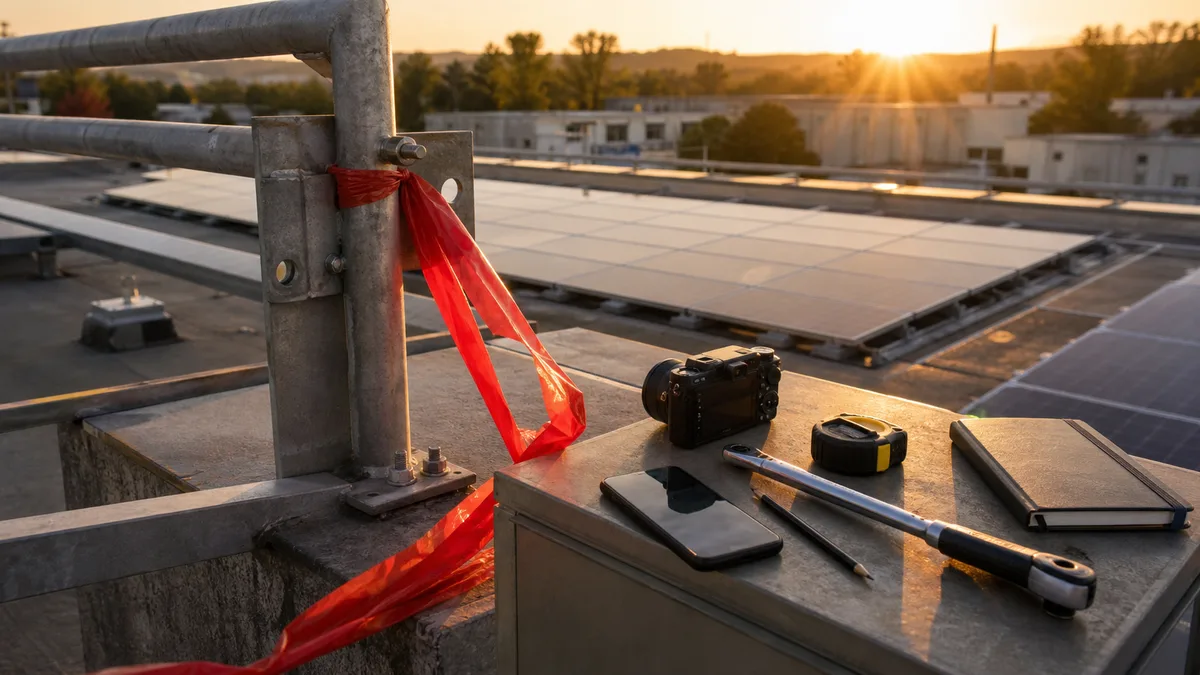
In practice you come across occupational safety reviews that get dispatched in the last week of December, take twenty minutes and end with the phrase “no defects found”. What remains is a single sheet of A4 that nobody opens again until the following December. Yet for many companies the review is the only occasion when someone looks at the operation once a year through something other than a production report — and the cheapest way to find out what has come loose, been built over or ceased to apply during those twelve months.
The annual OHS review does not rest on a recommendation or a standard, but on a single sentence in the Labour Code. That sentence is short, asks for little and, above all, prescribes no form. That is precisely why so many misconceptions cling to it — from “it always has to be done by a qualified professional” to “the inspector asks to see it first”. Let us go through what the law actually says, what the review has to cover, what a record you can go on working with looks like, and where companies most often get stuck.
What Section 108 of the Labour Code actually requires
Under Section 108(5) of Act No. 262/2006 Sb. (the Labour Code), the employer is obliged to organise, at least once a year, reviews of occupational safety and health protection at all of the employer’s workplaces and facilities, in agreement with the trade union organisation or the employee representative for OHS, and to remedy the shortcomings identified.
That one sentence contains four requirements, and every one of them tends to go missing in practice:
- At least once a year. This is a frequency, not a deadline of 31 December. A company that walks its operation every six months does more than the law asks — and halves the gap between a finding and its remedy.
- At all workplaces and facilities. That includes the boiler room, the archive, the garage, the roof with the photovoltaic array and the branch office a sales rep visits once a quarter. What gets skipped is exactly the place nobody normally goes — and that is where findings accumulate.
- In agreement with employee representatives. Where no trade union organisation or OHS representative operates, there is nobody to reach agreement with; that does not end the duty to organise the review. The practical minimum is to bring in the managers of the individual operations — they know where the work is done differently from how it is written down.
- And to remedy the shortcomings identified. This is the part records most often fail to see through. A finding without a responsible person and a deadline is not a finding, it is a note.
What you will not find in that provision: the form of the record, its mandatory particulars, or any qualification requirement for whoever leads the review.
Documentation: the distinction that gets muddled
The Labour Code expressly requires documentation for something else — for the identification and evaluation of risks and the measures adopted, under Section 102(4). For the review under Section 108(5) there is no equivalently worded instruction.
That does not mean a record is not worth keeping. Risk assessment is a document a company evidences on paper. The review is an activity, and Section 108(5) does not expressly prescribe a written record of it — but a record is the practical, and in everyday operation the strongest, means of showing that the review took place, what scope it covered and what followed from it. It can be evidenced in other ways too, by witness testimony or by follow-up orders and proof of remedial work, but that is substantially more laborious and less reliable.
One thing does need setting straight, though. In proceedings on an administrative offence it is the administrative authority that proves the breach of duty, not the employer: until guilt has been decided with final effect, the accused is presumed innocent and any doubt is resolved in their favour (Section 69(2) of Act No. 250/2016 Sb.), while Section 50(3) of the Administrative Procedure Code requires the administrative authority to establish the circumstances both for and against. Talk of a “burden of proof on the employer” is therefore inaccurate. It does not weaken the practical case for a record, however — under Section 81 of Act No. 250/2016 Sb., the facts established during an inspection may be the sole basis for a decision on an administrative offence, and arguing against what the inspector wrote down works better with your own documentation than from memory.
Who may lead it
Two things regularly get merged into one here, and it pays to keep them apart.
Leading the review itself. The text of Section 108(5) of the Labour Code specifies no particular qualification for whoever organises and leads the review. No duty to hire someone from outside for the walk-through follows from that provision.
Ensuring risk-prevention tasks. That is a separate duty under Section 9 of Act No. 309/2006 Sb., and it depends on headcount: up to 25 employees, the employer may handle risk-prevention tasks personally, provided they have the necessary knowledge; with 26 to 500 employees, personally only if professionally qualified, otherwise through a professionally qualified person; above 500 employees, through one or more professionally qualified persons (Section 9(3)).
There is one further bridge between the two that gets overlooked: for an employer with 26 or more employees, Section 9(4)(d) of Act No. 309/2006 Sb. requires the participation of a professionally qualified person in the regular evaluation of the state and level of occupational safety and health protection — and the annual review typically falls within such an evaluation. So the blanket line “you don’t need anyone from outside for the review” does not hold above 25 employees.
For a company of up to 25 employees, the message is unpopularly simple: it can manage the review in-house, provided it has the necessary knowledge. It needs an outline, last year’s record and someone willing to write down the uncomfortable parts too. The professional coverage of the remaining risk-prevention tasks has to be assessed separately, though — by headcount, by in-house knowledge and by whether the employer is professionally qualified. An external qualified professional also makes sense where the time, the distance or the knowledge of the rules for a given technology is missing; what such cooperation usually costs we covered separately. If you don’t feel up to the review, or you want a record that holds up under inspection, we will walk the operation with you and hand over a list of measures with deadlines and responsibilities, not a rubber stamp.
What the review has to cover
There is no need to invent the outline; you can copy it from the inspectorate. The most frequently identified shortcomings are summarised by the Státní úřad inspekce práce (State Labour Inspection Office) in Program kontrolních akcí SÚIP na rok 2026 (its 2026 inspection programme, issued in December 2025, p. 24), covering the monitored period of 2025, for which the document reports 7,462 inspections carried out. Roughly 30 % of the shortcomings fall to training outlines and scope, 27 % to the identification and evaluation of risks, 16 % to working procedures and 14 % to unmaintained equipment without inspections; the rest is spread across further areas. The document gives only these shares, not the counts of individual findings, so read the ranking of topics from them, not exact statistics. Even so, it is a ready-made list of chapters.
| Area | What to go through | The finding that keeps recurring |
|---|---|---|
| Training and its outlines | Whether the outline matches the risks of the specific operation, refresher intervals, attendance sheets, verification of knowledge | A generic outline off the internet that doesn’t know a single machine in the company; missing refresher training after a change of job duties |
| Risk identification and assessment | Whether the register is up to date after new technology, a move, a change of shift pattern or the arrival of agency workers | A document from the year the company moved — the two lines added last year aren’t in it |
| Working procedures | Operating instructions at machines, procedures for work at height and lone working, prohibitions and whether they can be enforced | The procedure on paper differs from practice on the shop floor, because “there’s no other way to do it” |
| Machinery and equipment | Checks under Government Regulation No. 378/2001 Sb., electrical inspections, reserved technical equipment, the manufacturer’s accompanying documentation | A circular saw without a riving knife, a grinder without a work rest, a deformed ladder rung, a compressor with an expired pressure-vessel inspection |
| Premises and operation | Escape routes kept clear, signage, rack load capacity and anchoring, traction battery charging, lighting and housekeeping | An escape route blocked with pallets before stocktaking; a rack straightened after a forklift hit and still in use |
| PPE and first aid | Issue records, condition and service life of protective equipment, first-aid kit contents, the accident book | Gloves issued with no record of to whom and when; expired sterile dressings; minor injuries that never made it into the accident book |
Checks of machinery under Government Regulation No. 378/2001 Sb. are carried out at least once every 12 months, unless the manufacturer, a special regulation or standard values specify otherwise — in more detail in the article on checks of machinery and technical equipment under Government Regulation 378/2001 Sb. For electrical installations the intervals depend on the environment under ČSN 33 1500 (the Czech technical standard for electrical installation inspections); the review is a good moment to compare the dates against the calendar rather than against a hunch.
Two findings recur across workshops, and both have a technical cause worth knowing. The first is a circular saw with the riving knife removed: the knife holds the kerf open, and when it is missing, the wood closes on the blade, jams against the rising teeth and the offcut is thrown back at the operator. The second is a cable reel extension lead used while still coiled — a coiled cable has no way of cooling, the insulation ages faster, and that is why the reel’s rating plate carries two different load figures, one for the unwound state and a lower one for the wound state. Both take a few seconds to spot during a review and cost nothing to put right.
What you risk if the review is missing
You will not find the word “review” in Act No. 251/2005 Sb., on labour inspection. There is therefore no standalone offence of “annual review not carried out”, and the answers the internet gives to this question contradict one another. Penalties rest on the general elements of offences in the field of occupational safety — Section 17 for natural persons, Section 30 for legal persons and self-employed natural persons. One of them targets breaches of duties concerning employee participation in resolving OHS matters, and its footnote refers precisely to Section 108 of the Labour Code; its upper penalty limit is CZK 300,000. The elements covering untrained employees, unassessed risks or a machine in an unsatisfactory condition carry a substantially higher ceiling — up to CZK 2,000,000.
The Labour Inspection Act recognises no standalone offence for failing to carry out the annual review — breaches of duties around Section 108 are assessed on the specific circumstances and the penalty cannot be estimated in advance. What is certain is what accumulates over a year without a review. And whether an inspector will ask for the review record specifically cannot be predicted — the only certainty is that an inspection with documented paperwork runs differently from one without it.
How much the inspectorate finds is a public figure. According to Program kontrolních akcí SÚIP na rok 2026 (December 2025), the Státní úřad inspekce práce plans at least 8,700 inspections for 2026. For the monitored period of 2025 — the document itself gives no more precise definition — a total of 781 fines amounting to CZK 41,543,988 were imposed in the area of occupational safety and reserved technical equipment governed by Act No. 250/2021 Sb. That is an aggregate across all breaches in both areas together, from untrained employees to equipment without inspections, and it cannot be used as an estimate of the penalty for a missing review; the amount of an individual fine depends on the seriousness of the breach, the size of the employer and which elements of the offence are involved.
A record you can work with
A record saying “review carried out, no defects found” proves only that somebody sat down somewhere. You can tell a usable record by the fact that the scope of the inspection is apparent from it and that tasks fall out of it. It should contain:
- the date and the name of whoever led the review,
- who took part on the employees’ behalf — the OHS representative, the trade union organisation, otherwise the operation managers; plus a note if none operate at the employer,
- a list of the workplaces actually walked, including the boiler room, the archive store, the garage and the roof,
- a finding described by place and thing (“rack R3 in the store — load capacity label missing, one upright deformed”), not phrased as “minor defects identified”,
- the measure, the name of the person responsible and the deadline,
- verification that it was completed, with a date — the part most often missing in companies, and the one that finally gives effect to the word “remedy” in the law.
A proper review can also end with nothing to remedy. But such a result has to be credibly supported by the scope of the inspection: a list of the workplaces actually walked, what was gone through at each, and who was present. The phrase “no defects found” on its own, with no description of scope, evidences nothing.
And last year’s findings with the “completed” column still empty are not a reason to stop recording findings — a truthfully recorded finding is always better than no record at all. They are a reason to write down what happened to them: what measure was adopted, by whom and with what result. An open finding with no documented measure is a weak spot during an inspection; the same finding with documented remedial work is, on the contrary, evidence that the system works.
When to do it so that it shows something
You don’t run a thermal survey on a switchboard that is powered down, and you don’t review an empty shop floor. On an idle operation you won’t spot that the operator can only reach the switch by going round a guard, or that the aisle between the racks turns into a dumping ground every afternoon after deliveries. A few rules that turn the review into work rather than a formality:
- During operation and on a normal shift, not during the plant shutdown or at the weekend.
- Not in the last week of December. The law sets a frequency and a scope, not a date; pick a time that leaves both time and budget for the findings.
- Tie it to the dates you track anyway — electrical inspections, fire extinguisher checks, refresher training. One calendar instead of five.
- A large site in stages. The text of Section 108(5) does not require the whole operation to be walked in a single day; what matters is that the records show everything was covered over the year.
- Bring last year’s record, the accident book, the schedule of inspections and checks, the risk register and the attendance sheets. A review without last year’s record in hand is a stroll.
What’s new for 2026 (and what isn’t)
The wording of Section 108(5) of the Labour Code as at 1 January 2026 is the same as a year earlier — there is no “2026 novelty” in the review itself, whatever the training leaflets promise. What has changed is the surroundings the review reaches into:
- Government Regulation No. 322/2025 Sb., which governs the records of occupational accidents, the accident book and the accident report, took effect on 1 January 2026. The review is a good moment to compare whether the form circulating around the company matches the new rules and whether minor injuries are making it into the book; what to do in the first hours after an accident is summarised in the article on an occupational accident and the accident book.
- The amended wording of Act No. 309/2006 Sb. and Government Regulation No. 591/2006 Sb. has applied since 1 November 2025. Companies that work on construction sites or commission construction work have one chapter more in the review.
Sources for this article
- Inspections of appliances and tools – a SOHE service.
- A labour inspectorate inspection – what an inspection goes through and in what order it asks for documentation.
- OHS documentation for a small company – the minimum set of paperwork the review builds on.
- OHS training for employees – refresher intervals and what the outline should actually contain.
- Zákon č. 262/2006 Sb. – the Labour Code; Section 108(5) (OHS reviews at least once a year) and Section 102(4) (documentation on risks and the measures adopted).
- Zákon č. 309/2006 Sb. – further conditions of OHS; Section 9(3) determines who may ensure risk-prevention tasks by headcount, Section 9(4)(d) requires, at 26 or more employees, the participation of a professionally qualified person in the regular evaluation of the state and level of OHS.
- Zákon č. 251/2005 Sb. – on labour inspection; offences in the field of occupational safety and the upper penalty limits (Section 17 and Section 30).
- Zákon č. 250/2016 Sb. – on liability for administrative offences; Section 69(2) (presumption of innocence, doubt resolved in the accused’s favour) and Section 81 (facts established during an inspection as the basis for a decision).
- Zákon č. 500/2004 Sb. – the Administrative Procedure Code; Section 50(3) requires the administrative authority to establish circumstances both for and against.
- Zákon č. 250/2021 Sb. – occupational safety in connection with the operation of reserved technical equipment.
- Nařízení vlády č. 378/2001 Sb. – requirements for the safe operation and use of machinery and equipment, including the frequency of checks.
- Nařízení vlády č. 322/2025 Sb. – records of occupational accidents, the accident book and the accident report; effective from 1 January 2026.
- Nařízení vlády č. 591/2006 Sb. – requirements for occupational safety and health protection on construction sites; amended as of 1 November 2025.
- Program kontrolních akcí SÚIP na rok 2026 – Státní úřad inspekce práce, December 2025; the inspection plan for 2026, the shares of the most frequent shortcomings and the summary of fines for the monitored period of 2025 (p. 24).
- ČSN 33 1500 – intervals for regular inspections of electrical installations by environment; the standard is not freely available.
This text is informative in nature and does not replace legal advice. The specific arrangements for the review, its scope and the follow-up measures need to be set according to the actual operation, the manufacturer’s documentation, the environment of use and the risk assessment.
Do you need to go through the annual review with someone who will also write down what makes uncomfortable reading, and leave you a list of measures with deadlines and responsibilities? Get in touch via a no-obligation enquiry or at info@sohe.cz. If equipment without inspections falls out of the review, we can follow straight on with inspections of appliances and tools, so the findings don’t carry over into the next year.