
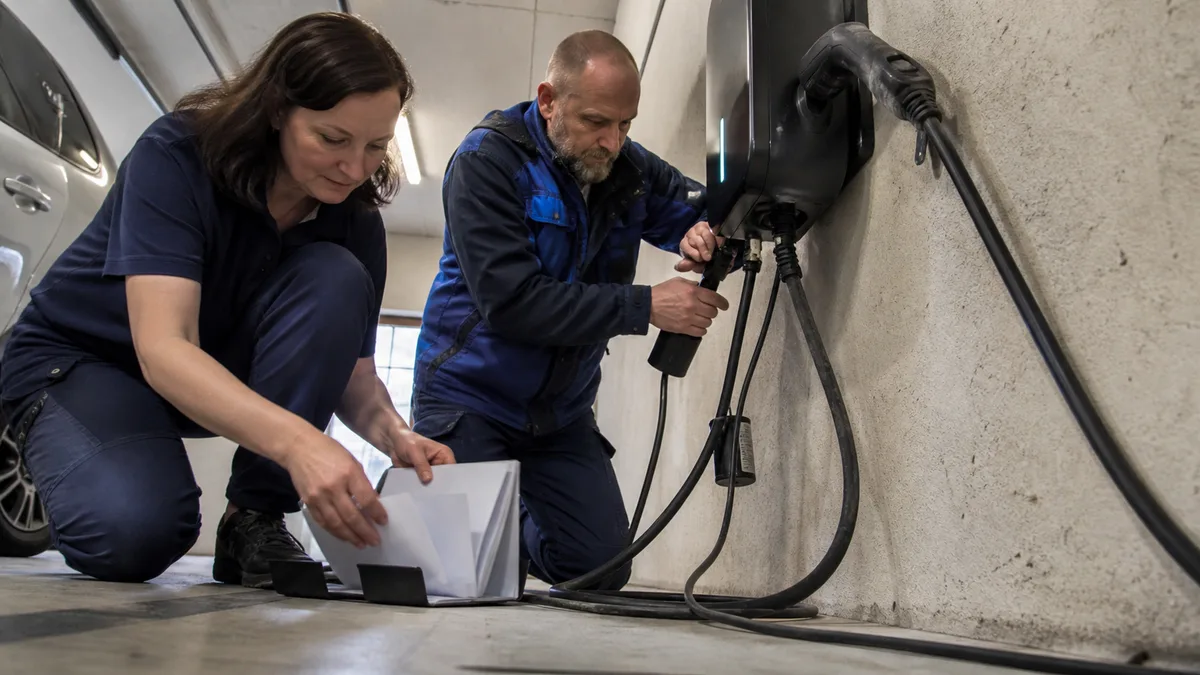
The electrician tightens the final terminal, the wallbox light turns green, and the first company car is fully charged by morning. The invoice goes to accounting, the station manual stays in the cardboard box, and no one deals with the initial inspection—the building’s electrical installation was inspected only last year, after all. The question does not arise until eighteen months later, during an inspection or when an insurance adjuster investigates an overnight garage fire: what was the basis for commissioning this station?
Several mutually contradictory claims circulate about company wallboxes. That they must be inspected once a year. That an inspection of the building’s electrical installation is sufficient. That if the station is certified, all protective measures have already been taken care of at the factory. The regulations tell a different story, and the difference is reflected not in the installation price but in what you have in your records.
We will examine how a wallbox is classified under Nařízení vlády č. 190/2022 Sb., ve znění nařízení vlády č. 175/2024 Sb., when an initial inspection is required and what documents you should obtain from the installation contractor, how the recurring inspection interval is determined, how to tell whether the technician tested the station rather than just its supply circuit, and what HZS recommends for garages.
A wallbox is designated electrical equipment. Sometimes even Class I
Nařízení vlády č. 190/2022 Sb., ve znění nařízení vlády č. 175/2024 Sb., governing designated electrical equipment includes the electrical installations of buildings and technologies. A permanently connected charging station forms part of such an installation. The exemptions in the regulation apply to appliances not intended for permanent connection—a wallbox bolted to the wall of a building and hard-wired to a distribution board does not qualify.
Most company charging stations fall into Class II, for which the procedure is straightforward: an initial inspection, documentation and recurring inspections. Class I adds another step that can be difficult to arrange retrospectively. Under Section 6 of the regulation, designated Class I electrical equipment may be commissioned on the basis of a certificate issued by an authorised organisation—Technická inspekce ČR—and the operator must retain it throughout the equipment’s service life. The initial inspection report does not replace this step.
Under Section 4 of the regulation, it is the environment, not the station’s power rating, that can place it in Class I. This includes buildings whose fire safety design allows more than 200 people to be present, as well as areas presenting a risk of explosion or fire involving flammable liquids. A garage beneath an office building or shopping centre, a workshop with a paint shop, or a flammable-materials store—the classification should be verified before the station is switched on, not during its first recurring inspection. Crucially, hazardous external influences must follow from the design or operating documentation, not from someone’s impression at the site. This leads directly to the document most often missing from the handover package.
The initial inspection and the documents handed over with it
An initial inspection is a prerequisite for commissioning; Section 6 of the regulation requires it for designated electrical equipment. A second trigger is overlooked even more often: under the same section, an inspection must also be carried out when a parameter of the overload and short-circuit protection changes or when the protection against electric shock is modified.
Connecting a wallbox to an existing distribution board does exactly that. A circuit breaker is added, a residual-current device is added or changed, and the distribution of loads across the phases changes. Last year’s inspection report for the building does not cover this intervention—it describes a condition that no longer exists.
Once installation is complete, Section 6 of the regulation requires you to obtain two items from the contractor:
- accompanying documentation corresponding to the installation as actually built, enabling its operation, maintenance and inspection—and including an assessment of external influences;
- an initial inspection report, unless you and the contractor have agreed on another way of arranging it.
The external influences assessment report is the item most often omitted and most sorely missed. Without it, it is difficult to justify the selected IP rating of an outdoor station, determine the interval until the next inspection, or support the classification of a disputed garage. Request it in the same email as the handover report, not a year later. We discuss everything that must accompany the equipment throughout its service life in our article on operating documentation for electrical equipment; the required contents of the first report itself are covered in our article on the initial electrical inspection.
The technical aspects of the connection are governed by standards—internal wiring by ČSN 33 2130 ed. 4 and the supply of electric vehicles itself by ČSN 33 2000-7-722 ed. 3. ČSN 33 2130 ed. 4 also newly addresses wiring for charging in collective garages. The construction aspect—preparing cable routes and charging points in new buildings and major building alterations—is a separate matter for the designer. If the wallbox increases your reserved capacity, the schedule must also account for the grid connection application submitted to the distribution company and its processing times; the application is filed electronically through the company’s portal.
You will not find “once a year” in the regulation
This is the most widespread misconception, and it even appears on charging-station sales pages. Příloha č. 4 nařízení vlády č. 190/2022 Sb., ve znění nařízení vlády č. 175/2024 Sb., which specifies recurring inspection intervals, does not contain a separate entry for charging stations. The interval is determined by the building and space in which the station is installed—summarised below, although the wording of the annex remains authoritative:
| Where the station is installed | Maximum recurring inspection interval |
|---|---|
| Building intended for administrative activities | 5 years |
| Building used for manufacturing, education, accommodation or medical purposes | 3 years |
| Building whose fire safety design allows more than 200 people to be present | 2 years |
| Wet areas and areas with a permanent presence of corrosive or contaminating substances | 1 year |
| Temporary construction-site installations | 0.5 years |
Areas presenting a risk of fire or explosion have their own regime in the annex, and equipment installed in them will often also be classified as Class I. Have both the classification and interval confirmed from the external influences assessment report rather than relying on the table in this article.
Three rules make the practical difference:
- If more than one row applies to a location, the shorter interval prevails. A wallbox in a production building that is also an area with a permanent presence of contaminating substances follows an annual cycle.
- A shorter manufacturer-specified interval takes precedence. Under Section 7 of the regulation, if the accompanying documentation specifies a recurring inspection interval shorter than the one in your inspection, maintenance and testing schedule, the manufacturer’s interval must be followed. This is where a one-year interval can legitimately arise—but as a requirement of the particular manufacturer, not as a blanket statutory obligation. That is why the manual from the box belongs in your records.
- Longer intervals are permitted only under a documented maintenance regime. Any extension depends on having a formal inspection, maintenance and testing schedule and records proving that it is actually followed. Ask the inspection technician to confirm the permissible extension for your building’s classification—without records, it is merely an unsupported claim.
When preparing next year’s schedule, use our 2027 inspection plan and add wallboxes as a separate line rather than as a sub-item of the building.
Type B RCD, or Type A with integrated 6 mA detection?
Charging a DC traction battery through an AC station can introduce smooth DC residual current into the installation. Neither a Type AC nor a Type A residual-current device responds to it, and such a current can also blind the device to faults that would otherwise cause it to trip. ČSN 33 2000-7-722 ed. 3 therefore requires each AC connection point to have a separate RCD with a rated residual current of no more than 30 mA, together with either a Type B RCD or a Type A or F RCD combined with a device detecting 6 mA DC residual current (RDC-DD).
The deciding question is simple: does the station have a built-in RDC-DD? Most models sold today do, in which case an upstream Type A RCD is sufficient. If not, a Type B RCD must be added—typically costing several thousand Czech crowns more. Check the manual for the exact variant, not a catalogue brochure covering the entire model range: in product families such as ABB Terra AC, Schneider EVlink, Wallbox Pulsar Plus, Zaptec, Alfen Eve, Mennekes Amtron and KEBA KeContact, the equipment differs between variants of the same model. Make sure the information is recorded in the documentation so the inspection technician can find it three years later.
The claim that “the station handles it internally” is not a guarantee in itself. In March 2023, Sweden’s Elsäkerhetsverket prohibited the sale of Easee Home and Easee Charge models, partly because of doubts that the electronic solution replacing an RCD would trip in every situation in which it was supposed to. The manufacturer challenged the decision, and no ban was imposed in the Czech Republic—but the case clearly illustrates why an inspection technician measures the operation of the protective system instead of merely reading about it in a data sheet.
How to tell whether the station was tested, not just its supply circuit
A wallbox inspection is not simply a matter of measuring loop impedance at the outgoing circuit in the distribution board. To verify the protective systems inside the station, the technician must simulate a vehicle—responding to the CP control signal and the PP signal in the Type 2 connector. Without this, the station will not switch on the power and cannot be tested.
EVSE adapters are used for this purpose, such as the Metrel A 1632 eMobility Analyser; Gossen Metrawatt offers a comparable adapter for its testers in the PROFITEST H+E range. These devices can simulate CP and PP circuits, induce fault conditions, verify the operation of the RCD built into the station and perform measurements in Mode 2, meaning on a portable cable with protective electronics.
In practical terms, this leaves one question worth asking before placing an order: what equipment will the technician use for the measurements? Without an adapter, they can verify the supply circuit but not the station. The report should then contain measured values for insulation resistance and fault-loop impedance, verification of protective bonding, and a functional RCD test including its response to a DC component—not merely the words “no defects found.” We explain how to read such a report and what each finding means in our article on how to read an electrical inspection report.
The second question is who will sign the report: an inspection technician holding a valid certificate and working for an organisation authorised for the relevant scope. Both have a limited validity period, and proof of both can be requested before the technician arrives.
If you would rather not piece all of this together yourself, our electrical inspections begin with exactly these checks: we review the documentation, the external influences assessment report and the building classification before agreeing on the scope, equipment and date.
Garages: what HZS recommends and why
The 2021 guidance issued by Ministerstvo vnitra – GŘ HZS ČR, “Požární bezpečnost staveb – elektromobilita,” is an advisory document for professionals preparing fire safety designs, not a directly binding regulation for operators. Its contents nevertheless shape what designers, firefighters and insurers will expect from you:
- a fire compartment used for parking and charging electric vehicles should be classified at least in the fourth fire safety level;
- EPS is recommended in collective garages, while compartments containing charging spaces should additionally have an automatic fixed fire suppression system and smoke and heat exhaust ventilation; when existing buildings are altered, ZOKT is recommended where a single fire compartment contains four or more charging spaces, and its omission should be justified in the PBŘ;
- charging spaces should be at least 3.5 m wide, equivalent to a space for people with physical disabilities, to allow emergency intervention;
- charging should take place only in fixed parking spaces, not in automated parking systems—a burning vehicle cannot be removed from such systems;
- the PBŘ should describe how a vehicle containing a battery in an abnormal condition will be removed from the garage, taking into account the equipment actually available to the locally responsible regional HZS; if it lacks the necessary equipment, measures should be proposed for the building owner;
- no requirements beyond the ordinary fire safety standards for buildings are imposed on individual and row garages—a small company with a wallbox in its own yard or a separate garage therefore does not need to address any of the preceding points.
The reason for these stricter recommendations is practical, not bureaucratic. A fire involving a traction battery introduces voltage at the terminals, the release of toxic gases, jets of hot electrolyte, contamination of firefighting water and the risk of reignition hours later—water cannot reliably extinguish the cell inside the battery; it only cools the surroundings. Garage types and their classification are governed by ČSN 73 6058; the category to which your building belongs follows from the design, not from the number of cars that fit inside.
How much it costs and what affects the price
Treat these figures as indicative; the final price depends on an on-site assessment:
- wallbox installation, including the initial inspection, commonly costs around CZK 10,000–20,000 in straightforward cases, excluding the station itself; the price is affected by the supply-cable length, protective devices, RCD and construction work;
- a separate charging-station inspection is commonly offered for a few thousand Czech crowns per station, with significant volume discounts where several charging spaces are located at one site;
- an external Type B RCD typically costs several thousand Czech crowns more than Type A—which is why built-in 6 mA detection should be checked before purchasing the station, not after installation.
The most expensive items are usually the ones no one anticipated: increasing the reserved capacity, retrospectively preparing a missing external influences assessment report, or discovering that the building falls into Class I and requires a certificate from an authorised organisation before commissioning.
What to prepare before calling an inspection technician
- the design documentation, or at least as-built drawings of the supply circuit and distribution board;
- the manufacturer’s manual for the exact station—type of protection, prescribed inspection interval and circuit-protection requirements;
- the external influences assessment report for the installation site;
- the latest inspection report for the building’s electrical installation;
- the number of charging spaces and information about any planned additions, for load-management purposes;
- the building’s fire safety design if the installation is in a garage or a building with higher occupancy.
Six items that should come together within a morning after a properly completed handover. If they do not, that is a finding in itself—and it is better to discover it now than during the first insurance claim.
Sources used for this article
- Electrical inspections – a SOHE service.
- Initial electrical inspection – when it is performed, what it must contain and why an inspection of the building does not replace it.
- Operating documentation for electrical equipment – what to obtain from the installation contractor and what must accompany the equipment throughout its service life.
- How to read an electrical inspection report – what the individual findings mean and how to recognise a report backed by properly completed work.
- Nařízení vlády č. 190/2022 Sb., ve znění nařízení vlády č. 175/2024 Sb. – governing designated electrical equipment and requirements for ensuring its safety; classification, initial and recurring inspections, and the intervals in Příloha č. 4.
- Zákon č. 250/2021 Sb., ve znění zákona č. 318/2025 Sb. – governing occupational safety in connection with the operation of designated technical equipment; the framework for authorised organisations, authorisations and certificates.
- ČSN 33 2000-7-722 ed. 3 – equipment for supplying electric vehicles; residual-current devices and protection against DC components.
- ČSN 33 2130 ed. 4 – internal electrical wiring.
- ČSN 73 6058 – individual, row and collective garages.
- Metodické doporučení MV-GŘ HZS ČR “Požární bezpečnost staveb – elektromobilita” (2021) – advisory material for professionals preparing fire safety designs.
This article is provided for information only and does not constitute legal advice. The specific inspection regime and classification of a charging station must be determined from its actual operation, the manufacturer’s documentation, the environment in which it is used and the risk assessment.
Are you installing wallboxes for company vehicles or taking over a completed installation from a contractor? We will review the documentation and building classification and carry out an electrical inspection, including measurements at the station itself using vehicle simulation rather than testing only the supply circuit. Send us a no-obligation enquiry or email info@sohe.cz, and we will get back to you with an available date.