
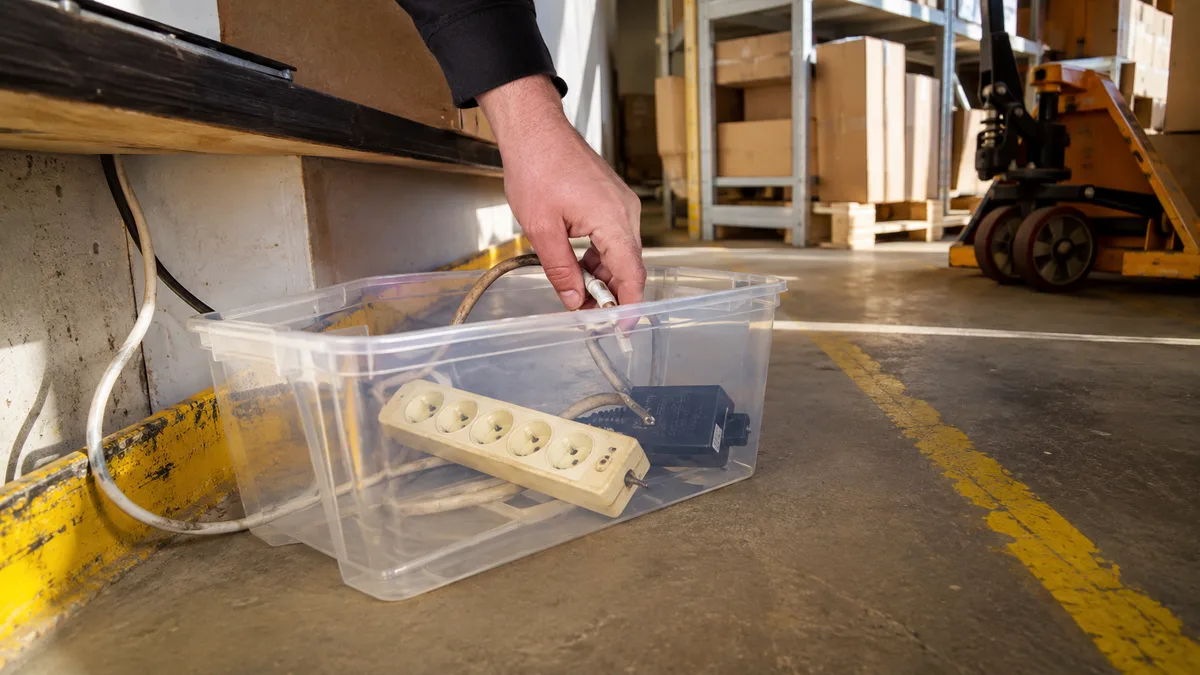
A power strip is often bought as an afterthought, plugged in under a desk and then effectively disappears from the inventory for the next five years. If it emerges six months later that the sockets in that production series lack safety shutters or that the lead melts under load, the company will never know. The retailer no longer stocks the product, nobody in the supply chain has your contact details and no recall email arrives.
Yet the information is publicly available. Every Friday, the European Commission publishes it in the Safety Gate system — complete with the brand, model designation, barcode and photograph. In Czech. Free of charge. It can also be downloaded as a file and compared with your own records.
This option receives little attention in the Czech Republic, even though it is the most comprehensive public source for retrospectively discovering that equipment still in use has since been recalled from the market. We will examine what the database contains, which office and workshop products were actually added over the past year, how to search it and what to do when you find a match.
What Safety Gate is and where its data comes from
Safety Gate is a rapid alert system for dangerous non-food products. Market surveillance authorities in Member States use it to report corrective measures involving products that pose a serious health and safety risk; the Commission checks the notifications and distributes them to the other Member States. Its legal basis is nařízení (EU) 2023/988 on general product safety, applicable since 13 December 2024 — Article 25 describes the system, Article 26 covers notifications and Article 34 establishes the public portal. Under Article 34(1), the portal provides the public with free and open access to selected information contained in notifications.
On the Czech side, responsibility is assigned to specific institutions. Under § 4 odst. 2 zákona č. 387/2024 Sb., o obecné bezpečnosti výrobků, the national Safety Gate contact point is Ministerstvo průmyslu a obchodu. Under § 5 odst. 1, market surveillance is carried out by eleven authorities; if no other authority has been designated for a particular product, responsibility rests with Česká obchodní inspekce under § 5 odst. 2. The reporting deadline is short: both § 6 odst. 1 of the same law and Article 26(4) of the regulation require notification no later than four working days after a corrective measure is imposed.
In practical terms, a report published on Friday contains cases that are days or weeks old, not months. Weekly reports have been available in the system since 2005; by 4 September 2026, there had been 1,114 of them.
A single record contains more than you might expect:
- the case number (for example,
SR/02163/26) and a link to the alert details; - the product category, product type, brand and commercial name;
- the type or model designation, batch number and barcode;
- the type of risk and a written description of the defect, usually including a reference to the breached legislation and European standard;
- the measures adopted, the party on which they were imposed and their effective date;
- the notifying country, country of origin and risk level;
- photographs of the product, often three;
- where it was sold — including the specific marketplace and listing code for online sales;
- where available, a link to the manufacturer’s or importer’s recall page.
The database focuses on consumer products, but professional products also appear in it. During the twelve-month period examined, 3,672 records were classified as consumer products and 180 as professional products. Power strips and chargers, however, are not divided by intended use — the same product may sit under a desk in an office or in a workshop.
Figures for the past twelve months
The following figures come from 52 weekly reports covering the period from 5 September 2025 (Report-2025-36) to 4 September 2026 (Report-2026-35), downloaded in XML format directly from the Safety Gate portal. They are counts of records in those reports, not the Commission’s official annual statistics.
- 3,852 alerts in total across all categories.
- 558 of them in the “Electrical appliances and equipment” category; 524 were classified as presenting a serious risk.
- 160 alerts directly concerned power supply equipment: extension leads and power strips, cable reels, chargers, mains adapters and power supplies.
- Of those 160, 45 concerned extension leads, power strips and cable reels; the remainder concerned chargers, adapters and power supplies.
- Risks: 133 cited electric shock and 45 fire (23 records cited both); other risks included burns and several chemical and environmental cases.
- 157 of the 160 were classified as presenting a serious risk.
- In 93 of the 160 cases, the measures included a recall from end users — an instruction to recover the product from people already using it.
- Country of origin: 130 of the 160 came from China, 12 from Poland, 4 from Germany, while 12 records stated “unknown”.
Now for the point that matters to Czech companies. During the same period, the Czech Republic reported 325 alerts, the fifth-highest figure in the entire EU. Yet precisely two of those 325 fell within the electrical category — a soldering iron and a Christmas lighting chain. The overwhelming majority of the remainder involved cosmetics (194) and chemical products (106). Extension leads and chargers also sold in the Czech Republic entered the database through notifications from Germany (31 of the 160), the United Kingdom in respect of Northern Ireland (28), Finland (27), France, Lithuania, Denmark, Hungary and Poland.
There are two conclusions. First, anyone who monitors only Czech sources will miss most cases. Second, a notification from another country does not mean that the product was not sold in the Czech Republic — products with Europlugs are typically part of the same series distributed throughout the internal market.
Specific cases relevant to offices
The following are selected records from the period examined. For each, we provide the weekly report date, brand and type, barcode, notifying country, the defect described in the record and the measure imposed.
Hama, Power strip 6 way, type 00 030383/G3101887, EAN 4007249303837 — report dated 13 February 2026, notified by Spain, case number SR/00443/26. The sockets lack safety shutters, allowing users to touch live parts. The product does not comply with the requirements of the Low Voltage Directive. Measure: withdrawal from the market imposed on both the manufacturer and distributor, effective from 19 January 2026. The record states that the product was sold online, including through Amazon (ASIN B073VDHKFP).
KOPP, POWERversal, types 226220013, 226320016, 229420012, 229520015, EAN 4008224565745, 4008224565752, 4008224646727, 4008224646734 — report dated 7 August 2026, notified by Germany, country of origin Germany. Due to an assembly error, users could receive an electric shock when touching the protective contact of the socket. The manufacturer itself adopted the measures: withdrawal from the market and recall from end users, effective from 18 May 2026. The record specifies that only products purchased between 1 January and 18 May 2026 were affected — exactly the kind of detail that makes monitoring the brand alone insufficient.
PLASTROL, extension leads PS-360, PS-460 and PS-560 in several lengths, EAN 5902273403203, 5902273403265, 5902273403326, 5902273406235 — report dated 14 August 2026, notified by Slovakia, country of origin Poland, SR/02257/26, SR/02258/26, SR/02259/26 and SR/02261/26. A design defect makes it possible to insert the plug of a Class I appliance into a socket intended for Class II appliances; the connected Class I appliance is then left without protection against electric shock. The products do not comply with the Low Voltage Directive or standards EN 60884-1 and EN 60884-2. Measures: withdrawal from the market, recall from end users and warning consumers, imposed on the distributor. The record states that the products were sold through tme.eu.
ACAR, extension lead PS-VMZ1, 10 m and 25 m — report dated 19 December 2025, notified by Slovakia, country of origin Poland, SR/04366/25. The same defect: a Class I plug can be inserted into a socket intended for Class II equipment. Sold through outlets including tme.sk. The same brand also appeared in a notification from Lithuania dated 28 November 2025 (type PS-2P, EAN 590179190018) due to inadequate insulation of the flexible lead.
GTV, extension leads AE-PS3G3M-00, AE-PS3G5M-00, AE-PS4G3M-00, AE-PS4G5M-00, AE-PS5G3M-00, AE-PS5G5M-00 — notifications from Lithuania (5 June 2026) and Poland (26 June 2026), country of origin Poland, EAN 5908231301192, 5908231301208, 5908231301215, 5908231301222, 5908231301239 and 5908231301246. The plugs lack protective sleeves, leaving live parts accessible. The measures differed between the two waves: the Lithuanian notifications involved withdrawal from the market imposed on the retailer, while the Polish measures were adopted by the manufacturer with effect from 11 June 2026 — some types were recalled from end users, while consumers were warned about the risks associated with others. In January 2026, the same brand was covered by a separate Polish notification concerning power connectors and terminals for a single-phase track system (types XLT-1FAC19-00 and others) due to inadequate protection of the protective conductor — in that case, the measures included recall from end users and a public announcement by the manufacturer.
Elektromet, Listwa zasilajaca przedluzacz, type YL-1113F — report dated 24 July 2026, notified by Poland, SR/02098/26. The rated current of the plug is lower than the rated current of the socket, meaning the device may overheat and cause a fire or burns; in addition, the clearance and creepage distances between the pin and earth are inadequate. Risks listed: burns, electric shock and fire.
RUGGED Trailing Sockets — report dated 9 January 2026, notified by Ireland, SR/00028/26. Due to a manufacturing defect, the product may overheat and the cable may melt under load, creating a risk of fire and burns. Measures: withdrawal from the market and recall from end users, effective from 28 November 2025 and adopted by the importer. The notification covers ten barcodes — one defect affecting an entire range of lengths and variants.
Akyga, power supply for desktop computers AK-B1-400, EAN 5901720130303 — report dated 5 December 2025, notified by Finland, SR/04233/25. Inadequate insulation between live primary parts and an accessible output connector; the capacitor bridging the basic insulation between the mains voltage and metal enclosure is not of the required Y2 type. The product does not comply with EN 62368-1. Measure: recall from end users, imposed on the distributor, effective from 12 November 2025. The notification also lists specific ranges of serial numbers.
Inter-Tech, power supply SL-500A, EAN 4260133120891, batch 88882009 — report dated 6 February 2026, notified by Finland, SR/00284/26. Inadequate creepage distance between live primary parts and accessible DC output connectors. Measure: recall from end users, effective from 26 January 2026.
Wozinsky, Fast GaN charger 65W, type WWCG01, EAN 5907769307492 — report dated 6 March 2026, notified by Finland, SR/00658/26. Inadequate charger insulation, creating a risk of electric shock and non-compliance with EN 62368-1. Measure: recall from end users, effective from 10 February 2026.
Topabol, socket adapter with four USB ports, type BYHL-803EU — report dated 24 April 2026, notified by Germany, SR/01218/26. The adapter has an earthed socket but a two-pin plug without a protective conductor, allowing a Class I appliance to be connected without earthing. Measure: recall from end users. Sold through Amazon (ASIN B0FRS259LK).
USB Charger Station, type WLX-A5+, twenty USB-A ports — report dated 31 October 2025, notified by the United Kingdom in respect of Northern Ireland, SR/03779/25. The plug is incorrectly earthed and may overheat and catch fire in the event of a fault; safety information is also missing. Measures: removal of the listing by the online marketplace, rejection of the product at the border and destruction of the product.
JSVER, World Travel Adapter Kit, type JSVER-PA1041-8D — report dated 31 July 2026, notified by Germany, SR/02139/26. Earthing is inadequate for some socket and plug combinations; in addition, the flat Type C plug can carry only 2.5 A, while Class I appliances require significantly more, potentially resulting in fire. Travel adapters have their own product type in the database — during the period examined, they were the subject of 15 notifications, plus one notification concerning an entire kit and one concerning a travel charger.
What about the workshop?
VIXSON Soldermas, soldering iron MSG001, 220 V / 60 W, EAN 3831127530319 — report dated 3 July 2026. This is one of only two Czech electrical records for the entire year: it was notified by the Czech Republic, SR/01930/26. Covers surrounding live parts can be removed without tools, allowing users to touch those parts. The product does not comply with EN 60335-1. Measure: sales ban imposed on the importer, effective from 11 June 2026. Notably, the product bears Class II equipment markings.
Kraft&Dele, welding machines KD1872 (MIG/MMA-200), KD1873 and KD1827 — three separate notifications from Poland between 5 September and 31 October 2025, EAN 5903957006963, 5903957006970 and 5903957005942. The cross-section of the power cable and the sockets used are inadequate; the conductor may overheat, damage the insulation and expose live parts. The products do not comply with EN 60974-1. Measures: withdrawal from the market and warning consumers. The report dated 9 January 2026 added two further notifications concerning inverter welding machines from the HECKERMANN and Rangers brands, both from Poland and both involving a risk of electric shock.
SAFELINE, cable reel CR115, EAN 5391361232106 — report dated 3 October 2025, notified by Ireland, SR/03424/25. The product is marked as having an IP44 ingress protection rating, but its actual rating is IP20; users therefore assume that the reel provides moisture protection when it does not. Measures: withdrawal from the market and recall from end users.
This last case also illustrates a potential pitfall. The product description specifies four Irish and British-style sockets — a reel of this kind was not sold in the Czech Republic. For notifications from Ireland and from the United Kingdom in respect of Northern Ireland, therefore, examine the photograph and description and check the shape of the plug and sockets. Some concern products fitted with BS 1363 plugs that are not intended for the Czech market. This does not apply across the board, however: chargers, adapters and power supplies are often identical.
How to search the database
The portal is available at ec.europa.eu/safety-gate-alerts. The search page is at /screen/search, and the overview of weekly reports is at /screen/webReport. The language is selected using the ?lang=cs parameter, and the translation also covers descriptions of defects and measures.
You can filter by a full-text query, product category, risk type, notifying country, country of origin, product type (consumer or professional), year and publication date range.
Three practical points are worth knowing:
- Search by product type and brand, not by barcode. The full-text query works for product type, brand and commercial name. Do not rely on the model designation or EAN — these details are included in the record so that you can verify a case you have already found, not as reliable search fields.
- The “Electrical appliances and equipment” category combined with a risk-type filter produces a useful shortlist faster than any text query. It contains 558 records for the twelve-month period — a manageable number to review.
- The Czech translation is machine-generated. The cited Hama notification says “výrobek postrádá žaluzie”, a translation of the English word shutters, meaning safety shutters inside a socket. In the SAFELINE reel notification, “IP labelling” became “označení duševního vlastnictví”. If the wording is unclear, switch to the English version of the same record.
When you want to compare your entire inventory at once
You can click through the database, but a company that keeps its appliance records in a spreadsheet needs something different: a way to compare hundreds of its own items with hundreds of database records. This is what the bulk exports published by the Commission as open data are for.
- List of all weekly reports in XML, in Czech:
https://ec.europa.eu/safety-gate-alerts/api/download/weeklyReport/list/xml/cs. For each report, it returns the date, week number and a link to its contents. - You can then download the contents of an individual report using the link provided in that list. Excel and PDF formats are also available alongside XML.
- The dataset is listed on the European open data portal as “Safety Gate (the EU rapid alert system – non-food)”.
This allows you to do what manual clicking cannot: extract one or two years of records, retain only the electrical category and compare the brands and types against your own equipment list. One download, one comparison, and the job can be finished in an afternoon.
Anyone who prefers not to download anything can subscribe to weekly reports by email at /screen/webReport/subscription. The report arrives on Fridays, and the portal offers 28 language versions, including Czech.
Česká obchodní inspekce also maintains its own overviews alongside the European portal — the “Rizikové výrobky” section covers products identified by ČOI on the Czech market, while “Ohlášené nebezpečné výrobky” covers voluntary recalls reported to ČOI by businesses. This is a much shorter list than the European database, but it directly concerns Czech retailers, making it a useful supplement rather than a replacement.
How to determine whether the product is yours
The brand alone is not enough. A manufacturer will commonly offer ten different extension lead lengths and socket configurations under the same name, while a notification usually affects only some of them. Three details are decisive:
- the type or model designation — on a power strip, it is usually moulded or printed on the underside of the housing; on a power supply or charger, it appears on the label next to the voltage and current information;
- the barcode (EAN) — it appears on the packaging and, for better-known brands, directly on the product or label; if you no longer have the packaging, it may be found on the invoice or in the online shop order;
- the batch or serial number, if specified in the notification — the Akyga power supply notification applied to specific ranges, while the KOPP notification covered only products purchased during a particular period.
The photograph and product description in the record also help. For online sales, the marketplace and listing code are often included — if you bought the product through Amazon and your order contains the ASIN, the comparison is conclusive.
The practical implication for your inventory is that every appliance entry needs to include the brand, type and, ideally, the EAN and acquisition date. A record that merely says “3 m extension lead” cannot be compared with the database.
What to do when you find a match
First, read which measure is stated in the record — these terms are not interchangeable in the database:
- withdrawal of the product from the market means that the product may no longer be sold; by itself, it says nothing about items already in use;
- recall of the product from end users is an instruction to recover the product from those already using it — this is the situation in which a company needs to act;
- sales ban, warning consumers of the risks, ban on placing the product on the market, destruction of the product, import rejected at the border and removal of a listing by an online marketplace are other categories you will commonly encounter.
Your own decision comes next. Under § 101 odst. 1 zákoníku práce, an employer must ensure employees’ occupational health and safety with regard to risks. Under § 102 odst. 3, the employer must continuously identify hazardous factors in the working environment, determine their causes, assess risks and adopt measures; this includes regularly checking, in particular, the condition of production and work equipment. Under § 102 odst. 5 písm. e), the general principles of prevention include replacing dangerous production and work equipment with less hazardous alternatives. Under § 4 odst. 1 zákona č. 309/2006 Sb., machinery, technical equipment, vehicles and tools must be suitable from a safety perspective for the work in which they are used and must be regularly and properly maintained, checked and inspected. Nařízení vlády č. 378/2001 Sb. further requires in § 3 odst. 1 písm. a) that equipment be used for its intended purposes and under its intended conditions, and in písm. f) that employees be protected against dangerous contact with energised equipment.
A documented alert concerning a serious risk associated with a specific type is precisely the kind of information this framework expects an employer to consider. A sensible procedure is:
- Remove the item from service and physically label it so that it does not end up back under a desk. Simply placing it in a cupboard next to spare equipment is not enough.
- Record the finding in your inventory — the date, the Safety Gate case number, a link to the record and what happened to the item. Under § 102 odst. 4 zákoníku práce, the employer must already maintain documentation on identifying and assessing risks and on the measures adopted; this belongs in that documentation.
- Find out how many items from the affected series you have. There are often more than anyone expects — they were ordered in batches of ten and distributed throughout the building.
- Contact the supplier. If the record contains a link to the manufacturer’s or importer’s recall page, go directly there.
- Consider whether your finding should be reported. If you can still see the product being sold, Česká obchodní inspekce accepts reports from the public.
One point should be made clear. The right to a remedy under Article 37 of nařízení (EU) 2023/988 — namely repair, replacement or reimbursement of the product’s value, with a choice of at least two options — applies to consumers. Under Article 3(17) of the same regulation, a consumer is a natural person acting for purposes outside their trade, business, craft or profession. A company that purchased the product in the course of business does not have this specific right under the regulation and must pursue defects with the supplier under the contract. That does not mean nothing can be done — it means the legal basis will be different.
There is one more situation to consider. If you not only use the products but also resell, rent out or import them, you are an economic operator under Article 3(13) of the regulation. In that case, this is no longer only about your own equipment: dangerous products must be reported through the Safety Business Gateway portal, from which the submission is sent to the national contact point, Ministerstvo průmyslu a obchodu.
Why regular appliance inspections will not catch this
This is the most common misunderstanding. A regular appliance test checks the condition of a specific item: the protective conductor, insulation condition, leakage current and mechanical damage to the power lead. It will reveal a broken protective conductor in a plug, cracked insulation or an appliance that has absorbed moisture.
The defects that led to the recalls in the cases above are different. Missing safety shutters in a socket, an incorrectly declared IP rating, the ability to insert a Class I plug into a socket intended for Class II equipment, insufficient clearances inside a charger or a capacitor of the wrong type are design or manufacturing defects affecting an entire series. They may not show up during ordinary measurements at all, and the appliance may pass its test without any issue.
The two checks therefore serve different purposes and do not replace one another. A database check works with the product type, while an inspection works with the individual item. A sensible system connects the two: the equipment list created for inspections is also the only practical basis for comparison with the database.
How to make this part of routine operations rather than a one-off exercise
The least expensive option is to subscribe to the weekly report by email and establish a rule that someone compares it with the equipment list once a month. For the electrical category, this averages eleven records per week.
Companies with well-maintained records can do more: once or twice a year, download a one-year extract from the open data and automatically compare it with the list of brands and types. The best time is while preparing for a bulk appliance inspection — the list is already up to date, and running it through a second filter takes hours rather than days.
There are two places where it is worth adding the necessary information permanently:
- purchasing records: for power strips, adapters and chargers, save the type and EAN with the invoice, rather than only the item description;
- the appliance inventory: add columns for brand, type, EAN and acquisition date so that the comparison can be performed without walking through the building.
A power strip is the least expensive item under a desk and, at the same time, the only one through which everything else draws power. Ninety-three of the 160 alerts resulted in an instruction to recover the product from people already using it — and in most cases, those people still do not know about it.
Sources used for this article
- Electrical appliance and tool inspections – a SOHE service.
- Electrical appliance inspections: how often to check office equipment and tools – dividing the inventory into groups and determining inspection frequency according to the environment and manner of use.
- Managing company appliance inspection records – how to manage item lists, deadlines and labels so that the records remain usable.
- Bulk appliance inspections in a company – how to compile a working list by location and shift; the same list forms the basis for comparison with the database.
- Safety Gate – alert search and weekly report overview – the source of all cases cited; the figures cover 52 weekly reports from Report-2025-36 (5 September 2025) through Report-2026-35 (4 September 2026), current as of 4 September 2026.
- List of weekly reports in XML (Czech) – bulk export for comparison with your own records.
- Safety Gate on the European open data portal – description of the dataset and available formats.
- Nařízení (EU) 2023/988 – on general product safety; applicable since 13 December 2024. Article 25 establishes the Safety Gate rapid alert system, Article 26(4) sets a four-working-day notification deadline, Article 34(1) provides for free public access to the portal, Article 37 covers remedies for consumers, and Article 3(13) and (17) define an economic operator and a consumer.
- Zákon č. 387/2024 Sb., ve znění zákona č. 218/2025 Sb. – on general product safety; § 4 odst. 2 designates Ministerstvo průmyslu a obchodu as the national Safety Gate contact point, § 5 odst. 1 and 2 defines the market surveillance authorities and the residual jurisdiction of Česká obchodní inspekce, while § 6 odst. 1 sets the four-working-day deadline. It replaced the repealed zákon č. 102/2001 Sb. with effect from 13 December 2024.
- Zákon č. 262/2006 Sb., ve znění pozdějších předpisů – zákoník práce; § 101 odst. 1 covers the duty to ensure occupational health and safety, § 102 odst. 3 covers continuous identification of hazardous factors and checks on the condition of work equipment, § 102 odst. 4 covers documentation, and § 102 odst. 5 písm. e) covers replacing dangerous equipment with less hazardous alternatives.
- Zákon č. 309/2006 Sb., ve znění pozdějších předpisů (naposledy zákona č. 318/2025 Sb., účinnost od 1. 11. 2025) – § 4 odst. 1 covers requirements for production and work equipment, including maintenance, checks and inspections.
- Nařízení vlády č. 378/2001 Sb. – detailed requirements for the safe operation and use of machinery, technical equipment, instruments and tools; § 3 odst. 1 písm. a) and f), and § 4 odst. 2 concerning subsequent checks at least once every 12 months.
- Česká obchodní inspekce – Rizikové výrobky and Ohlášené nebezpečné výrobky – Czech overviews that supplement the European database.
- ČOI – Oznamování nebezpečných výrobků – the reporting procedure for economic operators through the Safety Business Gateway portal.
- European standards EN 60884-1, EN 60884-2, EN 62368-1, EN 60335-1 and EN 60974-1 are cited in the article as they appear in the individual Safety Gate records. The standards are not freely available.
This article is provided for information only and does not constitute legal advice. The specific inspection regime for work equipment and the procedure for removing a non-compliant item from service must be determined according to the actual operation, the manufacturer’s documentation, the environment in which the equipment is used and the risk assessment.
Would you like an appliance list that makes this check possible — one that records the brand, type and acquisition date for every item? We can compile it during an electrical appliance and tool inspection and provide it in a format suitable for future comparisons. Email info@sohe.cz or send a non-binding enquiry with an estimate of the number of items and workplaces; we will get back to you with the proposed date and scope.