
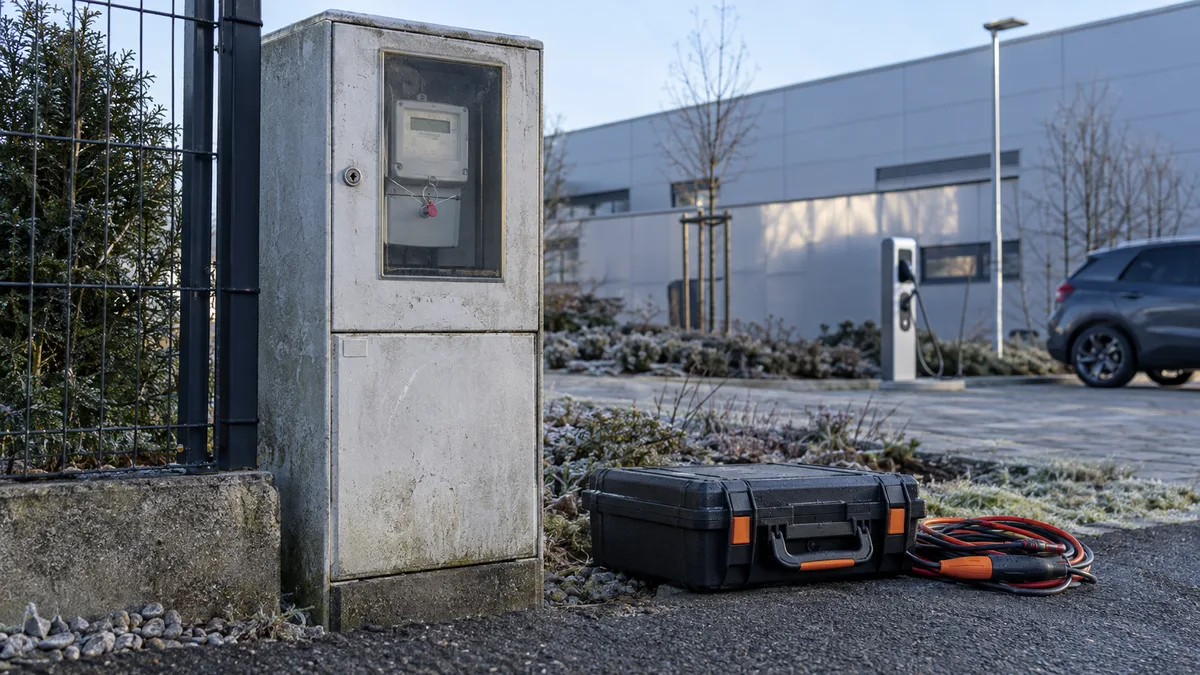
Applying for a higher main circuit breaker rating takes only a few minutes. The reason is usually familiar: two wallboxes in a company car park, a heat pump replacing a gas boiler, or a new machine in a workshop. A connection agreement containing the technical conditions then arrives, and an electrician replaces the breaker. At the meter cabinet, however, it may become apparent that the cable to the main distribution board is sized for the old rating, there is no spare room in the cabinet, and the distributor requires a document for resealing that nobody mentioned beforehand.
This is not a guide to inspecting the entire electrical installation. It explains where the distributor’s equipment ends, when to expect an inspection document for the metering point, and what to have ready before the electrical inspector arrives.
Where the distributor’s equipment ends
At smaller supply points, the distribution network usually ends at the service connection box. This is the main building connection box (HDS), located on the façade or in a pillar at the property boundary, and it contains the fuses protecting the main building supply cable. The precise boundary is defined by the connection agreement and the distributor’s conditions. In older buildings, it is worth checking this before ordering any work.
The customer’s electrical installation begins after the service connection box:
- the main building supply cable (HDV) from the service connection box to the meter cabinet,
- the meter cabinet, including the main circuit breaker upstream of the meter, terminals and conductors,
- the cable from the cabinet to the building’s main distribution board and everything downstream of it.
The distributor installs and owns the electricity meter in the cabinet and usually also the HDO receiver used to switch the low tariff.
A seal on the main circuit breaker or on the cover upstream of the meter does not determine ownership. It marks the unmetered section through which electricity flows before being recorded by the meter. Work on this section may only be carried out in accordance with the procedure specified by the distributor. The customer is therefore responsible for having the cabinet repaired, refurbished and inspected, but not without coordinating the work with the distributor.
The situation is often more complex at commercial sites. High-voltage supplies are metered in a transformer substation and are outside the scope of this article. At industrial sites and shopping centres, the network may be operated by a local distribution system operator rather than one of the major distributors. Its conditions and connection agreement then apply. In leased premises, the cabinet may also belong to the landlord, with the lease determining who is responsible for what.
Who requires the document and in what form
The requirements vary depending on the distributor to whose network the supply point is connected. Brno and South Moravia are served by EG.D, much of the rest of the Czech Republic by ČEZ Distribuce, and Prague by PREdistribuce. The inspection document for a metering point does not have the same form or recipient in every case. As of the review date of 17 September 2026, the distributors state the following:
- ČEZ Distribuce requires an inspection report to be submitted to it as the distributor, among other cases, when the main circuit breaker rating is increased without changing the tariff and when the meter cabinet is refurbished or replaced. For a new supply point or a change from a single-tariff to a dual-tariff rate, the customer submits the report to the electricity supplier, even if the breaker rating is increased at the same time. In some cases, confirmation that an inspection report has been issued is sufficient; this depends on the type of supply point and the work being performed. It does not require an inspection report when the main circuit breaker rating is reduced or when changing from a dual-tariff to a single-tariff rate.
- EG.D, under its connection conditions effective from 1 January 2024, requires an inspection report when the rating of the main circuit breaker upstream of the meter is increased, when the meter cabinet wiring is modified, for example because of a distribution tariff change, and when the meter cabinet is inspected or its condition checked. At a new supply point where the main building supply cable has not yet been connected and the initial inspection cannot be completed in full, it allows a record of a partial inspection. Both the inspection report and this record may be replaced in full by the document “Výpis z revizní zprávy/Záznam o provedené dílčí kontrole OM pro měření na hladině NN”, which also serves as confirmation from the electrical installation contractor for activities where the overview in the conditions permits it.
- PREdistribuce uses the Podklady pro uzavření smlouvy na hladině NN form for a new LV supply point. It must be completed by an electrical inspector using the original form, and the documentation is valid for three months.
These documents are updated, so follow the version valid on the date of your application and the technical conditions in your connection agreement. An inspection report, confirmation that one has been issued, an extract on the distributor’s form, a record of a partial inspection and confirmation from an electrical installation contractor are not interchangeable according to whichever document the contractor happens to have available. The distributor determines which one is required for the particular change.
When to expect an inspection document
| Change | What happens at the metering point | What to expect (according to distributor documents as of 17 September 2026) |
|---|---|---|
| New supply point | an HDV, meter cabinet and main circuit breaker are installed; the distributor installs the meter | ČEZ Distribuce: the customer submits an inspection report to the electricity supplier; EG.D: an inspection report, or a partial-inspection record if the HDV has not been connected; PREdistribuce: the Podklady pro uzavření smlouvy na hladině NN form |
| Increase in the main circuit breaker rating | a new breaker, checks of the HDV and downstream cable cross-sections, and an amendment to the connection agreement | ČEZ Distribuce: inspection report submitted to the distributor if the tariff does not change; EG.D: inspection report |
| Change in the number of phases | a breaker with a different number of poles, a different meter, changes to the cabinet wiring and an amendment to the connection agreement | the ČEZ Distribuce inspection-report page does not list this change separately; EG.D requires an inspection report when the meter cabinet wiring is modified; confirm the required document with the distributor |
| Change from a single-tariff to a dual-tariff rate | wiring for low-tariff switching and, for some tariffs, appliance blocking | ČEZ Distribuce: the customer submits an inspection report to the electricity supplier, even if the breaker rating is increased at the same time; EG.D: its activity overview specifies confirmation from an electrical installation contractor, but it requires an inspection report if the cabinet wiring is modified because of the tariff |
| Replacement or refurbishment of the meter cabinet | a new installation complying with the distributor’s current conditions | ČEZ Distribuce: inspection report submitted to the distributor; EG.D: inspection report, or a partial-inspection record if the HDV has not yet been connected and the initial inspection cannot be completed in full |
| Reduction in breaker rating or return to a single-tariff rate | replacement of the breaker or removal of the switching arrangement without altering the cables | ČEZ Distribuce does not require an inspection report; EG.D specifies confirmation from an electrical installation contractor for a breaker-rating reduction and requires no document for a return to a single-tariff rate; work on the sealed section must still be coordinated |
| Restoration of supply after meter removal | the supply point is put back into service | the required document depends on the reason for removal and the distributor’s conditions; EG.D permits a partial-inspection record if defects were found during removal and an inspection sheet was issued |
| Connection of a generating facility, such as a photovoltaic system | a separate connection process | an inspection of the generating facility and additional documentation |
When several changes are made at once, such as installing a higher-rated breaker and a new cabinet, the entire scope of work is assessed rather than only its simplest part. Connecting a generating facility has its own procedure. The inspection requirements are explained in Photovoltaic system inspection before the first parallel connection.
Increasing the breaker rating: the breaker is the easy part
The process usually consists of an application to the distributor, a new or amended connection agreement containing the technical conditions, modification of the metering point, inspection, submission of the required document and, finally, resealing. Replacing the breaker itself takes only a few minutes. The electrical inspector, however, checks more than the label on the new device:
- Compliance with the agreement. The breaker rating and number of poles must correspond to the connection agreement. For direct metering, distributors usually specify tripping characteristic B for the main circuit breaker.
- The cable downstream of the breaker. The main circuit breaker also protects the cable from the meter cabinet to the main distribution board. If a 3×25 A breaker is replaced by a 3×40 A breaker, the same cable is suddenly protected at a higher current. If its cross-section is inadequate, this is a defect, not a formality.
- The main building supply cable. Upstream of the breaker, it is protected by fuses in the service connection box. When the connected load is increased, the HDV cross-section must be checked against the new rating, along with whether the protection in the service connection box remains selective relative to the new breaker.
- The 80 A threshold. With direct metering, current flows directly through the meter. Both ČEZ Distribuce and EG.D use direct metering up to and including a main circuit breaker rating of 80 A. Above 80 A, indirect metering through current transformers is used, requiring a different cabinet, different documentation and a different budget.
- Terminals. Overheated, oxidised or improperly tightened terminals will become a problem sooner at a higher current.
A higher breaker rating does not automatically require a new cabinet. If the existing cabinet remains suitable in terms of design, current rating and wiring, modification is sufficient. An older metering point whose location would not meet today’s requirements is often retained when only the breaker or tariff is changed. Once the cabinet itself is replaced, however, the new installation is assessed against the distributor’s current conditions.
Before applying, it is worth calculating whether you really need a higher breaker rating. An 11 kW wallbox draws around 16 A per phase at full three-phase charging, so two such units draw approximately 32 A. At a supply point with a 3×32 A breaker, the options are either an increase in rating or load management that reduces charging output according to the building’s current consumption. A new circuit for a charging station is also separate work requiring its own inspection. For details, see EV charging stations for businesses and initial inspections.
Tariff changes: the wiring matters, not the line on the bill
With a dual-tariff rate, the distributor switches between the high and low tariffs using an HDO signal or the meter itself. The conditions for individual distribution tariffs are set by Energetický regulační úřad, for 2026 in cenový výměr č. 14/2025. Some tariffs require selected appliances to be blocked during the high-tariff period, typically through a contactor in the distribution board controlled by the low-tariff signal.
A switch to a dual-tariff rate is therefore not merely an administrative matter. The cabinet must have sufficient space and suitable wiring for switching, blocked appliances must actually be connected through the switched circuit, and no work may have been carried out on the unmetered section without prior coordination. The reverse change, from a dual-tariff to a single-tariff rate, usually involves only removing the switching function. The documentation requirements tend to reflect this more limited technical scope.
A metering-point inspection is not an inspection of the entire installation
The distributor is interested in the section through which the supply point is connected and metered: the main building supply cable, meter cabinet, main circuit breaker and the protective measures directly associated with them. An inspection limited to this scope is valid, but it cannot be presented as an inspection of the entire building.
For an extension or modification to an existing installation, ČSN 33 2000-6 ed. 2 requires verification that the change complies with the requirements and does not impair the safety of the existing installation. For a wallbox or heat pump, the inspection must therefore also cover the new supply circuit, its protection and protection against electric shock. An inspection of the meter cabinet alone does not cover these items. The circumstances in which a change requires an initial inspection are explained in Electrical inspection after refurbishment: when an initial inspection is required.
Businesses also have operational obligations. Under Section 3(1)(a) of nařízení vlády č. 190/2022 Sb., reserved electrical equipment expressly includes electrical equipment used for consuming electricity and electrical installations in buildings and technologies. The precise scope is assessed subject to the exceptions listed in Section 3(2). For the operation of reserved electrical equipment, Section 7(1) and (5) of the same regulation requires a documented schedule of inspections, maintenance and periodic inspections that specifies the tasks, intervals, records and inspection periods in accordance with Annex 4.
An inspection required by the distributor therefore does not replace the installation’s periodic inspection. Conversely, a periodic inspection may not contain the information the distributor requires on its own form.
What to prepare before the electrician and electrical inspector arrive
Most delays are not caused by testing, but by a missing agreement, an unclear brief or a locked cabinet. Prepare:
- the connection agreement, including its technical conditions and, for a change, the new agreement or amendment;
- the supply point’s EAN (the 18-digit number shown on the bill or agreement) and the meter number;
- the current and requested rating of the main circuit breaker, the number of phases and the distribution tariff;
- the rating-plate details of new appliances, such as the power input of the wallbox, heat pump or machine, and information about how they will be controlled;
- the most recent inspection report for the installation and as-built documentation, if available;
- for a new or replaced cabinet, the manufacturer’s documentation, rating plate and declaration of conformity;
- photographs only of items that are safely accessible without removing covers or seals: exterior views of the cabinet and service connection box, plus the labels on the main circuit breaker and meter if visible. Do not photograph supply conductors or other cabinet interiors yourself; these will be documented by a professionally qualified person once a safe condition has been established;
- same-day access to the service connection box, meter cabinet and main distribution board, including keys from the landlord in leased premises;
- an outage plan if work will be carried out upstream of the main circuit breaker.
Access to the cabinet is not merely a matter of convenience for the electrical inspector. Under Section 5(1)(b) of zákon č. 133/1985 Sb., o požární ochraně, legal entities and individuals engaged in business are required, among other things, to maintain unobstructed access to electrical distribution equipment. A cabinet blocked by pallets results in a wasted inspection visit and is also a fire-safety deficiency.
If a seal needs to be removed, do not remove it yourself. The distributor determines who must report the work and who will reseal the equipment and when. The electrician or electrical inspector coordinates this with the distributor in advance. If the cabinet or main building supply cable is being replaced, expect the entire supply point to be disconnected. At a business, the outage should be planned in advance rather than discovered on the morning of the work.
If you are unsure which document your distributor requires for a particular change or what its scope should be, send us only the relevant technical conditions from the connection agreement, exterior photographs of the cabinet taken without removing covers or seals, and a description of the change through our no-obligation enquiry. You may redact sensitive personal and pricing information in the agreement. We will propose the appropriate scope and carry out the inspection.
What is actually checked during the inspection
An inspection under ČSN 33 2000-6 ed. 2 has two parts: visual examination and testing with measurements. At a metering point, this means:
- visual examination: wiring against the diagram, conductor cross-sections and markings, the rating and tripping characteristic of protective devices, the condition and tightness of terminals, the cabinet’s mechanical condition and degree of protection, whether it can be sealed, and its accessibility;
- testing and measurements: continuity of protective and bonding conductors, insulation resistance, protection by automatic disconnection of supply (fault-loop impedance), operation of residual-current devices if included within the inspected scope, and phase sequence for a three-phase supply.
A usable report identifies the supply point, states the rating and type of the main circuit breaker, and defines the scope precisely. It also contains the measured values, instruments used, identified defects and an unambiguous conclusion. It is signed by an electrical inspector holding certification for the relevant scope, and the certificate number is stated in the report. Confirmation from an electrical installation contractor that installation work has been completed is a different document and does not replace an inspection report where the distributor requires one. The required contents of the report are summarised in Inspection report requirements.
A report without measured values or a defined scope provides weak evidence both for the distributor and for you. A generic statement that “the building’s electrical installation is capable of safe operation” does not replace an inspection of components the inspector neither examined nor measured.
If the inspection identifies a serious defect, such as burnt terminals or damaged insulation in the unmetered section, Section 7(8) of nařízení vlády č. 190/2022 Sb. applies. If a condition posing an immediate threat to occupational or operational safety is identified, the equipment must be disconnected from the power supply without delay and secured against unintended reconnection. If this is not possible, repairs must be arranged without undue delay. Switching off the main circuit breaker, however, does not de-energise the section upstream of it. Whether the distributor’s fault line must be called in such a case depends on where the ownership boundary lies under the connection agreement and on the procedure specified by the distributor. Disconnection by the distributor does not itself arrange the repair. If the defect is in the customer’s installation, it must be repaired by a professionally qualified electrical installation contractor, which must coordinate any work on the sealed section with the distributor.
What affects the inspection price
A fixed price for “one cabinet” quoted without seeing the agreement and photographs is often a price for a different scope from the one ultimately required. The price mainly depends on:
- whether the work concerns a check after breaker replacement, refurbishment of the metering point, a new supply point or indirect metering;
- how many meters the cabinet contains and whether the downstream distribution board and new circuits are also being inspected;
- the availability of documentation, as tracing wiring without a diagram involves additional work;
- the number of visits and coordination of seal removal and replacement;
- repeat measurements after defects have been remedied.
Before placing an order, obtain written confirmation of the inspection scope and the type of output to be provided: an inspection report, an extract on the distributor’s form or another document. Also check whether a second visit is included in the price and who will communicate with the distributor. Repairs to defects are usually charged separately.
What each finding means
| Inspection finding | What it means | What to do |
|---|---|---|
| The main circuit breaker differs from the one specified in the connection agreement | non-compliance with the agreement | replace it after coordinating the work with the distributor |
| The cable to the main distribution board has a smaller cross-section than required for the new breaker | the cable is not protected against overload | install a larger cable or provide separate protection for the supply cable |
| Overheated or blackened terminals upstream of the meter | a defect in the unmetered section; depending on the handover point and connection agreement, this may be the distributor’s equipment or the customer’s installation | do not intervene; if there is an immediate danger, arrange urgent disconnection according to the ownership boundary and the emergency procedure of the relevant distributor or owner of the upstream equipment; have the customer-owned section repaired by a professionally qualified electrical installation contractor and coordinate work on the sealed section with the distributor |
| The cabinet lacks space or wiring for low-tariff switching | the cabinet does not meet the requirements of the requested tariff | modify or replace the cabinet |
| The cabinet is obstructed by shelving or pallets | the distribution equipment is inaccessible | clear the access route |
Sources for this article
- Electrical inspections – a SOHE service.
- Electrical inspection after refurbishment: when an initial inspection is required – how modifications to an existing installation are assessed.
- Inspection report requirements – what a report must contain to be accepted by the distributor and during an audit.
- EV charging stations for businesses and initial inspections – inspection of a new wallbox circuit.
- Nařízení vlády č. 190/2022 Sb. – on reserved electrical equipment and requirements for ensuring its safety; classification of equipment used for consuming electricity and electrical installations in buildings, the schedule of inspections, maintenance and periodic inspections, and the procedure in the event of an immediate hazard.
- Zákon č. 133/1985 Sb. – on fire protection; unobstructed access to electrical distribution equipment.
- ČSN 33 2000-6 ed. 2 Elektrické instalace nízkého napětí – Část 6: Revize – visual examination, testing and measurements, and inspection of modifications to an existing installation.
- ČEZ Distribuce: Inspection report – when and to whom an inspection report must be submitted, when the distributor does not require one, and when confirmation that a report has been issued is sufficient; checked on 17 September 2026.
- ČEZ Distribuce: LV connection conditions, Chapter 3 – direct metering up to and including 80 A, indirect metering above 80 A; checked on 17 September 2026.
- EG.D: Connection conditions for LV metering assemblies, effective from 1 January 2024 – the inspection report, record of a partial inspection, inspection-report extract, overview of routine activities and direct-metering threshold; checked on 17 September 2026.
- PREdistribuce: New LV connection – the Podklady pro uzavření smlouvy na hladině NN form; checked on 17 September 2026.
- PREdistribuce: Work on the unmetered part of the customer installation – reporting work to the fault line and the resealing procedure; checked on 17 September 2026.
- Energetický regulační věstník 18/2025 – cenový výměr Energetického regulačního úřadu č. 14/2025 containing the distribution tariff conditions for customers supplied from low-voltage networks in 2026; checked on 17 September 2026.
This article is provided for information only and does not constitute legal advice. The specific inspection-document requirement must be verified against the connection agreement and the distributor’s current conditions. The inspection scope must be determined according to the actual operation, the manufacturer’s documentation, the operating environment and the risk assessment.
SOHE inspects meter cabinets, main building supply cables and new circuits after an increase in breaker rating or a tariff change as part of its Electrical inspections service. Through our no-obligation enquiry, send only the relevant technical conditions from the connection agreement, exterior photographs of the cabinet taken without removing covers or seals, and a brief description of the change. You may redact sensitive personal and pricing information. Based on these documents, we will propose the appropriate inspection scope and the document required for the change.