
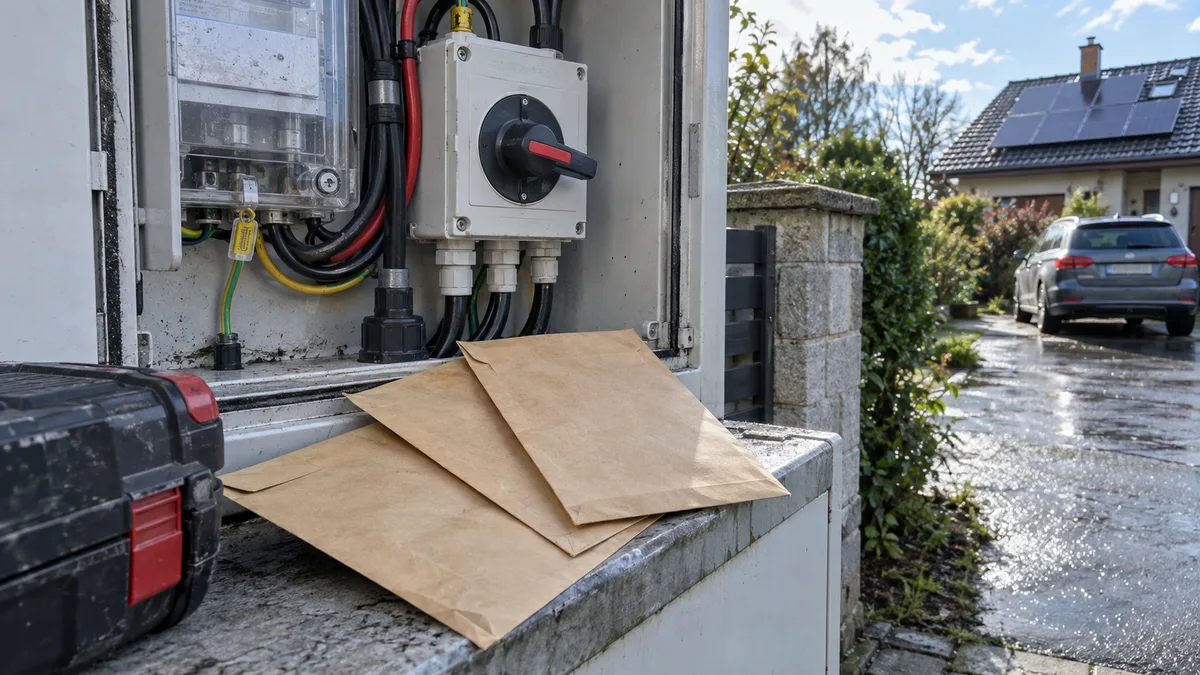
The panels have been on the roof since June, the inverter is connected, and the installer has issued its invoice and left. Yet the power plant remains idle—or it only supplies on-site consumption, with no power exported to the grid. One document is missing. Or perhaps three.
This is when we receive the most calls: the project has been paid for, the grant deadline is approaching, and several documents that nobody mentioned in advance stand between the completed installation and lawful parallel operation with the grid. The procedure is set out in Příloha 4 Pravidel provozování distribučních soustav, issued in identical wording by all Czech distribution system operators; the current edition dates from 2025. The inspection report is only one item on its list.
Three documents, three different people
The most common obstacle is not that a document is missing. It is that someone other than the person expected by the owner must issue it.
| Document | Issued by | Purpose |
|---|---|---|
| Initial inspection report for the power plant’s electrical equipment | an inspection technician certified for the relevant scope | demonstrates that the equipment complies with the approved documentation and is capable of safe operation |
| Protection settings report | the specialist company that configured the protection functions | records the values to which the inverter has been set under the connection agreement |
| Power-generating module document, or an installation document for small-scale sources | the applicant, using supporting documentation from the inverter manufacturer | demonstrates compliance with the RfG Regulation, the European network code |
The required documents also include as-built design documentation, a single-line diagram, and confirmation from the installer that the power plant has been constructed in accordance with the connection agreement and applicable regulations and standards. PREdistribuce publishes virtually the same list for power-generating plants, while ČEZ Distribuce describes the same procedural steps. The common basis is Příloha 4 PPDS, although local connection conditions may differ.
Responsibility is the crucial point. For an application for permission to commence permanent operation, Příloha 4 PPDS states that the applicant is responsible for the authenticity and accuracy of the submitted documents. This means the owner of the connection point or power plant, not the installer. The installer is responsible for the documents it has signed itself.
Why inspection reports are rejected
The required contents of an inspection report are listed in § 10 odst. 1 nařízení vlády č. 190/2022 Sb., o vyhrazených technických elektrických zařízeních a požadavcích na zajištění jejich bezpečnosti. Distributors add their own requirements because the report must also provide information about metering. The EG.D low-voltage network connection conditions, effective from 1 January 2026, require an initial or extraordinary inspection report for a microgeneration facility or power-generating plant under ČSN 33 1500 and NV 190/2022. They specify that it must include:
- the date of issue and address of the inspected premises,
- the main circuit breaker parameters: number of phases, rating, and tripping characteristic,
- for indirect metering, the type and ratio of the current transformers, including their calibration reports,
- the parameters of connected generating units, electricity storage facilities, and other equipment,
- information confirming whether the connection point complies with the distribution system operator’s connection conditions,
- the inspection technician’s stamp and signature, including their certificate number.
The conditions also state that, for the report to be accepted, it should declare that the electrical equipment is free of defects and safe to operate. This is the reason most applications are returned: under the regulation, a report concluding that the equipment is “fit for operation subject to reservations” or listing minor defects to be corrected is a valid document, but it is insufficient for submission to the distributor. We explain the meaning of each possible conclusion in our article on the requirements for an inspection report.
When the inspection report alone is not enough
Alongside the inspection report, the list of required documents briefly mentions an “additional document required under another legal regulation for Class I equipment.” Most owners are unaware of this requirement.
Equipment classification is governed by § 4 odst. 1 nařízení vlády č. 190/2022 Sb. Class I includes, among other things, electrical equipment in a building whose fire safety design allows more than 200 people to be present—for example, a school, sports arena, department store, or large production hall. These are precisely the types of buildings where photovoltaic installations are currently growing fastest. Under § 6 odst. 6 of the same regulation, such equipment may be placed in service only on the basis of a certificate issued by an authorised organisation pursuant to § 6 odst. 1 písm. b) zákona č. 250/2021 Sb., o bezpečnosti práce v souvislosti s provozem vyhrazených technických zařízení. The operator must retain this certificate throughout the equipment’s service life. Under § 20 odst. 2 písm. b) of the same Act, inspections and tests before commissioning must be carried out by employees of the authorised organisation or in their presence.
Whether a particular power plant falls within Class I depends on the building’s fire safety design and the determination of external influences. It must be assessed individually and should be addressed during the design phase. Discovering the requirement only after construction has been completed and the plant is awaiting connection can cause delays of several weeks.
Where your equipment ends and the distribution system begins
The boundary is at the service connection box. Under the EG.D connection conditions, this box is secured by the distributor, belongs to the distributor, and may be accessed only by its authorised personnel. The metering equipment is also owned by the distributor, which installs it at the power plant operator’s expense but covers its maintenance and regular accuracy verification. By contrast, any modification of the delivery or connection point required to install the metering equipment is paid for by the power plant operator under the same conditions. This leads to two frequent problems with new photovoltaic installations:
- A disconnecting device at the output of the meter switchboard. EG.D requires one at every connection point with an installed power-generating plant or backup source where the application for a new connection was submitted on or after 1 July 2022. Power-generating plants with an installed capacity of up to 800 W are exempt.
- A label on the meter switchboard door. Under the connection conditions, the customer—not the distributor—is responsible for marking a switchboard connected to a power-generating plant with an adhesive label in accordance with ČSN 33 2000-7-712.
What the distributor’s technician will check on site
Příloha 4 PPDS contains a form for verifying the actual condition of the power plant, which is completed during the inspection. Its individual items can serve as a checklist before you book the appointment:
- all mandatory documents and a valid power-generating module document have been submitted,
- the installed capacity matches the capacity stated in the application,
- a permanently accessible switching point with an isolation function—the disconnection point—has been installed,
- the meter switchboard is prepared and wired, including provision for remote dispatch control,
- a grid failure has been simulated and the power plant has been confirmed to disconnect from the system,
- no reverse voltage was measured at the meter terminals during the simulation.
The final two points explain why a technician from the installation company should attend the appointment. Simulating a grid failure is not merely a paperwork exercise.
What to give the inspection technician before the visit
The documents required for an initial inspection are listed in příloha č. 2 část A bod I nařízení vlády č. 190/2022 Sb. Three of them are particularly likely to be overlooked in photovoltaic projects:
- the external influences assessment report, unless it forms part of the accompanying documentation,
- records of examinations and tests performed during installation—for an installation constructed in stages, this may be the only evidence of work later concealed beneath the finished structure,
- identification of the company that carried out the electrical installation, including its authorisation number.
If the initial inspection is performed in stages and separate reports are produced for individual sections, § 10 odst. 2 of the regulation requires a single consolidated initial inspection report to be issued before the entire installation is handed over and placed into permanent operation. On projects where two different contractors installed the rooftop power plant and the new switchboard, this requirement is usually discovered too late. The general framework is explained in our article on the initial electrical inspection, while the article on mandatory PV inspections explains why the electrical part of a photovoltaic installation is classified as designated electrical equipment.
Connection is not the end of the process
According to a note in Příloha 4 PPDS, the final operational notification issued by the distributor after permanent operation has been authorised is considered the record of the power plant’s first parallel connection to the distribution system. It proves that the connection process has been completed, but it does not mean that no further action will ever be required. The same appendix states that switches, protection systems, and other remote-control equipment used during permanent operation must undergo functional testing at regular intervals, at least once every four years. The tests must be performed by qualified staff employed by the power plant operator or by a specialist company. Their results must be recorded in a test report retained by the equipment owner and submitted to the distributor upon request. The article on periodic PV inspections explains when the power plant itself is due for its next periodic inspection.
Frequently asked questions
Who submits the application if the power plant is installed on a rented production hall?
Under Příloha 4 PPDS, both the application for permission to operate for compliance verification and the application for permission to commence permanent operation must be submitted by the owner of the connection point or power plant to which the power-generating module is connected. It makes no difference who paid for the power plant.
How long does the process take?
Příloha 4 PPDS sets a 30-day time limit from the submission of a complete application, both for the decision permitting operation for compliance verification and for permission to commence permanent operation. However, the period begins only once the application is complete—each missing document sends the process back to the beginning.
Does the same procedure apply to a small power plant on a family home?
The scope is more limited. For Type A1 and A2 power-generating modules, including microgeneration facilities, Příloha 4 PPDS replaces compliance verification with the submission of an installation document. The applicant therefore submits only an application for permission to commence permanent operation. The simplified connection of a microgeneration facility is governed by § 16 vyhlášky č. 16/2016 Sb., o podmínkách připojení k elektrizační soustavě, entitled Podmínky zjednodušeného připojení k distribuční soustavě. An initial inspection report must also be submitted in this case.
Sources used for this article
- PV inspections and servicing – a SOHE service.
- Inspection report requirements: what the report must contain – how to interpret the report’s conclusion and why its wording matters.
- Initial electrical inspection: when it is mandatory and what you need for final building approval – the general framework for an initial inspection and what to prepare.
- PV inspections: statutory requirements, intervals, and risks for commercial power plants – why the electrical part of a photovoltaic installation is designated electrical equipment.
- Periodic PV inspection after the initial inspection – how the interval for the next inspection is determined.
- Nařízení vlády č. 190/2022 Sb., ve znění účinném od 1. 7. 2024 – o vyhrazených technických elektrických zařízeních a požadavcích na zajištění jejich bezpečnosti; the cited provisions were § 4 odst. 1 písm. c) (a building permitting the presence of more than 200 people as Class I), § 6 odst. 6 (placing Class I equipment into service on the basis of a certificate issued by an authorised organisation), § 10 odst. 1 (inspection report requirements), § 10 odst. 2 (consolidated initial inspection report), and příloha č. 2 část A bod I (documents required for the initial inspection).
- Zákon č. 250/2021 Sb., ve znění pozdějších předpisů – o bezpečnosti práce v souvislosti s provozem vyhrazených technických zařízení; the cited provisions were § 6 odst. 1 písm. b) (a certificate issued by an authorised organisation for Class I equipment) and § 20 odst. 2 písm. b) (examinations and tests before commissioning).
- Vyhláška č. 16/2016 Sb., ve znění pozdějších předpisů – o podmínkách připojení k elektrizační soustavě; § 16 governs the conditions for simplified connection to the distribution system.
- Příloha 4 Pravidel provozování distribučních soustav, 2025 edition (Pravidla pro paralelní provoz výroben a akumulačních zařízení), and the EG.D Připojovací podmínky nn effective from 1 January 2026; also information published by ČEZ Distribuce on commissioning a power-generating plant and PREdistribuce’s overview of the documents required to connect one.
- The technical standards ČSN 33 2000-7-712 and ČSN 33 1500 are identified by designation only; the standards are not freely available.
This article is for informational purposes and does not constitute legal advice. The specific inspection and documentation arrangements and the equipment’s classification must reflect actual operating conditions, the manufacturer’s documentation, the environment in which the equipment is used, and the relevant risk assessment.
Is your photovoltaic installation complete and awaiting connection, or would you like to have all the documents in order before the installer leaves? As part of our PV inspection and servicing service, we will perform the initial inspection and review which documents your application requires and what is still missing. Email us at info@sohe.cz or use our non-binding enquiry form—all we need is the power plant’s capacity, the type of building, and the distributor’s name.