
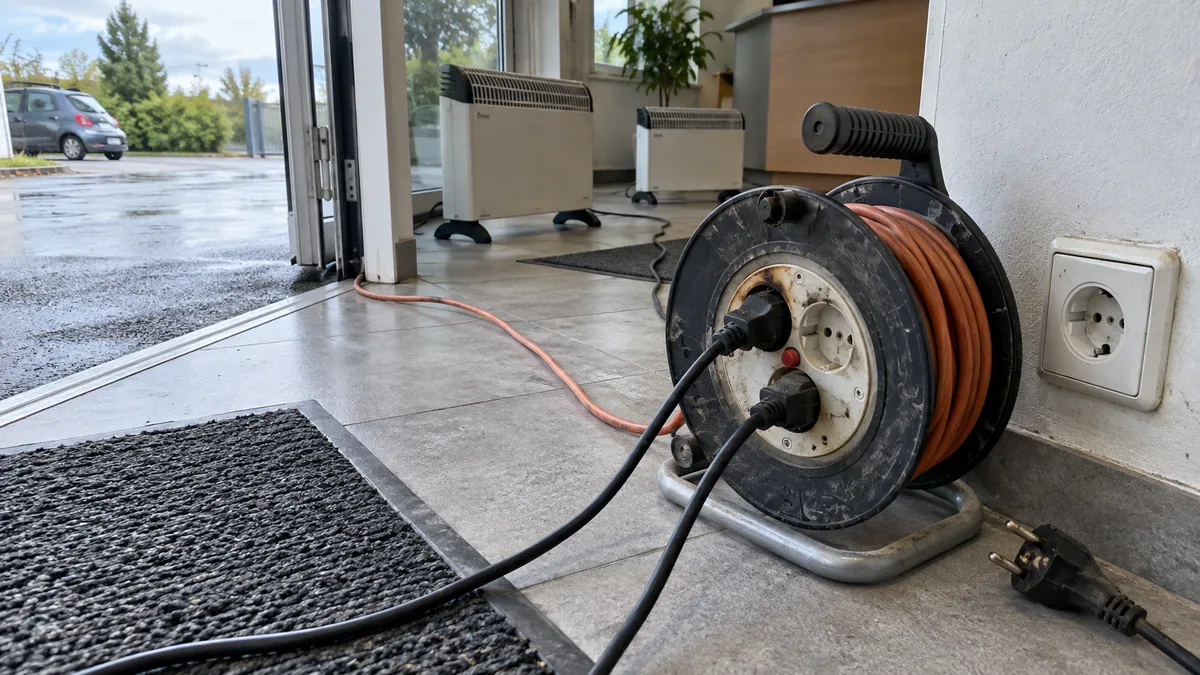
The first cold morning makes itself known through the power sockets. Two space heaters put away in April come back out of storage, a radiant heater appears at reception, and someone runs an extension lead across the corridor because there is “a draught by the window”. Most of these appliances never make it into the equipment register. The electrical installation, meanwhile, is unchanged from summer—except that several extra kilowatts are added within two weeks.
This is not another guide to inspection intervals. It is a checklist for one morning between late September and mid-November.
What the 2025 figures say about heaters
The statistical yearbook published by Hasičský záchranný sbor ČR breaks fires down by cause. For 2025, it records 19,031 fires causing direct damage of CZK 5,267.8 million. The figures for heaters are as follows:
| Cause of fire | 2024 | 2025 | Direct damage in 2025 |
|---|---|---|---|
| incorrect operation of a heater | 152 | 183 | CZK 41.9 million |
| combustible materials near a heater | 42 | 43 | CZK 11.0 million |
| heater faults in total | 138 | 143 | CZK 98.9 million |
| including incorrect heater placement or installation | 61 | 70 | CZK 52.7 million |
Together, these categories account for 369 fires, compared with 332 a year earlier, and damage of CZK 151.8 million, up from CZK 80.9 million. Fires caused by incorrect operation showed the sharpest increase—approximately one fifth year on year.
Two important qualifications apply to these figures. The statistics do not distinguish between heater types, so the figures include stoves, boilers, and gas heaters as well as electric space heaters. Nor do they distinguish workplaces from homes. Even so, they reveal something important: the two largest categories—operation and placement or installation—are not equipment faults. They concern where a heater was placed and how it was used. That is precisely what a pre-season checklist should address.
The socket is designated electrical equipment; the extension lead is not
A single socket brings together two regulatory regimes with different legal foundations.
Fixed installation. Under § 3 odst. 1 písm. a) nařízení vlády č. 190/2022 Sb., designated electrical equipment includes electrical installations in buildings and technologies—in other words, socket circuits, distribution boards, and protective devices, subject to the exemptions listed in § 3 odst. 2. For their operation, § 7 odst. 1 and 5 require a documented schedule of examinations, maintenance, and inspections specifying the activities, intervals, records, and inspection deadlines set out in příloha č. 4 of the same regulation.
Equipment connected to it. By contrast, § 3 odst. 2 excludes hand-held electromechanical tools, electronic devices, and electrical appliances rated up to and including 400 V from designated electrical equipment, provided they are not intended for fixed connection to the mains [písm. a)]. Extension cords and detachable leads are also expressly excluded [písm. b)].
This does not mean that no obligations apply to them. Under § 4 odst. 1 písm. c) zákona č. 309/2006 Sb., machinery, technical equipment, vehicles, and tools must be properly and regularly maintained, checked, and inspected. The procedure for appliances connected by flexible leads is described in ČSN 33 1600 ed. 2 Revize a kontroly elektrických spotřebičů během používání from November 2009, as amended by Z1 from April 2021 and Z2 from September 2021. Its scope also covers extension and detachable leads and hand-held electrical tools, but not appliances forming part of a fixed installation. The standard’s introduction states that its purpose is to protect against electric shock and fire. The article Electrical appliance inspections: how often to check equipment, tools, and extension leads explains how inspection and testing intervals are determined from this classification.
Checklist: portable heaters
- Rating plate and power consumption. Record the rated power of each appliance; without it, you cannot complete the next step.
- Manufacturer’s instructions. Under § 5 odst. 1 písm. c) zákona č. 133/1985 Sb., o požární ochraně, legal entities and individuals engaged in business must comply with the technical conditions and instructions relating to the fire safety of products or activities. Safe clearances from combustible materials are specified in the instructions—not left to the memory of the person who positioned the heater.
- How it is connected. Check the heater’s instructions to see whether connection through an extension lead is permitted, and check the lead’s rating plate to confirm that it can carry the required load. This also addresses § 3 odst. 1 písm. a) nařízení vlády č. 378/2001 Sb., which sets the use of equipment under its intended conditions and in accordance with its operating documentation as a minimum requirement.
- Where it is placed. Cardboard boxes, curtains, an upholstered chair, or a pile of papers under a desk: “incorrect heater placement or installation” was the costliest individual cause of heater-related fires in the 2025 HZS statistics.
- Who switches it off. Assign responsibility for switching off the heater at the end of the shift and for checking that this has been done. Without a named person, no one is responsible.
- Records. Seasonal appliances rarely make it into the equipment register because they were “only borrowed”. Record them as soon as they are brought into use.
Checklist: extension leads and cable reels
- Load capacity on the rating plate. Cable reels often show two ratings—one for a coiled cable and one for a fully unwound cable. If a lower value is listed, it applies when the cable remains coiled on the reel.
- The full length of the cable. Check the entire lead for cut insulation, taped repairs, bent plug pins, and blackened sockets.
- Daisy-chaining. Connecting extension leads in series or plugging a multi-way adaptor into an extension lead is governed by § 3 odst. 1 písm. a) nařízení vlády č. 378/2001 Sb. and the manufacturer’s instructions. The question is the same as for the heater: does the manufacturer permit it, and can the lead carry the load?
- Where it runs. Under a carpet, across a threshold, or through a fire-compartment door: a cable that people walk over deteriorates faster than its appearance suggests.
- A permanent arrangement. An extension lead left in the same place for a third heating season is evidence of a missing socket. The solution is an electrician, not another extension lead.
Checklist: socket circuit and distribution board
- Total load versus circuit protection. A single-phase circuit protected at 16 A can supply approximately 3,680 VA at 230 V. Two 2 kW space heaters exceed that—and the circuit will usually also be powering whatever was already running before the heaters were connected.
- Warm socket or plug. Heated plastic, a burning smell, or a circuit breaker that repeatedly trips. For designated equipment, § 7 odst. 8 nařízení vlády č. 190/2022 Sb. addresses this situation: if a condition posing an immediate threat to occupational or operational safety is identified, the equipment must be disconnected from the power supply without delay and secured against unintended reconnection. If disconnection is not possible, repairs must be arranged without undue delay.
- Access to the distribution board. Under § 5 odst. 1 písm. b) zákona č. 133/1985 Sb., a company must, among other things, keep access to electrical distribution equipment and heating shut-off valves unobstructed. A heater or shelving unit does not belong in front of a distribution board, even for a single season.
What each finding means
| What you see | What it means | What to do |
|---|---|---|
| Coiled cable reel under full load | operation outside the conditions stated on the rating plate | fully unwind it or use a longer lead |
| Space heater connected to an underrated lead | overloaded lead | connect it directly to a socket |
| Blackened or warm socket | fixed-installation fault | disconnect it, secure it, and have an electrician investigate |
| Heater near cardboard boxes or a curtain | clearance specified in the instructions has not been maintained | relocate it and record the finding in the inspection |
| Space heater under a desk every winter | inadequate workplace heating | measure the temperature and address the heating system |
A space heater under a desk is an indicator, not a whim
When heaters appear in an office every November, the issue is usually treated as a matter of employee discipline. Yet there is a benchmark against which the situation can be measured. Under § 3b odst. 2, nařízení vlády č. 361/2007 Sb. assesses heat exposure against the permissible microclimatic values in příloha č. 1, část A, tabulka č. 2. For work class I—defined in tabulka č. 1 of the same annex as seated work involving minimal whole-body movement, administrative office work, and computer work—the minimum operative or resultant globe temperature is 20°C. The corresponding minimum is 18°C for class IIa and 14°C for class IIb. For classes I and IIa, these values carry the note “od 1. 7. 2024”. The table applies to non-outdoor workplaces where the temperature is not maintained.
The practical implication is simple: before a company investigates who owns the space heater, it is worth measuring the workplace temperature. If it is below the value specified for the relevant work class, the solution is adequate heating, not an appliance policy. If it is above that value, an internal policy has a firm basis. The article Employees’ personal appliances in the workplace explains how such a policy can address equipment brought from home.
Where to record the findings so someone can locate them next year
A walk-through without a written record becomes impossible to substantiate within a month. Two suitable records will usually already exist in the company: the appliance register, including seasonal equipment, and the record of the preventive fire inspection. Under § 5 odst. 1 písm. e) zákona č. 133/1985 Sb., a company must arrange regular checks of compliance with fire protection regulations by an odborně způsobilá osoba, technik požární ochrany, or preventista požární ochrany, and remedy any identified defects without delay. The applicable intervals and procedure are explained in the article on preventive fire inspections in the workplace.
Frequently asked questions
Can we plug a space heater into an extension lead?
There is no blanket statutory prohibition. The deciding factors are the instructions for both the heater and the lead, as well as the load capacity shown on the lead’s rating plate. § 5 odst. 1 písm. c) zákona č. 133/1985 Sb. requires compliance with technical conditions and instructions relating to the fire safety of products, while § 3 odst. 1 písm. a) nařízení vlády č. 378/2001 Sb. requires equipment to be used under its intended conditions.
Is an extension lead designated electrical equipment?
No. § 3 odst. 2 písm. b) nařízení vlády č. 190/2022 Sb. expressly excludes extension cords and detachable leads from designated electrical equipment. By contrast, the socket circuit into which the lead is connected is designated electrical equipment under § 3 odst. 1 písm. a).
Who can carry out the pre-season check?
Operating staff can perform a visual walk-through under the company’s internal policy. For operating and working on electrical equipment, § 19 odst. 1 zákona č. 250/2021 Sb. distinguishes between osoby znalé, osoby poučené, and osoby školené (seznámené). Osoby znalé include osoby pro samostatnou činnost, osoby pro řízení činnosti, and revizní technici. Measurements and formal appliance inspections must be carried out by an appropriately qualified person.
Are appliance inspections completed in spring sufficient?
An inspection report records the condition of an appliance on the date it was tested—not where it stands today, what it is connected to, or what else is operating on the same circuit. Yet these are precisely the factors that appear most often in the HZS statistics.
Sources for this article
- Revize spotřebičů a nářadí – a service provided by SOHE.
- Electrical appliance inspections: how often to check equipment, tools, and extension leads – how inspection and testing intervals are determined by the environment and type of equipment.
- Employees’ personal appliances in the workplace – how an internal policy can address personal heaters and leads brought from home.
- Preventive fire inspections in the workplace – where to record the seasonal walk-through and who is authorised to carry it out.
- Statistická ročenka HZS ČR 2025 and Statistická ročenka HZS ČR 2024 – the source of all fire and damage figures quoted above; table Požáry podle příčiny a činnosti při vzniku; přehled ročenek.
- Zákon č. 133/1985 Sb. – o požární ochraně, as effective from 30 August 2025; § 5 odst. 1 písm. b) unobstructed access to electrical distribution equipment and heating shut-off valves, písm. c) compliance with technical conditions and instructions relating to the fire safety of products or activities, and písm. e) regular checks of compliance with fire protection regulations.
- Zákon č. 309/2006 Sb. – o zajištění dalších podmínek bezpečnosti a ochrany zdraví při práci, as effective from 1 November 2025; § 4 odst. 1 písm. c) regular maintenance, checks, and inspections of technical equipment and tools.
- Nařízení vlády č. 190/2022 Sb. – o vyhrazených elektrických zařízeních a požadavcích na zajištění jejich bezpečnosti, as effective from 1 July 2024; § 3 odst. 1 písm. a) electrical installations in buildings, § 3 odst. 2 písm. a) and b) exclusion of appliances rated up to 400 V and extension cords, § 7 odst. 1 and 5 schedule of examinations, maintenance, and inspections, and § 7 odst. 8 procedure where a condition poses an immediate safety threat.
- Nařízení vlády č. 378/2001 Sb. – bližší požadavky na bezpečný provoz a používání strojů, technických zařízení, přístrojů a nářadí; § 3 odst. 1 písm. a) use of equipment under its intended conditions and in accordance with its operating documentation.
- Nařízení vlády č. 361/2007 Sb. – kterým se stanoví podmínky ochrany zdraví při práci, as effective from 1 September 2026; § 3b odst. 2 assessment of heat exposure, příloha č. 1 část A tabulka č. 1 work classes, and tabulka č. 2 permissible microclimatic conditions.
- Zákon č. 250/2021 Sb. – o bezpečnosti práce v souvislosti s provozem vyhrazených technických zařízení, as effective from 1 November 2025; § 19 odst. 1 osoby znalé, osoby poučené, and osoby školené.
- ČSN 33 1600 ed. 2 Revize a kontroly elektrických spotřebičů během používání (November 2009), as amended by Z1 (April 2021) and Z2 (September 2021) – scope and introduction according to the free preview provided by Česká agentura pro standardizaci; the standard is not freely available, so no link is provided.
This article is for information purposes only and does not constitute legal advice. The specific inspection regime for heaters, extension leads, and socket circuits must reflect the actual operation, manufacturer’s documentation, conditions of use, and risk assessment.
Would you like your portable heaters and extension leads checked before the season and recorded in a single register? We can provide appliance and tool inspections, including seasonal equipment, and set the next inspection dates. Indicative per-item prices are available in our price list; the exact price depends on the scope and number of workplaces. Email info@sohe.cz or send a no-obligation enquiry with an estimate of the number of appliances and sites.