
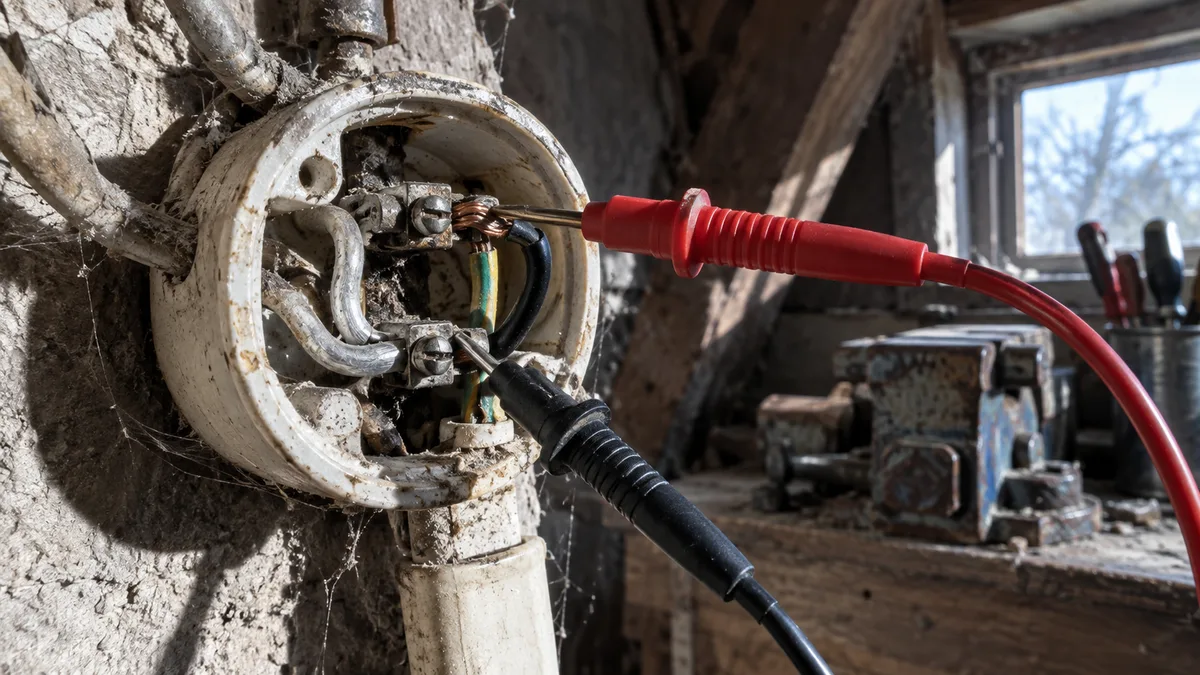
An electrical inspection is not generally required when buying a property. Neither Zákon č. 250/2021 Sb. nor Nařízení vlády č. 190/2022 Sb. stipulates that the sale of a family house itself requires a new electrical inspection report.
However, this does not mean that switching on the lights and testing a few sockets will reliably establish the condition of the installation. A circuit breaker may hold even when the installation has ineffective fault protection, improperly protected wiring or undocumented alterations.
An inspection before purchase should primarily answer four questions:
- Is the assessed part of the electrical installation safe to use?
- Does the actual work match what the seller describes as a renovation?
- Which defects should be remedied before moving in?
- Can the installation support the planned induction hob, electric heating, heat pump, wallbox or workshop equipment?
If the house will also serve as an office, accommodation facility, business premises or workplace for employees, tell the technician about its intended use in advance. A standard house inspection may not cover every device, load and operating condition relevant to the future business.
Initial screening before reserving, testing before buying
It is advisable to arrange a technical assessment before taking financial or contractual steps that are difficult to reverse. Access to the installation, the ability to switch off circuits and the conditions required for testing must be agreed with the owner in advance.
| Stage | What to check | Expected outcome |
|---|---|---|
| Initial viewing | Visible parts of the installation, distribution boards, age of alterations and available documentation | Decision on whether to arrange a more detailed inspection |
| Before the final decision | Professional examination and testing within the agreed scope | Written list of findings and information for preparing a budget |
| Before renovation | New appliances, power requirements, number of circuits and distribution board capacity | Scope of the required electrical and building work |
| Before starting business operations | Actual use of the house and connected equipment | Assessment of the installation for its intended operation |
If you want to arrange the examination, testing and written report as a single service, we provide this as part of our electrical installation inspection service. Before the visit, specify whether you require a formal electrical inspection report or a technical assessment focused on the purchase decision.
Documents to request from the seller
It is not enough to be told that “an inspection report exists.” Every report has a defined scope. It may cover only a new distribution board, one floor, an extension or a separate technology.
In particular, request:
- all available electrical inspection reports, including appendices and measured values;
- initial electrical inspection reports issued after renovations, extensions and additions to the installation;
- design documentation or as-built drawings;
- an up-to-date description of circuits and distribution boards;
- documentation for photovoltaic systems, batteries, wallboxes, heat pumps and electric heating;
- documentation and reports relating to lightning protection, if installed on the property;
- records of changes to the main circuit breaker or meter distribution board;
- handover records or invoices showing the scope of the work performed.
Missing documentation does not in itself prove that the installation is unsafe. It does, however, increase the uncertainty of the assessment. A technician can establish the condition of accessible parts more readily than the route, cross-section or connection method of a cable concealed inside a wall.
Verify claims that “the electrics are new” section by section. New sockets, switches and a recently installed distribution board do not prove that all wiring has been replaced. If the seller provides a post-renovation report, check whether it is an initial electrical inspection and which part of the house it actually covers.
Checklist for the initial viewing
Do not dismantle sockets or remove distribution board covers without the owner’s permission. During the initial visit, look for accessible signs of defects and improvised alterations:
- scorching, deformation or discoloration of sockets and switches;
- loose accessories, missing covers or accessible conductors;
- smells of overheating, crackling or buzzing;
- multi-socket adapters and extension leads under permanent load near an oven, water heater, washing machine or heater;
- a distribution board without legible circuit labels;
- devices installed provisionally or left uncovered inside a distribution board;
- a new floor, bathroom or kitchen connected to an apparently original installation;
- cables routed through doors, lying loose on floors or lacking protection against damage;
- unsuitable sockets or equipment in a damp basement, garage or outdoor area;
- circuit breakers or residual-current devices that trip repeatedly;
- photovoltaic systems, batteries, wallboxes or heat pumps without available documentation.
Older ceramic fuses or aluminium conductors do not determine the outcome of the assessment on their own. The condition of connections, the protective measures used, wiring loads and the integration of later alterations are what matter. A particularly risky combination is an original installation supplemented with high-power appliances without evidence of new circuits and appropriate protection.
What to agree with the technician
The phrase “electrical check of the house” does not define a precise scope. Before placing an order, therefore provide:
- the number of floors, distribution boards and outbuildings;
- the approximate number of circuits;
- the age of the house and any known renovations;
- the availability of designs and previous reports;
- the presence of photovoltaic systems, batteries, wallboxes and electric heating;
- planned appliances and the property’s future use;
- the required deliverable and the deadline for the purchase decision.
Confirm separately whether the work includes the internal electrical installation, the meter section, outbuildings, photovoltaic systems and lightning protection. These systems may require different scopes of examination, testing and professional qualifications.
What examination and testing can reveal
The specific procedures are selected according to the installation, accessibility and agreed scope. They may include, for example:
| Procedure | What it may reveal |
|---|---|
| Examination of distribution boards and accessible parts | Damage, unsuitable enclosures, improvised alterations or unclear wiring |
| Verification of protective conductor and bonding continuity | An interrupted or incorrectly connected protective path |
| Insulation resistance testing | Damaged, deteriorated or damp insulation in the tested circuit |
| Fault-loop impedance testing | Data for assessing whether the circuit will disconnect in the event of a fault |
| Residual-current device testing | Device operation and measurable trip parameters |
| Polarity and wiring checks | Reversed conductors and connection errors |
| Comparison of protective devices with accessible wiring | An unsuitable combination of circuit breaker and wiring |
| Inspection of surge protection and earthing | Condition of components included in the agreed scope |
Some tests require circuits to be switched off temporarily or sensitive equipment to be disconnected. Agree on the conditions before the visit, particularly if the house is occupied or contains technology that cannot be shut down without preparation.
An electrical inspection is not a destructive investigation of every cable inside the walls. It will not reveal every concealed branch or confirm the route of inaccessible wiring without additional documentation. Thermal imaging may show unusual heating in accessible connections and devices, but its findings depend on the load at the time and do not replace electrical testing.
How to compare quotations
A price “for a family house” without a defined scope does not provide enough information. Two quotations may differ in the number of distribution boards, circuits and tests included, as well as in the form of the final deliverable.
Confirm in advance:
- whether you will receive a formal electrical inspection report or a record of the technical examination;
- which parts of the house and which outbuildings are included;
- whether the report contains measured values and clearly identifies the defects found;
- how parts that could not be verified will be described;
- whether photovoltaic systems, batteries and lightning protection are assessed separately;
- whether the technician will distinguish between safety defects, restrictions on future use and recommended upgrades;
- how much time will be required on site and which circuits will need to be switched off.
For a formal inspection, request the electrical inspection technician’s identification, certificate number and scope of authorisation appropriate to the equipment being assessed. The report should state precisely what was inspected and what was excluded.
How to interpret the findings
Not every difference from current technical practice represents the same level of risk. The report should distinguish an identified defect from a restriction on future use and from a recommended upgrade.
| Category | Example | Practical response |
|---|---|---|
| Safety defect | Accessible live part, damaged insulation or ineffective fault protection | Do not use the affected part until it has been repaired, following the technician’s instructions |
| Defect following an alteration | New circuit without appropriate protection or supporting documentation | Correct the work and subsequently verify the result |
| Restriction on use | Insufficient capacity for a wallbox, workshop or heat pump | Include the required alterations in the purchase budget |
| Recommended upgrade | Better circuit distribution or spare capacity in the distribution board | Plan the work together with other renovations |
| Unverified part | Inaccessible extension or unclear concealed wiring | Allow for further investigation and a financial reserve |
A written conclusion should not treat an unverified part as an installation free from defects. A formal electrical inspection report should clearly state the result for the precisely defined scope of equipment.
How to use the findings when buying
Turn the findings into a specific list of work, priorities and associated costs:
- The installation is capable of safe operation within the assessed scope. Recommended upgrades can be combined with a future renovation.
- Partial repairs are required. Obtain prices for the specific work and determine whether it will also affect plasterwork, tiling or room fittings.
- Part of the installation is not safe to use. Agree with the technician how it should be disconnected, repaired and subsequently verified.
- The scope could not be assessed adequately. Allow for further investigation, additional documentation and a reserve for concealed defects.
- The installation is unsuitable for the intended use. Include new circuits, distribution board alterations, possible changes to the supply connection and building work in the budget.
An electrical inspection report does not determine the property’s market value. It does, however, provide a basis for a technical budget and helps distinguish the repair of a safety defect from an investment in greater comfort or capacity.
Quick answer
An electrical inspection is not generally required when buying a house. Nevertheless, it is sensible to arrange a professional examination, testing and a written conclusion before making the final decision. Check the scope of available reports, protective measures, undocumented alterations and the installation’s ability to supply the planned appliances.
Frequently asked questions
Is the seller required to obtain a new electrical inspection report?
The sale of a family house itself is not listed in Zákon č. 250/2021 Sb. or Nařízení vlády č. 190/2022 Sb. as a reason to issue a new electrical inspection report. However, request all available reports relating to renovations and extensions and check their scope.
Is an electrician’s examination sufficient?
A professional examination may be useful for an initial technical assessment. If you need a formal electrical inspection report defining the equipment, recording measured values and providing the electrical inspection technician’s conclusion, request this deliverable explicitly.
Do aluminium conductors mean the entire installation must be replaced?
Not on their own. The condition of connections, protective measures, loads and the way alterations were made are decisive. However, an original installation may not have sufficient capacity for an induction hob, electric heating, wallbox or workshop.
Can an inspection be carried out without documentation?
In many cases, the examination and necessary testing can be performed, but missing documentation may limit verification of concealed parts and prolong the work on site. Practical preparations are summarised in Electrical inspection without documentation: what to prepare.
Does the house inspection also include the photovoltaic system and lightning protection?
Only if they are explicitly included in the agreed scope and the inspection is performed by a person with the appropriate professional qualifications. Mention photovoltaic systems, batteries, lightning protection and surge protection when requesting a quotation.
Sources used for this article
- Electrical installation inspection – a SOHE service.
- How to read an electrical inspection report – an explanation of the conclusion, scope and individual findings.
- Electrical inspection after renovation – the difference between inspecting an existing installation and conducting an initial inspection after alterations.
- Zákon č. 250/2021 Sb. – the legal framework governing the safe operation of designated technical equipment and professional competence.
- Nařízení vlády č. 190/2022 Sb. – requirements for designated electrical equipment, its checks, inspections and inspection reports.
This article is for informational purposes and does not constitute legal advice. The specific inspection regime must be determined according to actual operations, the manufacturer’s documentation, the operating environment and the risk assessment.
Do you need to assess the condition of a house’s electrical installation before buying? Book an electrical installation inspection or send a no-obligation enquiry. You can also describe the size of the house and the available documentation in advance by emailing info@sohe.cz.