
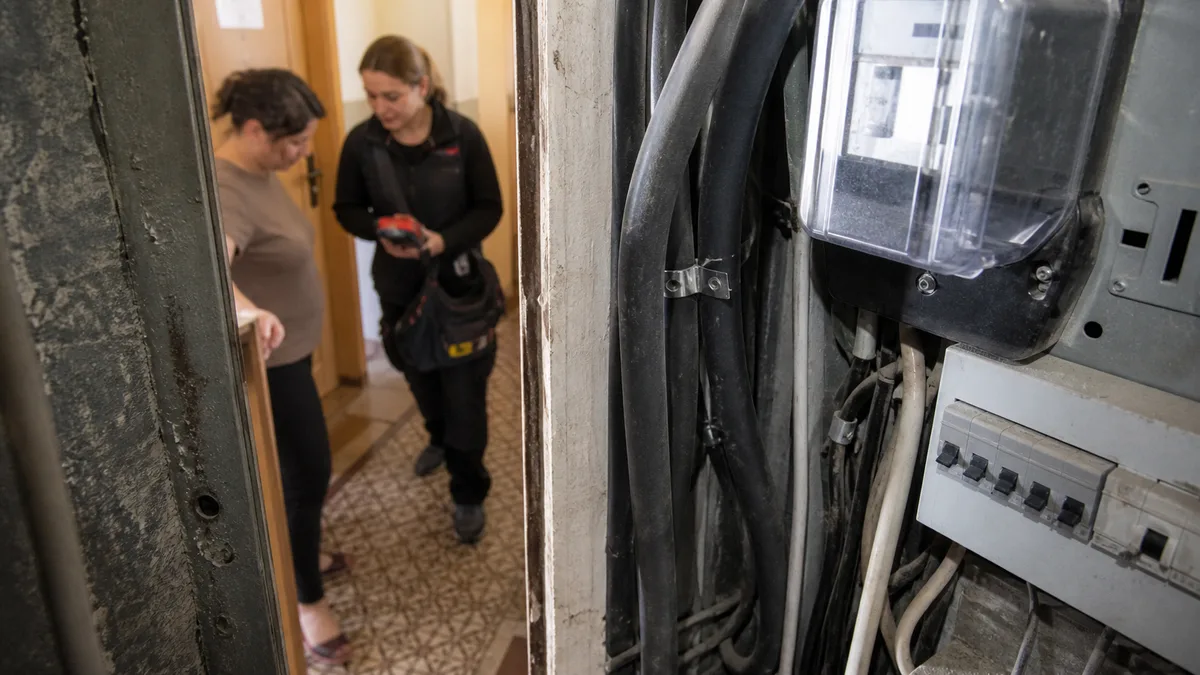
The technician opens a floor distribution board in an apartment block built in the late 1970s, spends an hour taking measurements, and then asks a question no one on the SVJ committee is prepared to answer: “Who can let me into apartment 14? The riser runs through it.” This is immediately followed by a second, considerably more expensive question: who will pay for this part—the building or the apartment owner? At the annual meeting, someone then complains that the committee spent communal funds on someone else’s electrical installation.
Several mutually contradictory claims circulate about electrical inspections in apartment buildings. That responsibility ends at the apartment threshold. That if a circuit breaker is located inside the apartment, the wiring leading to it belongs to the owner. That every apartment building is legally required to undergo an inspection every five years. The regulations say otherwise, and the difference is reflected not in the inspection price but in who is responsible for what when something goes wrong.
We will explain where the boundary lies under Nařízení vlády č. 366/2013 Sb., who orders the inspection and how it is paid for, which parts of the individual utility systems are common, how to identify the boundary in an older building, where the “five-year interval” comes from, and what should be included in the order.
The apartment circuit breaker, not the apartment door, defines the boundary
For electrical wiring, the boundary between the common parts of the building and the part belonging to the unit owner lies at the apartment circuit breaker downstream of the electricity meter. In § 6, Nařízení vlády č. 366/2013 Sb. includes among the common parts “electrical wiring up to the apartment circuit breaker downstream of the electricity meter.” The physical location of the equipment does not change this: common wiring may run inside an apartment, a riser may be located in a service shaft accessible only from the entrance hall, and the meter distribution board may be mounted in the apartment core. This does not make that part the property of the apartment owner.
Two components are regularly confused. The main circuit breaker upstream of the electricity meter provides protection before metering—it determines the reserved capacity and is sealed. The apartment circuit breaker downstream of the meter is the one referred to by the regulation. If the owner’s declaration uses only the general term “apartment circuit breaker,” the boundary must be verified from the actual wiring, not from the label inside the cabinet door.
It is worth noting how the level of precision in the regulation differs between utility systems. For water, it refers to pipes up to the sub-meters or shut-off valves for the apartment, “including these meters or valves.” For electricity, it merely says “up to the apartment circuit breaker.” Whether the device itself is still a common part or is the first component beyond the boundary is interpreted differently in practice, and the owner’s declaration may clarify it. Where there is no circuit breaker downstream of the meter and the wiring continues directly to the apartment distribution board, defining the boundary in the declaration is the only way to settle the issue in advance. Parts which, by their nature, serve unit owners collectively are common parts under § 1160 občanského zákoníku, regardless of where they are located.
There is one more boundary that is often overlooked: the electricity meter itself belongs neither to the SVJ nor to the apartment owner. Under § 49 energetického zákona, metering is provided by the distribution system operator, which also owns the metering equipment. The inspection technician does not break its seals—they take measurements up to and downstream of the meter, not inside it.
Who orders the inspection and how it is paid for
The inspection of common electrical wiring is ordered by the person responsible for managing the building. Under § 1190 občanského zákoníku, this is the společenství vlastníků (SVJ), or the building administrator if no SVJ has been established. In § 7, Nařízení vlády č. 366/2013 Sb. lists, among the building management activities relating to its operation and technical condition, inspections of utility networks, common technical equipment, fire-safety equipment, lightning protection systems, and energy distribution systems. The list is introduced by the word “zejména,” meaning that it is not exhaustive.
The contractor therefore invoices the SVJ, and the cost is paid from the building management funds. Unit owners contribute to these funds—in accordance with § 1180 občanského zákoníku, in proportion to their share of the common parts unless otherwise stipulated. The work is therefore not “free for owners,” nor is each apartment normally invoiced separately; allocation of the cost is governed by the owner’s declaration and the approved budget.
Inspection of the electrical installation downstream of the apartment circuit breaker is the responsibility of the unit owner, who orders and pays for it personally. This follows the same logic described in our article on the allocation of costs between landlords and tenants: the party responsible for the equipment pays, not the person who has the key to the door. The SVJ may offer a shared appointment and a better volume price, but the order, inspection report, and invoice should distinguish between three items:
- common wiring paid for from the building management funds,
- apartment installations paid for by the individual owners,
- repairs and correction of defects, which are not part of the inspection itself.
Access to an apartment because common wiring runs through it is addressed by § 1183 občanského zákoníku: a unit owner must grant access where required for maintenance, repair, or another duly approved alteration to the building, provided that the person responsible for managing the building has notified the owner in advance. The same applies to the installation, maintenance, and inspection of energy consumption metering equipment. The phrase “in advance” matters here—an appointment posted on the noticeboard one day beforehand is often the source of half the conflicts surrounding inspections.
What belongs to the building and what belongs to the apartment
| Utility system or equipment | Common part managed by the SVJ | Part belonging to the unit owner |
|---|---|---|
| Electricity | Main building wiring, floor distribution boards, branches and wiring up to the apartment circuit breaker downstream of the electricity meter, distribution board for common-area consumption | Apartment distribution board and circuits beyond the boundary—sockets, lights, and fixed outlets |
| Gas | Pipework up to the shut-off valve for the apartment | Pipework and appliances downstream of the shut-off valve |
| Hot and cold water | Risers and branches up to the apartment’s sub-meters or shut-off valves, including these meters and valves | Pipework inside the apartment, including taps |
| Lighting | Corridors, staircases, cellars, bicycle storage rooms, and garages; emergency lighting, including backup power supplies | Light fittings and lighting circuits inside the unit |
| Lightning protection system | Part of the roof and therefore a common part of the building | — |
| Fire-safety equipment | The building’s fire-safety equipment | Equipment that is not part of the building’s fire-safety design |
For water, it is useful to know about an exception that runs counter to intuition: a riser remains a common part even if it runs through a shaft accessible only from an apartment. A locked door does not move the ownership boundary. Gas equipment is governed by its own regulation—Nařízení vlády č. 191/2022 Sb.—and its inspection regime should be determined separately; however, this does not remove the ownership boundary established by Nařízení vlády č. 366/2013 Sb. Lifts also have their own regime of professional inspections and tests and are not included in the building’s electrical inspection, even though they are a common part.
How to identify the boundary in an older building
Opening a distribution board is not enough. After two generations of committee members, labels are often out of date; circuits have been reconfigured during renovations, and the documentation describes a system that no longer exists.
Before ordering an inspection, it is worth preparing the following: the owner’s declaration defining the common parts, as-built documentation, previous inspection reports, the external influences assessment report, an overview of subsequent alterations (lift replacement, rooftop solar installation, garage charging stations, sockets in cellar storage units, emergency lighting), and a list of distribution boards, technical rooms, and apartments that will need to be accessed. In § 8, Nařízení vlády č. 366/2013 Sb. treats the maintenance of the building’s technical and operating documentation, including construction documentation reflecting its actual condition, as a building management activity. Missing documentation is therefore not merely an inconvenience for the inspection technician; it is unfinished building management work.
The factor that increases the cost of work in such a building most is aluminium. Aluminium conductors were commonly used in residential construction until the end of the 1980s, and their connections age differently from copper ones: the material creeps beneath the terminal, contact pressure falls, resistance increases, and the connection begins to heat up before any effect on operation becomes apparent. For floor distribution boards, it therefore makes sense to order a thermal imaging inspection of distribution boards together with the electrical inspection—a hot connection is found under load, not after the power has been switched off.
Another issue that cannot be assessed from a desk is the PEN conductor. Original risers use a TN-C system, with the PEN conductor separated into PE and N only in the apartment distribution board. Following later rewiring, technicians sometimes find a point where the separated conductors have been reconnected—and that defect sits precisely on the boundary between the building and the apartment. This is why it is useful to establish in advance who will deal with it. If the wiring cannot be determined from the available documents, it must be verified on site; responsibility is not assigned according to which cabinet contains the conductor or who holds the key to that cabinet.
“Once every five years” is not a statutory interval for every building
The table in ČSN 33 1500 specifies a five-year interval for masonry residential and office buildings. The figure therefore has a genuine source—but not a statutory provision imposing it universally on every apartment building. Technical standards are not generally binding in their own right; their contents become binding where a legal regulation or contract refers to them.
The maximum intervals for periodic inspections of vyhrazená elektrická zařízení are set out in příloha č. 4 nařízení vlády č. 190/2022 Sb. and are derived from the environment and type of premises, not from the number of apartments. Where several rows apply to the same location, the shorter interval prevails: a dry corridor, a damp cellar, and an area with a fire hazard are assessed differently even when they are under the same roof. For technologies added later, § 7 of the same regulation gives precedence to a shorter interval specified in the manufacturer’s accompanying documentation—typically for a garage charging station or rooftop solar installation, which should each appear as a separate line in the inspection schedule rather than as a sub-item of the building. Whether and to what extent a particular part of the building falls within this regime is something the committee should have confirmed by the inspection technician.
Ask the technician to state the next inspection date and the basis used to determine it: the classification of the premises, the external influences assessment report, or a shorter interval specified by the manufacturer. The statement “apartment buildings are inspected every five years” does not constitute a proper determination of the interval. We discuss this in more detail in our article on electrical installation inspection intervals.
Why quotations cannot be compared by the number of apartments
“Inspection of common electrical systems” can mean two very different things. It may refer only to the distribution board serving common-area loads—corridor lighting, the lift, boiler room, and laundry room—or to the entire common wiring system, including the main building wiring and branches to the individual electricity meters. The difference in time and price can be severalfold, and a price calculated per apartment will not reveal it.
The factors that actually determine the price are:
- the number and condition of distribution boards and whether they can be opened and measured safely;
- the main building wiring and branches to the units—the most demanding part in terms of arranging access;
- cellars, bicycle storage rooms, garages, the lift machine room, boiler room, and technical rooms;
- emergency lighting and lighting in common areas;
- missing or outdated documentation—this makes it take longer to identify circuits, boundaries, and the actual wiring; the prescribed measurements must still be performed, but determining what belongs where requires additional time;
- the need to enter apartments and coordinate appointments with dozens of people;
- additional technologies—solar installations, charging stations, CCTV, and access-control systems.
A quotation that does not list the included equipment and spaces cannot be meaningfully compared with anything else.
What the order should specify
Before accepting a quotation, ask for the following to be defined in writing:
- which distribution boards, wiring systems, and spaces the inspection includes and what is excluded;
- whether it includes the main building wiring and the boundaries of the individual units;
- which documents the SVJ must provide and by when;
- whether a shutdown or access to apartments will be required and how far in advance it will be announced;
- whether the price includes the inspection report, measured values, and a list of defects with recommended corrective measures;
- whether any repairs will be priced separately.
Also verify the scope of the technician’s authorisation. Inspection technician certificates are now issued by a designated organisation under Zákon č. 250/2021 Sb.; sections from a long-repealed decree still appear in quotations, and we provide a conversion guide to the current qualifications in a separate article.
An inspection report for an older building will typically note the absence of residual current devices. For new and renovated installations, ČSN 33 2000-4-41 ed. 3 requires supplementary protection by an RCD rated at no more than 30 mA for sockets up to 32 A intended for general use. An installation dating from 1978 does not have to be retroactively rebuilt to comply with today’s standard, but the report will identify this as a risk that the committee should address during the next major renovation. Above all, the report must describe the parts that were actually inspected and measured—a document issued without visiting the building will not resolve a dispute over responsibility.
Defining this scope takes more time than signing a quotation. We carry out electrical installation inspections in apartment buildings, including an initial survey of distribution boards and a written definition of what is and is not included in the price. If the committee does not feel confident defining the scope itself, simply send us a no-obligation enquiry with a list of the equipment present in the building.
Sources for this article
- Electrical installation inspections – a service provided by SOHE.
- Operating documentation for electrical equipment – what records must be maintained and retained throughout the equipment’s service life.
- How to read an electrical inspection report – what the individual defects mean and the order in which to address them.
- Inspection schedule for 2027 – how to plan inspection dates for the entire year.
- Nařízení vlády č. 366/2013 Sb. – defines the common parts of a building and activities relating to management of the building and land.
- Zákon č. 89/2012 Sb. – občanský zákoník: common parts, the person responsible for managing the building, owners’ contributions, and access to apartments.
- Nařízení vlády č. 190/2022 Sb. – requirements for vyhrazená elektrická zařízení; periodic inspection intervals in příloha č. 4.
- Zákon č. 250/2021 Sb. – occupational safety in connection with the operation of vyhrazená technická zařízení, certificates, and authorisations.
- Zákon č. 458/2000 Sb. – energetický zákon: electricity metering and ownership of metering equipment.
- Nařízení vlády č. 191/2022 Sb. – vyhrazená plynová zařízení and their inspection regime.
- ČSN 33 1500 – intervals for periodic inspections of electrical equipment; the standard is not freely available.
- ČSN 33 2000-4-41 ed. 3 – protective measures for ensuring safety and supplementary protection using residual current devices; the standard is not freely available.
This article is for informational purposes and does not constitute legal advice. The specific inspection regime for an apartment building must be determined according to its actual operation, the manufacturer’s documentation, the environment in which equipment is used, and the risk assessment.
Do you need an inspection of the common wiring, or are you unsure how far the SVJ’s responsibility extends in a particular building? Our electrical installation inspections include a clear definition of scope and an inspection report showing what was actually measured. Send us a no-obligation enquiry or email info@sohe.cz, and we will review the scope before anything is ordered.