
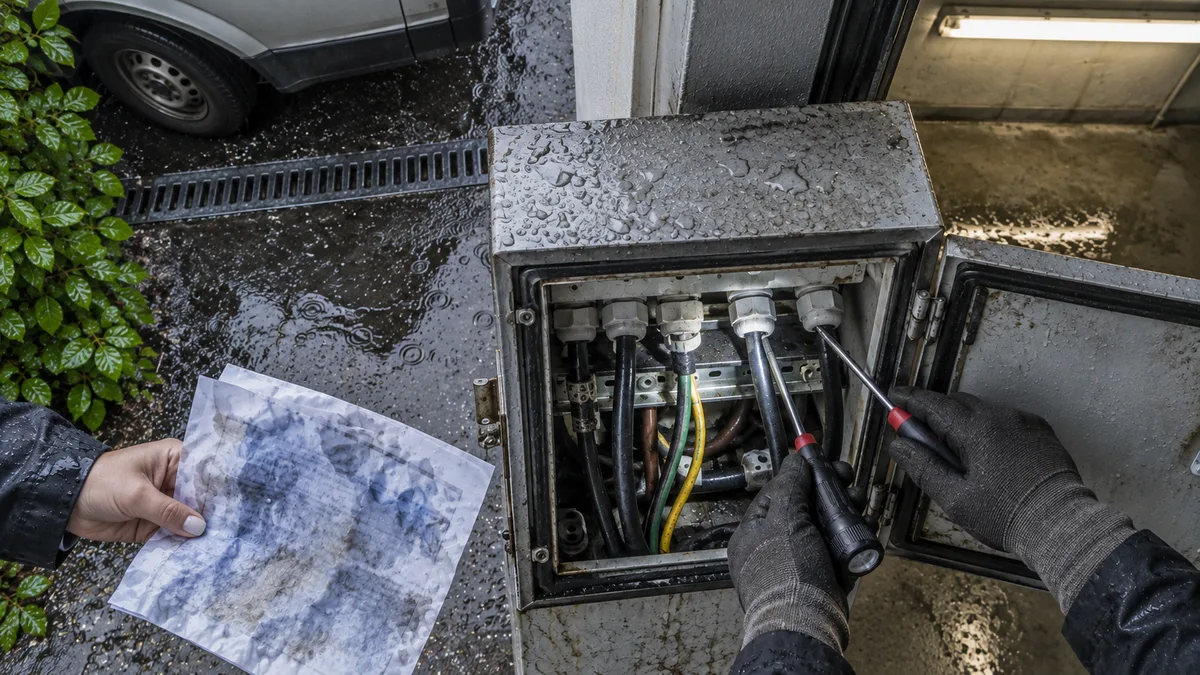
Arrange the preparation of the external influences report with the electrical designer and, depending on the operation, specialists from other disciplines. The inspection itself does not replace the determination of external influences. After installation is completed, the contractor must hand over accompanying documentation including an assessment of external influences under § 6(3)(a) of Czech Government Regulation No. 190/2022 Sb.
An electrical inspector does more than check measured values. They also assess whether the electrical installation is suitable for the environment in which it operates. A distribution board in an office may require a different degree of protection from one in a car wash. A cable installed in a heated corridor may not withstand conditions in a cold store or next to a drying oven.
The external influences report provides the basis for this assessment. Czech Government Regulation No. 190/2022 Sb. lists it among the supporting documents for the inspection of designated electrical equipment unless the relevant assessment is already included in the accompanying or operational documentation. If it is missing, the inspector may still examine the installation and take measurements, but their conclusion about its suitability for the environment will have less reliable support.
The specific regime under Czech Act No. 250/2021 Sb. and Czech Government Regulation No. 190/2022 Sb. applies to designated electrical equipment. For other equipment, follow the applicable legal regime, the manufacturer’s documentation, technical standards and the risk assessment.
When you need a separate report
A separate report is not required for every office or every socket. The methodology associated with ČSN 33 2000-5-51 ed. 3, published since 2022 as the technical standardisation information TNI 33 2000-5-51, allows the report to be omitted where external influences are clearly normal or are specified directly for the space by a particular technical standard. Such an assessment must nevertheless follow from professional documentation, typically the design documentation. A statement from the operator that “it is just an ordinary office” is not enough.
Particular attention should be paid to spaces where the conditions clearly differ from a normal environment:
| Space or change | What needs to be assessed |
|---|---|
| Workshop or production facility | dust, water, vibration, mechanical impact, temperature and substances used |
| Warehouse | properties and quantities of materials, fire risk and evacuation conditions |
| Outdoor distribution board, car park or façade | rain, frost, solar radiation, wind and lightning activity |
| Car wash, wash bay or commercial kitchen | splashing and jetting water, steam, temperature and cleaning chemicals |
| Cold store, freezer room or boiler room | extreme temperatures, condensation and humidity |
| Charging industrial truck traction batteries | battery type, ventilation and, for lead-acid batteries, hydrogen released during charging |
| Paint shop, solvent dispensing area or work involving combustible dust | potential explosive atmospheres and links to zone classification documentation |
| Conversion of a warehouse into a workshop or production area | new machinery, substances, number of occupants and intended use |
In areas with an explosion hazard, the external influences report must be supplemented by a separate zone classification under the ČSN EN 60079 series. Neither document replaces the other.
Conditions in a family home or small office are also usually normal. However, this exemption cannot be extended without assessment to a garage, boiler room, outdoor distribution board or electric vehicle charging point.
What is actually assessed as an external influence
External influences are not limited to moisture. They describe the environment, how the space is used and the characteristics of the building. They are recorded using codes defined in ČSN 33 2000-5-51 ed. 3: two letters identify the type of influence and a number indicates its level.
Three groups are assessed:
- Environment (A): for example ambient temperature (AA), presence of water (AD), foreign solid bodies including dust (AE), corrosive substances (AF), mechanical impact (AG), vibration (AH), solar radiation (AN) or lightning activity (AQ).
- Utilisation (B): capability of persons (BA, ranging from ordinary persons to skilled persons), evacuation conditions in an emergency (BD), and the nature of processed or stored materials (BE, including fire and explosion hazards).
- Building construction (C): materials used (CA) and structural design (CB).
For a business owner, the letters themselves are not what matters. What matters is what follows from them. If the committee assigns a wash bay the AD4 classification for splashing water, this affects the required degree of protection for luminaires, sockets and distribution boards, as well as cable selection and protective measures. If it identifies an increased fire risk due to wood dust, this affects both equipment selection and maintenance requirements.
Who prepares and signs the report
The report is not usually a decision made by one person at a desk. Under this methodology (TNI 33 2000-5-51), external influences are determined by a committee whose composition reflects the nature of the premises. It is usually convened by the investor or their representative, often at the request of the electrical designer.
The committee includes the designer responsible for the electrical installation. Depending on the operation, its members may also include:
- a representative of the operator who understands the actual operation;
- the building designer;
- a process engineer;
- a fire safety specialist;
- a professionally competent person responsible for risk prevention;
- a ventilation, heating or cooling system designer;
- an electrical inspector.
An electrical inspector may therefore sit on the committee and contribute experience gained from inspections. Their inspection authorisation does not, however, make them an expert in fire safety design, chemical processes or ventilation.
What a usable report should contain
The document must clearly identify which rooms it assesses. A generic form with no connection to the floor plan is of no use to the electrical inspector.
In particular, check that it includes:
- identification of the premises, operator and spaces being assessed;
- the composition of the committee and its members’ signatures;
- a description of the intended or actual operation;
- the supporting materials used, such as drawings, the fire safety design and the process description;
- the external influences determined for each space;
- justification for influences that are not normal;
- measures arising from the identified influences;
- the date and an unambiguous version number;
- a floor plan or table that allows each result to be assigned to a specific room.
The report must reflect actual conditions. A document prepared for a cardboard warehouse cannot be used without review after a paint booth or industrial truck charging station has been installed in part of the building.
What an electrical inspector cannot reliably assess without the report
The inspector can examine the installation and take the available measurements. Without information about the operating conditions, however, they have no reliable basis for determining whether the installation was designed appropriately.
For example, they lack the information needed to answer whether:
- the distribution board’s degree of protection is suitable for the water and dust to which it is exposed;
- the cables and equipment can withstand the temperature or chemical environment;
- the installation accounts for impacts from material-handling equipment and machinery vibration;
- the measures used are appropriate for the substances being stored;
- evacuation conditions have changed;
- the documentation still reflects the actual situation.
An inspection does not replace a missing report. An inspection report verifies the condition of the equipment; it is not a substitute for a multidisciplinary design decision. Missing documentation may therefore be recorded as a limitation on the scope of the inspection or as a reservation in its conclusion. The article How to Read an Electrical Inspection Report and Understand Defects explains how to interpret such entries.
When the report should be updated
The report does not have a fixed validity period in years. It remains usable for as long as it reflects the premises and their actual operation. Its currency should therefore be linked to changes, not to a date.
A review is particularly appropriate when:
- the purpose of a room changes;
- a new production process or technology is introduced;
- the substances stored or processed change;
- machinery or equipment is moved to another part of the premises;
- ventilation, heating or cooling is changed;
- building work is carried out or the layout changes;
- the number of occupants or their evacuation conditions change;
- the description in the report is found not to match the actual situation.
Please note that a review may be necessary even when the electrical installation itself has not been altered. It is enough for washing, grinding or charging activities to begin in the same room, even if the cables and distribution boards remain unchanged. If the installation is also being altered, consider whether an initial inspection is required; see Electrical Inspection After Renovation: When an Initial Inspection Is Required.
A completely new document is not always necessary. An amendment sheet or an assessment limited to the affected rooms may be sufficient. The decision must, however, be traceable and signed. A handwritten note added to the old report by the operator does not fulfil this role.
What to do if the report is missing
Do not immediately order only a periodic inspection. First send the inspector the previous inspection report, any available drawings, the floor plan, a description of the operation and a list of changes since the last inspection.
Depending on the situation, one of three steps then follows:
- search for the report in the handover, design or operational documentation — under § 6 paragraph 3 point a) of Czech Government Regulation No. 190/2022 Sb., the external influences assessment is a mandatory part of the accompanying documentation supplied to the customer after installation, so it can often be obtained from the original designer or landlord;
- verify whether a separate report is actually required for the spaces concerned;
- determine the external influences again and supplement the as-built documentation.
The article Electrical Inspection Without Documentation: What to Prepare explains in detail how to proceed when supporting documents are missing. An overview of other required records is available in Operational Documentation for Electrical Equipment: What a Company Must Keep.
Not sure which of these requirements applies to your operation? Send us your documents. We will review them, identify what is missing for the inspection and schedule the inspection to follow on from the completion of the documentation.
How to compare quotations for preparing the report
The price depends on the number and variety of spaces, the complexity of the technology, the quality of the existing documentation and the number of specialists who must take part in the assessment. The quotation should therefore list the site survey, completion of supporting documents, committee work, preparation of the report and the inspection itself separately.
Ask whether you will receive:
- a report linked to specific rooms;
- a list of the supporting documents used;
- justification for influences that are not normal;
- signatures from the responsible specialists;
- an electronic version with clear version identification;
- a definition of what is not included in the price.
Be wary of a generic report that assigns the same conditions to every space without a site survey. It is equally problematic if the supplier does not ask to see the process description, list of substances or information about operational changes.
Sources used for this article
- Electrical inspections – a SOHE service.
- Electrical Inspection Without Documentation: What to Prepare – how to proceed when the design, reports and previous inspection records are missing.
- Operational Documentation for Electrical Equipment – which electrical equipment records a company must keep.
- How to Read an Electrical Inspection Report – the difference between a defect, a recommendation and a limitation on the scope of an inspection.
- Czech Government Regulation No. 190/2022 Sb. – designated electrical equipment, its inspections and the supporting documents required for inspection.
- Czech Act No. 250/2021 Sb. – the safe operation of designated technical equipment and professional competence.
- ČSN 33 2000-5-51 ed. 3 – selection and erection of electrical equipment and the determination and coding of external influences.
- TNI 33 2000-5-51 – technical standardisation information containing the methodology for determining external influences, the composition of the committee and a report template.
- The ČSN EN 60079 series – areas with explosion hazards and zone classification.
This article is for information only and does not constitute legal advice. The specific arrangements for determining external influences and carrying out inspections must reflect the actual operation, the manufacturer’s documentation, the conditions of use and the risk assessment.
Are you preparing for an inspection and unsure whether you have an external influences report? Take a look at our electrical inspection service or send us a no-obligation enquiry, or email info@sohe.cz. We will review the documents first and then recommend the next steps.