
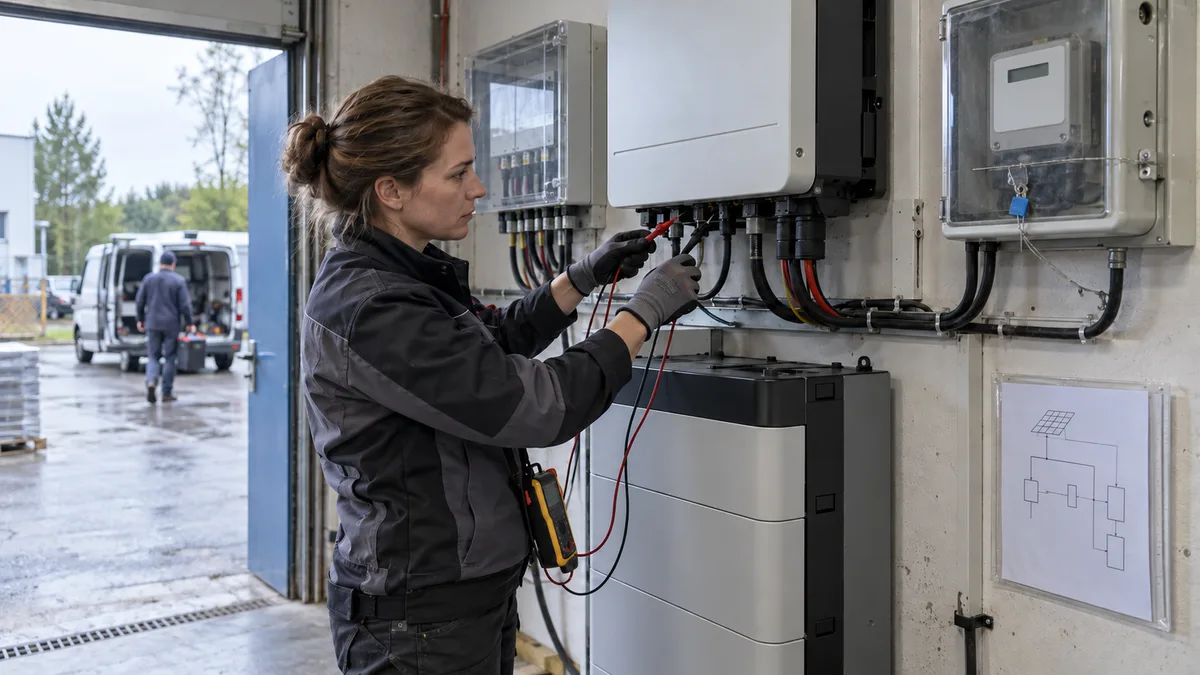
Business photovoltaic systems often expand after a few years of operation: more panels are added to the roof, a battery or backup capability for grid outages is installed, or a faulty inverter is replaced. In practice, three separate matters are often confused, although they have different purposes and involve different parties. An electrical safety inspection is required under nařízení vlády č. 190/2022 Sb. and serves to verify safety. Updating the documentation is the operator’s duty under the same regulation. Applying to the distribution system operator is a contractual step, because the modification may alter the parameters under which the generating plant is connected to the grid.
As electrical equipment used to generate and convert electricity, a PV system falls within the category of reserved electrical equipment under § 3(1)(a) of nařízení vlády č. 190/2022 Sb. Modifications are therefore subject to the regulation’s inspection rules, and the operator must record them in the documentation under § 6(5).
A quick answer for each type of change
| Change | Inspection under NV 190/2022 | Distribution system operator (ČEZ Distribuce, EG.D) |
|---|---|---|
| Adding panels, increasing installed capacity | Yes — the new section must be inspected after installation is complete (§ 6(2)(c)) | ČEZ: connection application. EG.D: application entitled “Změna odběrného místa s výrobnou” (modification of a supply point with a generating plant) |
| Adding a battery | Yes — after installation is complete (§ 6(2)(c)) | ČEZ: connection application. EG.D: the first battery requires a new connection agreement; changing the capacity of an existing battery only requires notification |
| Changing the operating mode (island operation, backup) | Yes, if protection against electric shock, overload or short circuit changes (§ 6(4)); otherwise, the inspection technician must assess the situation | ČEZ: connection application. EG.D: check with the distribution system operator |
| Replacing a faulty inverter with the same type and power rating | After a repair, “as necessary” (§ 6(2)(c)); required if protective measures change (§ 6(4)) | EG.D: no contact required if the parameters in the connection agreement remain unchanged (installed capacity and inverter power rating). ČEZ: check before ordering |
| Repairs after damage (storm, hail) | As necessary to verify safety (§ 6(2)(c)) | Check with the distribution system operator if the generating plant’s parameters change |
In its frequently asked questions, EG.D defines a PV system’s installed capacity as the sum of the panels’ rated power outputs. Adding panels therefore changes it even if the inverter remains the same.
What to do and who can help
Do not put the modified system into operation on the strength of an installation completion record alone, particularly in these situations:
- Strings or a battery have been added. This constitutes installation of a new section of reserved electrical equipment. Under § 6(2)(c) of nařízení vlády č. 190/2022 Sb., an inspection must be carried out after installation is complete and before the equipment is subsequently put into operation.
- The distribution system operator requires an inspection report. ČEZ Distribuce requires details from the inspection report when applying for permanent operation; under Section 19.2 of its low-voltage connection requirements, EG.D requires an initial or extraordinary inspection report when connecting a generating plant.
- Overcurrent protection, surge protection or earthing is changing. A change to the parameters of protection against overload and short circuit, electric shock or atmospheric electricity triggers an inspection under § 6(4) of the same regulation.
What we do at SOHE:
- Scope and timing. Tell us what is changing and send the documentation you have for the original installation; we will confirm the price and date in advance.
- On-site inspection. An electrical inspection technician checks and tests the modified section on both the DC and AC sides, including its interface with the rest of the system.
- Inspection report. You receive a report meeting the requirements of § 10 of the regulation, which you can use in your subsequent dealings with the distribution system operator.
You can book a PV system inspection for businesses or send a no-obligation enquiry. The connection application is submitted by the generating plant operator or someone authorised to act on their behalf.
Inspections: what the regulation actually says
The key provision is § 6(2)(c) of nařízení vlády č. 190/2022 Sb. Reserved electrical equipment whose electrical or functional characteristics may have changed as a result of installation, repair or relocation must undergo an inspection before being put back into operation: always after installation is complete, and after repair or relocation as necessary, so that its safety is always verified.
The distinction between installation and repair matters for PV systems. Adding a panel array or battery storage constitutes installation of a new section. Replacing a faulty inverter with an identical unit is more appropriately treated as a repair, and the scope of verification depends on what actually changed during the work.
The second rule is in § 6(4): an inspection is also required following a change to the parameters of protection against overload and short circuit, protection against electric shock, or the characteristics of protection against the effects of atmospheric and static electricity. When a PV system is expanded, this occurs more often than it might seem:
- new strings require new fuses or disconnectors on the DC side,
- a more powerful inverter or a battery changes the AC-side overcurrent protection in the distribution board,
- surge protective devices (SPDs) are added or replaced,
- new mounting structures are connected to the earthing and bonding system, and panels may end up at a different distance from the lightning protection system.
However, replacing a component does not automatically mean the entire generating plant needs to be inspected. What changed determines whether verification is required and how extensive it needs to be. Under § 10(2) of the regulation, an initial inspection may be carried out in stages; before the entire installation enters permanent operation, a single consolidated initial inspection report is then prepared, drawing on the individual reports. The procedure for a new generating plant is explained in PV system inspection before the first parallel grid connection, while electrical inspection after refurbishment explains the general approach to inspections after building alterations.
Documentation: changes must be recorded
Under § 6(5) of nařízení vlády č. 190/2022 Sb., the operator of reserved electrical equipment must ensure that changes are recorded in the accompanying or operating documentation. Under § 6(3)(a), the accompanying documentation must reflect the installation as built and allow individual components to be replaced and the system to be expanded further; it must also include an assessment of external influences.
In practice, this means updating the single-line diagram, component list (panel, inverter and battery types), and description of overcurrent protection and other protective measures, and filing the new inspection report for the modified section. This also helps with future inspections: under Annex 2, Part B, point II(b), the technician conducting the next periodic inspection also assesses changes made since the previous inspection. Without records, those changes have to be identified on site. Operating documentation for electrical equipment summarises what the documentation should generally contain, while periodic PV system inspections after the initial inspection covers subsequent inspection intervals.
Distribution system operator: when to apply
On its page about connecting microgenerators and generating plants up to 100 kW, ČEZ Distribuce explicitly states that a connection application is also required when you:
- change installed capacity by altering technical parameters, for example by adding photovoltaic panels,
- change the agreed export capacity for feeding surplus electricity into the grid,
- add batteries for energy storage,
- change the generating unit’s operating mode, for example by enabling island operation.
For subsequent permission to enter permanent operation, ČEZ Distribuce requires details from the inspection report (the inspection technician’s name and registration number, and the report number and date). A mandatory attachment is the “Instalační dokument výrobního modulu typu A1/A2” (type A1/A2 power-generating module installation document), including the inverter certificate or test report. On its inspection reports page, ČEZ Distribuce adds that it does not require a report for the entire property; inspecting the modified section is sufficient.
EG.D provides an application entitled “Změna odběrného místa s výrobnou (nízké napětí)” (modification of a supply point with a generating plant, low voltage) for these situations, including changes to installed capacity. The application is used to change the main circuit-breaker rating, installed capacity or agreed export capacity, and includes fields describing the generating plant and its operating mode. According to the application page, EG.D sends a proposed connection agreement within 15 working days. Section 19.2 of the low-voltage connection requirements effective from 1 January 2026 requires an initial or extraordinary inspection report when connecting microgenerators and generating plants, in accordance with ČSN 33 1500 and nařízení vlády č. 190/2022 Sb. Under Section 19.3, the report must include, among other things, the parameters of the connected generating units and a statement on whether the supply point meets the connection requirements.
For other distribution system operators, follow their own requirements; these were not verified for this article.
Inverter replacement: what is established and what remains unclear
The following is documented: ČEZ Distribuce requires an inverter certificate or test report to accompany an application for permanent operation, and maintains a list of approved inverters. In an article dated 1 November 2024, EG.D announced that, from the end of 2024 or the start of 2025 (depending on the generating plant’s capacity), applicants for permanent operation must provide a certificate or compliance report for the power-generating module, covering the specific inverter type and firmware version. The inverter type therefore matters to the distribution system operator.
The operators take different approaches to replacing a faulty inverter with one of the same type and power rating. EG.D states explicitly in its frequently asked questions that faulty equipment in a generating plant may be replaced without contacting the operator only if the technical parameters in the connection agreement remain unchanged: neither the generating plant’s installed capacity nor the inverter’s power rating may change. Changing the inverter power rating requires a new connection agreement. ČEZ Distribuce does not specifically address replacement of a faulty inverter with an identical unit on the pages used for this article, so do not automatically apply EG.D’s procedure to ČEZ. Before ordering a new inverter, check the procedure with your distribution system operator, particularly if the type, power rating or firmware version differs. If replacement follows damage, PV systems after storms or hail explains the next steps.
What to prepare for the inspection technician
- the original initial inspection report and the generating plant’s design documentation,
- a description of the change: what was added or replaced, where and when,
- technical datasheets for the new panels, battery or inverter,
- an updated as-built single-line diagram,
- the connection agreement number and, where applicable, the application reference from the distribution system operator,
- the report on the determination of external influences if the installation is being extended into a different area.
If you are adding a battery, also read battery storage for a business PV system; for rooftop installations, see fire safety for rooftop PV systems. PV system maintenance and checks between inspections explains what to check during operation between formal inspections.
Sources used for this article
- Photovoltaic (PV) system inspections – a SOHE service.
- PV system inspection before the first parallel grid connection – initial inspection of a new generating plant and documents for the distribution system operator.
- Battery storage for a business PV system – what changes when a battery is added to a generating plant.
- Operating documentation for electrical equipment – where to record changes.
- Nařízení vlády č. 190/2022 Sb. – § 3 (reserved electrical equipment), § 6 (inspections after installation, repair and changes to protective measures, accompanying documentation, recording changes), § 10 (inspection reports and consolidated reports where initial inspections are carried out in stages), and Annex 2 (inspection documentation and scope).
- ČEZ Distribuce — connecting a microgenerator, generating plant or storage up to 100 kW, permission for permanent operation and inspection reports – when to apply and which documents to provide.
- EG.D — changes to generating plants, application to modify a supply point with a generating plant (low voltage), low-voltage connection requirements effective from 1 January 2026, frequently asked questions about generating plants and article on power-generating module certificates.
- ČSN 33 1500 – inspection of electrical equipment (a technical standard, not part of Sbírka zákonů).
Sources verified on 16 October 2026; EG.D’s answers on equipment replacement and batteries verified on 3 November 2026. This article is for information only and does not replace legal advice. The specific inspection requirements and procedure with the distribution system operator must be determined according to the actual modification, manufacturer documentation, the operator’s requirements and a risk assessment.
Expanding your business PV system or replacing an inverter? Send us a description of the change and the original installation documentation. We will clarify the scope of the PV system inspection and confirm the price and date in advance. Simply send a no-obligation enquiry or email info@sohe.cz.